The shade is the largest piece of architecture
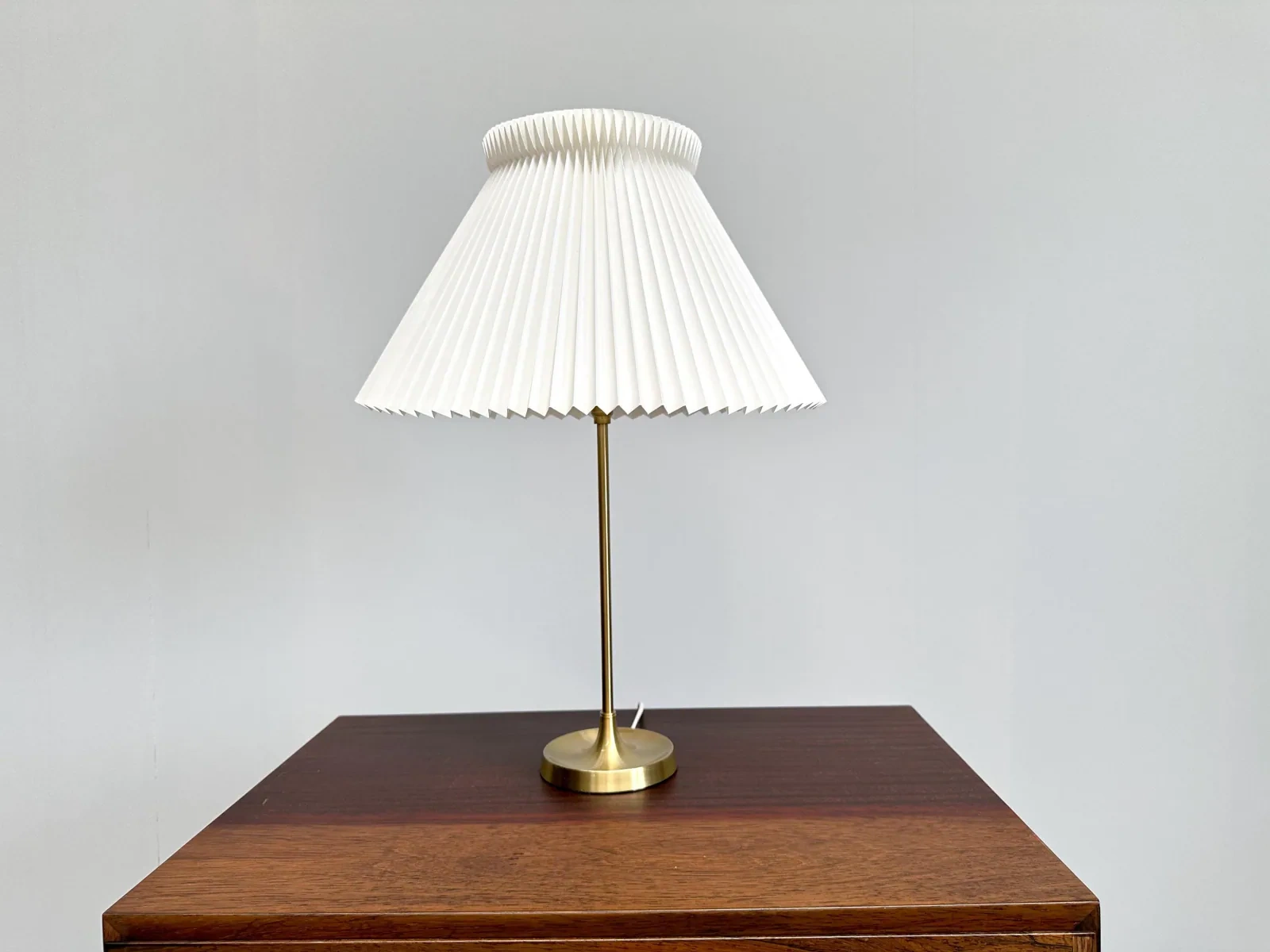
Model 307 can be reduced to two strong gestures: a broad folded cone and a slender brass line. The shade occupies most of the visual field. The stem holds it at reading height, while the circular foot makes the minimum polite announcement that gravity has been considered.
Le Klint identifies the lamp as Esben Klint's 1948 design. In the company's current specification, a special 406A stand carries a hand-folded Model 2 shade with a side length of 23 centimetres.1 Those are useful exact-model facts, but they describe the current product. They do not measure, date or authenticate the lamp in a seller's photograph.
The composition works because the hierarchy is so decisive. Hardware does not compete with shade. The stem meets the centre, then almost vanishes; the folded volume decides the lamp's apparent diameter and character. Calling the shade an accessory would be like calling a roof the decorative bit above a house.
Pleats turn a sheet into a volume
A plain sheet bends easily in one direction and flops in several others. Add repeated creases and its behaviour changes. Every ridge and valley establishes a small angled face; together they make a corrugated surface that can open into a cone while holding a regular profile.
On Model 307, long pleats radiate between a wide lower rim and a narrow upper neck. The circumference changes, but the rhythm remains legible. At the top, a shorter band of cross-folds turns around the shade like a compact crown. It finishes the transition from sloping wall to collar and makes the upper edge look constructed rather than merely cut.
Le Klint calls its shade hand-folded and says mastery of its models takes folding technicians several years.1 imm cologne's account of the Odense workshop similarly describes a craft that resisted attempts at machine production.3 The interesting point is not romance about hands for its own sake. A repeating pattern still needs accurate spacing, sequence and closure if its final circle is to meet itself.
The folds edit the light twice
The shade changes light before the reader thinks about symbolism or family history. First, its translucent material interrupts a direct view of the source. Second, the pleats create many differently angled faces. Ridges catch light; valleys retain narrow shadows; the whole circumference moves between the two rather than glowing as one blank cylinder.
This gives the unlit lamp a graphic rhythm and the lit lamp a graduated one. The lower rim remains open, so useful light can reach the table, while the broad folded wall becomes a softer luminous boundary around the bulb. The seller photograph is unlit, yet the alternating bright faces and grey seams already make that geometry visible.
The mechanism should not be turned into a laboratory claim that all Le Klint materials transmit light identically. Le Klint's present Model 307 can be specified with paper or its “standard” hard-PVC foil; the company describes different light character and care for the two.1 Same fold pattern, different sheet: geometry persists while transmission, surface and ageing can change.
The family problem began with an oil lamp
Le Klint traces the folded-shade tradition to around 1900–01. Architect and engineer P.V. Jensen-Klint needed to soften the sharp light of a petroleum lamp, direct it usefully and keep paper away from the hot glass. Inspired, the company says, by Japanese origami, he developed cross-pleating that could turn a collar at right angles to the main pleats.2
An independent imm cologne account preserves the same practical starting point: diffuse the flame, maintain distance from hot glass, then refine the folding method as a family craft.3 That second source supports the broad history; it is not evidence that P.V. designed Model 307.
The distinction matters. Model 307 did not spring fully formed from the first oil-lamp shade. It arrived nearly half a century later, after several family members had worked on the system and after electric fittings had changed the problem. A useful lineage is not the same thing as one unaltered object passed down the dining table.
A collar made the fold attachable
Le Klint credits P.V.'s son Tage with a crucial refinement to Model 1: a “grip-collar” that uses the shade's own elasticity to attach to a frame. The company dates the patent principle to 1938, five years before Tage founded Le Klint in 1943.2 imm cologne independently repeats that sequence.3
That history explains why the top of a Le Klint shade deserves attention. The collar is not simply a frill added to disguise a wire ring. Changing the direction and density of the folds can make a compliant sheet meet hardware as a controlled three-dimensional edge.
The reviewed sources specifically describe the patented principle through Model 1, while current Model 307 uses Model 2.1 This article therefore does not claim that every detail of Model 1's attachment is identical on the 307. The family lesson is narrower and more useful: folded elasticity could solve connection as well as appearance. Even lampshades have joints; the clever ones persuade us to call them collars.
1948 is not a material date
Esben Klint was the third generation in this design story. Le Klint describes him as the son of Kaare Klint and grandson of P.V. Jensen-Klint, educated in Copenhagen and in leading architects' offices.4 His documented 1948 Model 307 places a new brass stand beneath an established folding language.1
It is tempting to make that date describe every visible part of every lamp. The company's own history prevents it. Le Klint says a new foil material was introduced in the 1960s and enabled different folded forms; its current Model 307 is now offered with either paper or hard-PVC standard foil. 2 The design date, material introduction and date of an individual shade are three separate questions.
That separation is especially important for vintage lighting, where shades are vulnerable, replaceable working components. A paper origin story does not turn plastic into an error, and a period-looking pleat does not reveal when a shade was fitted. The folds can preserve a design language while the sheet carrying them belongs to another chapter.
A current lamp is a looking prompt, not a certificate
PatinaHall currently lists one table lamp as Le Klint Model 307 with a brass frame and pleated plastic shade; its licensed frontal photograph appears here.5 The view is excellent for reading the design: broad lower rim, converging pleats, compact top collar, thin central stem and low round foot.
It does not independently prove the attribution, production date, material, shade originality, dimensions, condition or electrical safety of the object. Those remain seller descriptions. Le Klint's historical and current records document the model family; they do not authenticate this lamp through visual similarity.
Continue to Timberline for a complementary lesson in making structure visible. Esben Klint folds a surface until it becomes volume, joint and diffuser. Mads Caprani bends a line until it becomes upright, arm and suspension. Both lamps look simple only after the difficult geometry has agreed to behave.