A balance problem drawn as punctuation
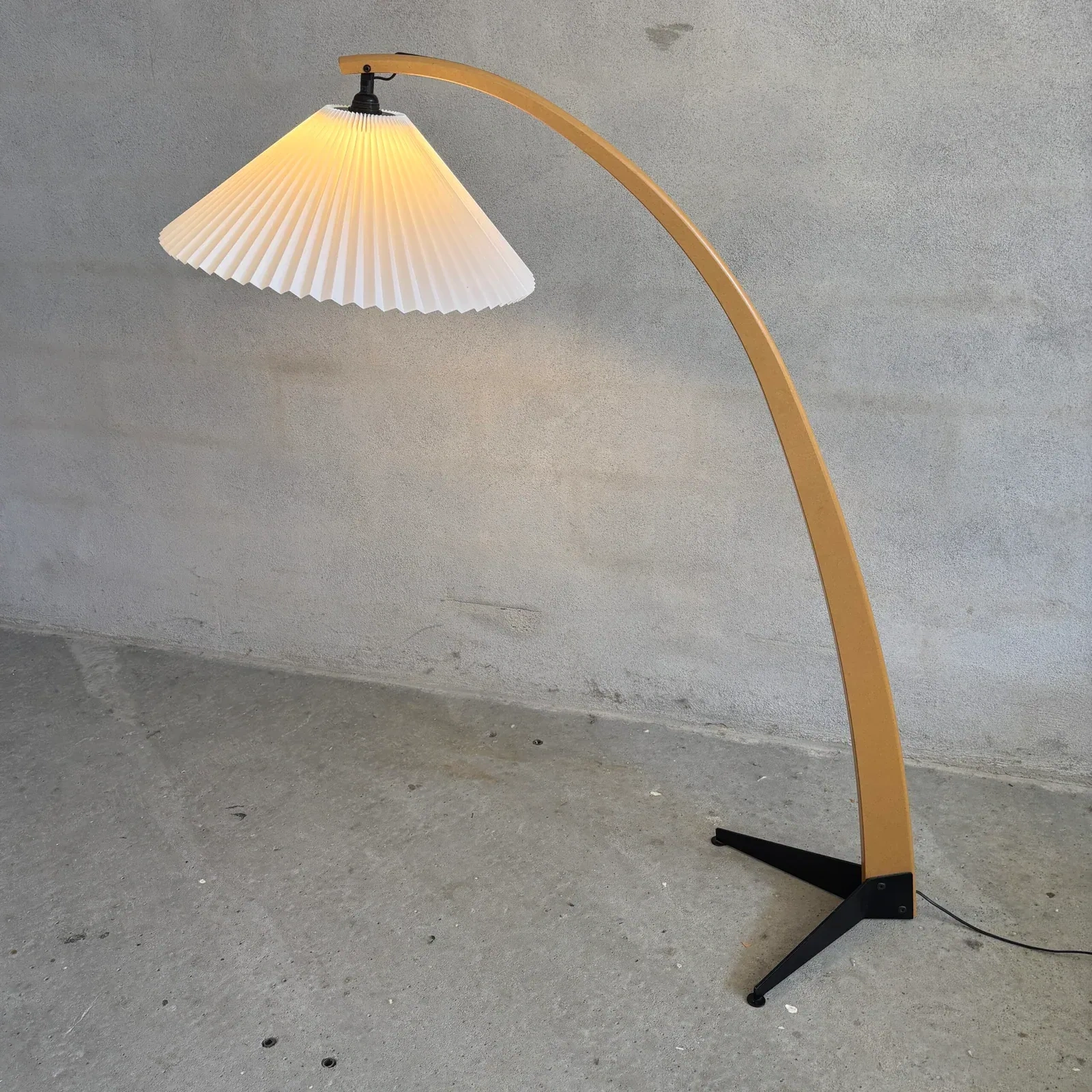
Timberline begins with a small structural drama. Its shade is not perched above the base like a conventional standard lamp; it hangs well to one side. Between the two, a single wooden line climbs, bends and returns towards the light. The whole object resembles a question mark that has exchanged its dot for a pair of sensible shoes.
That resemblance is more than a nickname pasted onto a silhouette. The curve lets one member perform three visual jobs: upright, outreach and suspension. Because there is no separate horizontal arm, the eye can travel from floor to shade without changing tracks. The lamp looks as if it were drawn in one stroke, even though a real floor and a real pull of gravity are less easily impressed.
GUBI dates Mads Caprani's design to the 1970s and describes the inset cable and adjustable shade as considered details.1 Those features matter because they protect the single-line reading. Services and movement are present, but neither needs to become the main event.
The curve is not merely a curve
A long bent member can look effortless after someone else has solved it. In GUBI's current reissue, the spine is made from several layers of oak and birch. The company says it reverse-engineered the line of curvature and deliberately left the layers legible in profile.1 That account describes the current production object. It should not be used as a recipe for identifying every older lamp that resembles Timberline.
The wider engineering logic is independently useful. The US Forest Products Laboratory explains that thin laminations can be bent to a required radius with more moderate fibre stress than a single thick member; lamination can also achieve thickness-to-radius combinations unavailable to one solid piece.2 This is general wood technology, not a secret Caprani workshop record.
It does, however, sharpen the looking. A laminated curve is not timber being asked politely to forget that it grew straight. Thin pieces can be formed and bonded into a new collective geometry. The visible edge then becomes both construction and ornament: the method draws its own fine parallel lines.
The floor has to answer the shade
Move down the arc and the lamp's charm becomes a problem in leverage. The shade, fitting and upper timber sit away from the point where the stem meets the floor. Their weight creates an overturning tendency. A base therefore has to provide mass and spread in the opposite direction, even if the composition wants to look airborne.
GUBI specifies cast iron for the base of its present floor lamp and describes the shade as adjustable.1 Iron puts useful weight where visual weight is least intrusive: low and dark. Adjustment changes more than the direction of light, because turning the shade also slightly changes how its mass sits at the end of the arm. The current manufacturer has done the calculation; this is not an invitation to test a vintage lamp's tipping point.
In the PatinaHall photograph, the low black foot spreads across the floor while the pale stem departs from one side. Read the two together. The arc asks the elegant question; the base supplies the unglamorous but indispensable answer.
A cable that declines a second starring role
An electric lamp cannot really be one line. It needs conductors, a fitting, a switch and a route to a socket. Place a loose black cable along a pale wooden arc and the eye receives two drawings, one deliberate and one looking for somewhere to sit.
GUBI calls out Timberline's inset cord.1 The detail is easy to overlook precisely because success makes it quiet. The cable follows the structural profile instead of crossing the open space beneath the curve. Near the shade, dark electrical components briefly become visible, then the pleats take over.
This is a useful distinction between concealment and dishonesty. Timberline does not pretend electricity is unnecessary; the cord eventually leaves the base and heads across the floor like every other domestic cable. It merely edits the route through the most expressive part of the lamp. One line remains the headline, while the infrastructure accepts a smaller type size.
The question mark is a family story
GUBI reports a story from Caprani's family: while searching for a new lamp, the designer doodled question marks and realised that the punctuation itself might provide the form.1 It is almost suspiciously perfect—an idea about light arriving as a literal light-bulb moment.
The right response is neither to discard the anecdote nor to engrave it on a bronze plaque. GUBI labels it as a family story. No dated sketch or contemporary catalogue reviewed for this article proves the exact scene. Kept inside that boundary, the tale still helps: once the reader sees the question mark, the lamp's rise, turn and hanging shade become difficult to unsee.
There may also be a gentler joke in the name Timberline. A timber line usually marks the altitude beyond which trees stop growing. Here timber keeps climbing, curves through the air and stops only when it has found somewhere to hang a shade. The interpretation belongs to the object; it is not offered as another documented naming story.
Caprani knew the electrical side first
GUBI's biography says Caprani trained first as an electrician and later as an electrical engineer before working at Louis Poulsen alongside major Danish design figures.3 That background makes Timberline's edited cable route and adjustable light feel less like styling placed over a lamp and more like someone thinking through the whole appliance.
The same source says he took over his father's lamp factory in 1979, renamed it Caprani Light and developed an international business. It identifies Timberline as the firm's flagship and says the design became widely known as the Caprani Lamp.3 Notice the chronological boundary: GUBI places the design broadly in the 1970s, then gives 1979 for the takeover and renaming. Those statements do not justify inventing an exact design year or assuming that every period example carries the same construction.
GUBI also says Timberline spent decades out of production before its return. The absence is left broad. “Decades” is enough to explain why a familiar shape can feel rediscovered without manufacturing a tidier stop-and-start timeline than the reviewed sources provide.
A current lamp is evidence for looking
PatinaHall currently lists one floor lamp as a Mads Caprani design and supplies the licensed photograph used here.4 It is a particularly useful view because the complete reach is visible at once: low black base, rising pale arc, small dark fitting and illuminated pleated shade.
The image can teach those visible relationships. It cannot independently authenticate the lamp, date it, identify its production edition, confirm its wood species or establish that the shade is original. The seller's dimensions, condition and electrical-function statements remain seller claims. GUBI's current specifications explain a documented reissue; resemblance does not transfer every specification to this object.
Continue to Le Klint 307 for another Danish lamp that makes its construction the visual story. Timberline bends a long line until it can carry light. Model 307 folds a broad surface until it can shape light. One begins with a question mark, the other with something closer to very disciplined paper engineering.