The workshop tool hiding in a dining chair
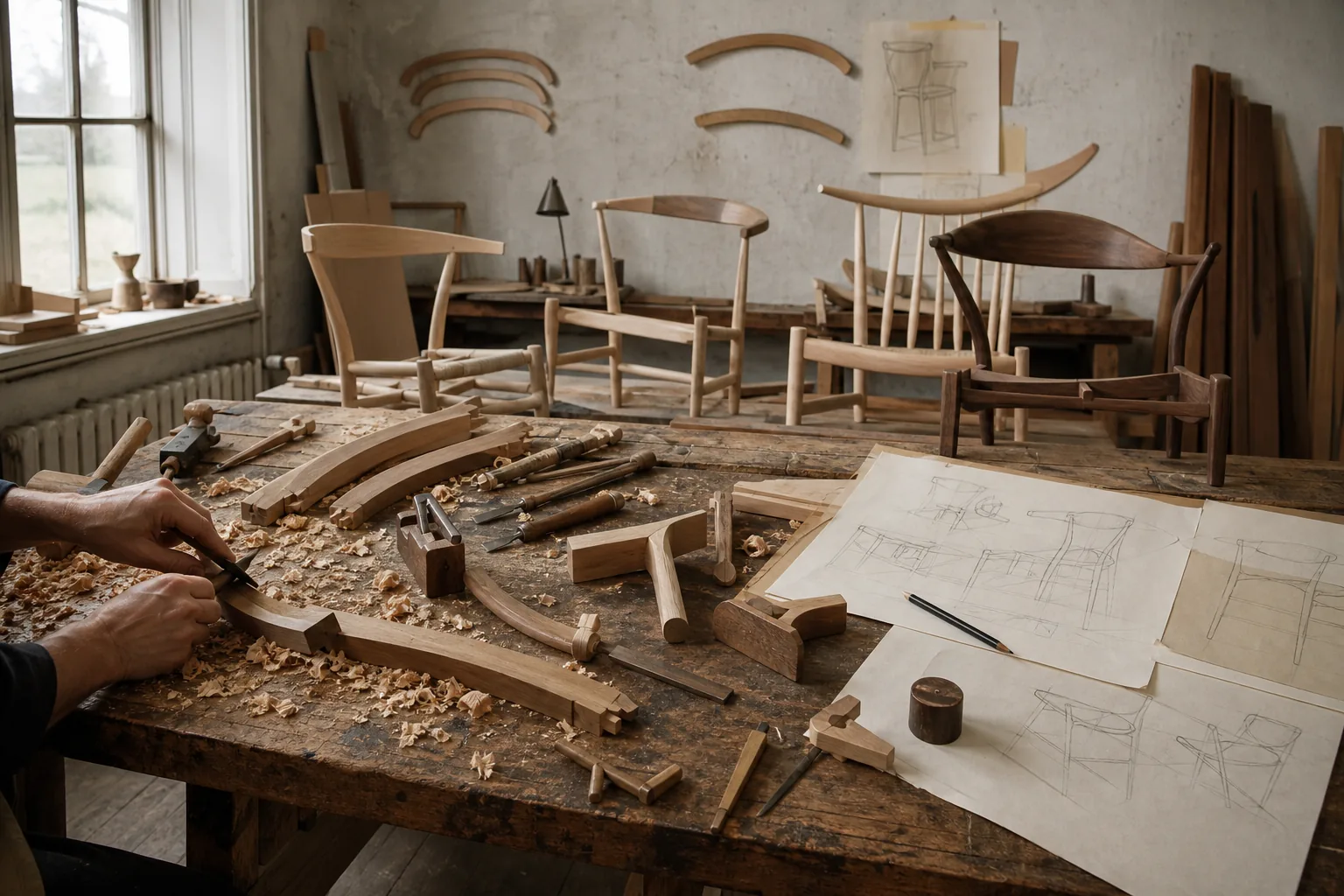
A sawbuck is furniture for work: a splayed support that holds timber steady while somebody cuts it. It does not need a back, does not care where knees go and has no opinion about dinner. Yet its stance gives Hans J. Wegner's CH29 both a nickname and a starting structure.
Carl Hansen & Søn dates the chair to 1952 and says Wegner drew his inspiration from the sawbucks and saw horses used by carpenters and woodcutters. 1 That source matters because it turns a visual resemblance into an attributable design history. The angled supports are not something a later viewer happened to nickname after a trip to the toolshed; the current manufacturer presents the workshop object as Wegner's prompt.
The interesting question is what happened next. A sawbuck already knows how to stand. A dining chair must also receive a body, allow it to shift and remain civil enough to gather around a table. CH29 is the story of that translation.
The source remains visible, but the tool disappears
Borrowing a type is not the same as copying its outline. A traditional sawbuck commonly makes stability obvious through two spreading supports and a member joining them. CH29 preserves the legible splay but reorganises the parts around a seat and back. The result feels related to the workshop device without pretending that a carpenter's stand becomes comfortable merely because somebody has placed a cushion on it.
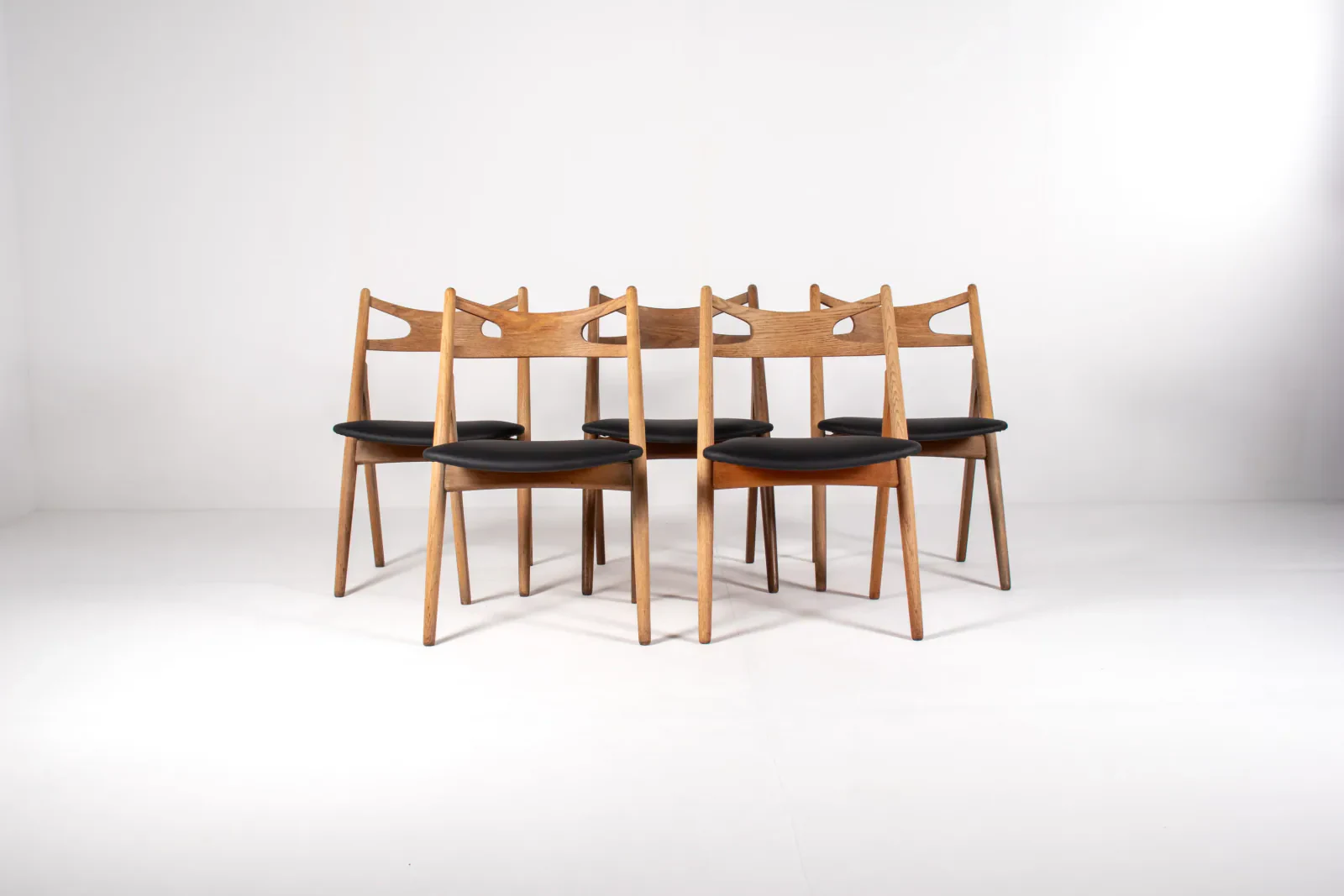
Look at the seller photograph as a group rather than five portraits. The repeated leg angles produce a rhythm beneath the black seats. Uprights rise past those seats to meet broad backs, while the front edges spread laterally. The source idea is clearest not in one decorative detail but in the chair's overall attitude: planted, open and slightly braced.
That distinction protects the design from an easy slogan. “Inspired by a sawbuck” explains where the organising idea began. It does not mean that every joint, angle or load path in the chair can be reconstructed from the name, and the reviewed sources do not provide an engineering analysis. The nickname is a way into the object, not a substitute for it.
The seat widens towards the sitter
Carl Hansen & Søn singles out a decisive difference in plan: the seat is significantly wider at the front.1 A normal rectangle would keep the same width from back to front. CH29 opens as it moves away from the backrest, giving the sitter more room where thighs and knees need to move.
That widening also changes how the frame is read. The chair does not resemble a box standing on four corners. Its front feels generous, while the narrower rear gathers the body towards the back. From straight ahead, the black seat in the current photograph projects beyond the timber below and makes the change in width especially easy to compare across all five chairs.
Here the workshop analogy encounters anatomy. A sawbuck is designed around a piece of timber placed upon it. A dining chair is designed around a person who does not remain geometrically obedient. Wegner kept the useful spread of the support but let the upper surface answer a moving human occupant.
The back completes the change of species
The manufacturer's second comfort claim concerns the strongly curved back, which it says works with the wider seat to support varied sitting positions. 1 This is more than an upholstered addition to a severe timber frame. The curve changes the direction of contact as a sitter turns or settles, while its broad horizontal presence visually binds the rear uprights.
In the current group, each back appears as a shallow arc with an opening near either end. The cut-outs lighten the broad board and separate its centre from the posts without hiding the continuity of the curve. We can describe those visible facts. We should not turn them into an undocumented claim about a particular chair's comfort or strength.
The chair now has two equally clear readings. Below the seat, splay and brace recall equipment that steadies work. Above it, width and curvature address a body. CH29 succeeds because neither reading has to erase the other.
Wegner approached drawing through making
The sawbuck reference also belongs to a designer who knew the workshop from inside. Museum Sønderjylland records that Wegner began a cabinetmaker's apprenticeship in Tønder in 1928, at fourteen, and later gave the museum a selection of chairs for its water-tower exhibition. 2 Carl Hansen & Søn's profile adds his later Copenhagen education and the beginning of his relationship with the manufacturer in 1949.3
Those biographical facts do not prove that one childhood tool produced one specific drawing. They give the reference an appropriate scale. Wegner's career joined visual invention to the realities of parts, joints, timber and repetition. A workshop support could therefore be more than rustic imagery; it could present a compact lesson in how a few elements stand together.
CH29 makes that lesson sociable. The construction remains visually direct, but directness is not severity. Curvature, upholstery and the widening seat keep the chair from becoming a demonstration rig with table manners.
A production gap became part of the story
Carl Hansen & Søn says CH29 left production in the 1970s and returned about 20 years later at the suggestion of Wegner's family. The manufacturer reports that the relaunched chair quickly succeeded again. 1
The wording deserves to remain as exact—and as inexact—as the source. It gives us a decade for the interruption and an interval before the return, not two precise calendar years. Filling those blanks by arithmetic would create a cleaner timeline than the reviewed evidence provides.
The gap nevertheless sharpens the design argument. A chair can disappear from a catalogue while its structural idea remains readable. When CH29 came back, viewers did not need a long explanation before recognising the stance, the broadening seat and the curved back as one coherent object. The sawbuck had not become fashionable furniture by changing its clothes; Wegner's translation had made the old support newly useful.
Five current chairs, with five firm limits
PatinaHall's current listing describes a set of five CH29 chairs, attributes them to Wegner and Carl Hansen & Søn, and adds seller claims about age, oak, upholstery, stamps and condition.4 Its licensed photograph is valuable here because repetition makes proportion visible: front width, leg splay and back curvature can be compared across the group.
The listing is not an independent museum record or an authentication report. The image cannot prove the designer, maker, decade, material beneath a finish, meaning of a stamp or future performance of any chair. Those limits are not fine print; they keep visual reading and object history in their proper jobs.
For another Danish object whose name contains a compact explanation, continue to the PH 4/3 Table Lamp. CH29's name points backwards to a workshop support. PH 4/3's fraction points inwards to the sizes of its shades. Neither name is merely a label once you know where to look.