The model number is the first diagram
The name PH 4/3 looks administrative: designer's initials, slash, two digits, file it under lighting. In fact, Louis Poulsen explains that PH model numbers refer to shade size. On this table lamp, the 4 indicates an approximately 40-centimetre top shade, while the 3 identifies lower shades borrowed from the smaller 3/3 model.3
That means the fraction is doing editorial work before the lamp is switched on. It tells us that the three visible curves are not simply one shape copied at three equal scales. A larger upper member has been paired with a more compact middle and lower set.
One small clarification prevents a surprising amount of confusion: the 3 after the slash does not mean “three shades”. PH 4/3 does have three shades, but the denominator belongs to the family from which the lower pair came. The name is closer to a recipe than a count.
A pure family, then a useful mismatch
Louis Poulsen describes “pure” PH combinations through an example such as 2/2: an approximately 20-centimetre top shade accompanied by its corresponding middle and lower shades.3 Numerator and denominator agree because all three belong to the same proportional family.
PH 4/3 is a hybrid. Its broad 4-class top shade meets the lower pair from 3/3. The manufacturer says such hybrids arose from a wish to hang pendants lower, then notes that the same system was used for wall, table and floor lamps. A broad top can collect and redirect light while the smaller lower shades keep the assembly compact beneath it.
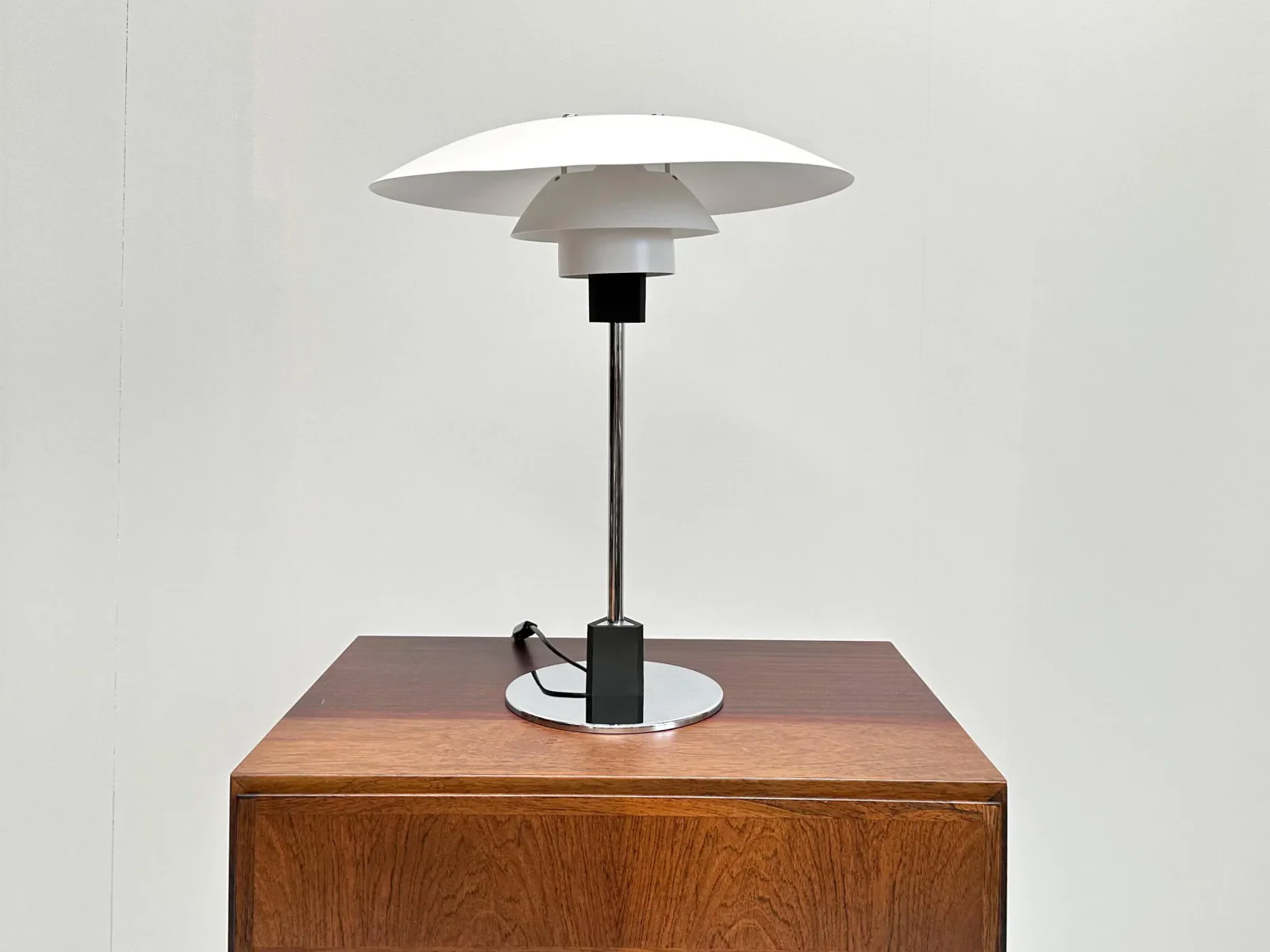
This is why the current photograph feels slightly surprising even before its name is decoded. The top shade establishes a wide horizon. The next shade contracts decisively, and the lowest element gathers the stack around the source and stem. It is a family resemblance with one deliberately oversized relative at the table.
Three shades manage one bright source
Henningsen developed the three-shade system during 1925–26, according to Louis Poulsen, and first used it for lights made for a Paris exhibition. 3 His problem was glare: useful illumination should reach surfaces and people without requiring the eye to meet the brightest point directly.
The shades therefore work as a sequence rather than three decorative hats. Each intercepts light at a different distance and angle. From an ordinary view beside the lamp, the curved surfaces overlap the route towards the bulb; light reaches the room after reflection or diffusion instead of arriving only as a hard exposed point.
The manufacturer says Henningsen based the curves on the logarithmic spiral, seeking even light distribution along each shade and equal reduction from one shade to the next because of their distance from the source. 3 The useful takeaway is not that every reader must perform the calculation. It is that the familiar three-tier silhouette records an optical investigation, not just a preference for layered circles.
The gaps are part of the lamp
Look at the dark intervals between the white shades in the seller photograph. They prevent the lamp from becoming a closed dome. Each surface remains separate enough to receive, conceal and pass light in relation to the next. The empty space is working space.
Louis Poulsen says early shades were metal with painted undersides—white, gold or silver depending on the intended diffuse, warm or cool effect—and that glass entered the system later.3 Glass could add light into the room as well as direct it downwards. In other words, the three-shade geometry is a framework, not a promise that every PH lamp has the same material behaviour.
Museum objects make that variation concrete. Smithsonian's PH 4/3 uses three graduated glass segments on a patinated metal base. 1 NGV's exact PH 4/3 instead records patinated bronze and painted copper.2 Same model name, materially different catalogued objects; neither specification should be silently pasted onto every lamp with three curves.
1926, 1927 and 1966 all belong—differently
The chronology refuses one effortless year. Smithsonian dates its PH 4/3 Table Lamp to 1926, identifies Poul Henningsen as designer and Louis Poulsen as manufacturer, and records manufacture in Denmark. 1 MoMA separately catalogues a related PH Table Lamp—not identified there as this exact 4/3 model—in 1926, made in Bakelite, glass and brass.4
NGV records its exact PH 4/3 as designed in 1927 and manufactured in 1927–28 by Louis Poulsen & Co.2 It also says the design has remained in production with minor modifications since its introduction. Then Louis Poulsen adds another boundary: PH 4/3 Table “in its current form” was introduced in 1966.3
These statements need not be flattened into a contest with one winner. They may attach dates to different exact objects, introductions, revisions or what each institution calls the design. The sources reviewed here do not resolve that taxonomy fully. The honest sequence is therefore visible: the broad PH system in 1925–26; exact museum PH 4/3 records at 1926 and 1927–28; a current table form identified with 1966.
One system produced roughly a thousand answers
Louis Poulsen estimates that about one thousand models have been produced from the three-shade system across table, floor and wall lamps, pendants and chandeliers.3 That number makes the fraction more important, not less. Without a naming grammar, a large family of related curves would become a fog of nearly identical white profiles.
The system allowed combinations to change scale, placement and material while retaining a shared method of glare control. PH 4/3 is memorable because its code marks a deliberate mismatch. A broad top and smaller lower pair let the lamp occupy space differently from a pure family while remaining recognisably part of the same optical research.
There is a pleasant modesty in that name. Many famous lamps receive botanical nicknames or heroic titles. This one turns up carrying a fraction and expects the shades to make the introduction.
A current lamp, useful for looking rather than proving
PatinaHall's current listing describes one vintage PH 4/3 and supplies the licensed frontal photograph used here.5 The image is unusually good at showing the size hierarchy: broad top, compact middle, smaller lower element, then a thin stem and circular base.
It is not an independent attribution, dating record or electrical assessment. The listing's claims about maker, materials, dimensions, condition and age remain seller claims. The museum and manufacturer records explain the design family; they do not authenticate this lamp by resemblance.
Continue to the CH29 Sawbuck Chair for a different kind of explanatory name. PH 4/3 encodes the relationship among shades. CH29's nickname recalls the support beneath a carpenter's work. One is almost a formula, the other almost a workshop joke—and both become more interesting when the label sends us back to the object.