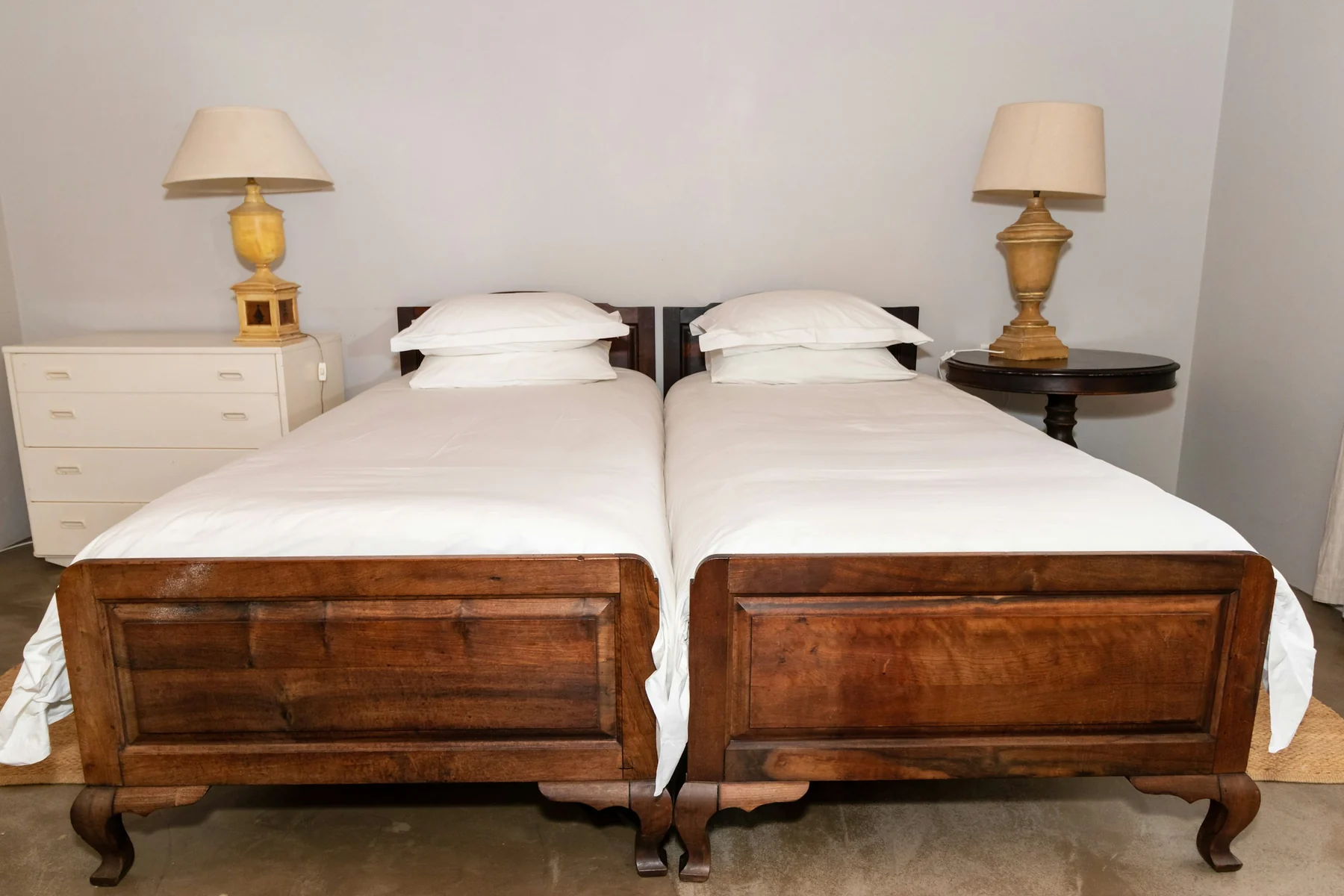
Define the adult bed and mattress brief
Begin with the sleepers, the exact mattress you intend to use and whether the bed must be ready on arrival. Record the mattress manufacturer, model, construction, stated dimensions, thickness and base requirements from current documentation. If the mattress has not been chosen, keep several candidates separate rather than designing around a generic size.
Write the use brief
- Sleeper and useRecord adult daily or occasional use, the number of sleepers and any practical height or access needs without turning the Guide into medical advice.
- Mattress candidateKeep the exact product dimensions and support instructions, revision date and seller or manufacturer source.
- Work toleranceDecide whether a custom mattress, reversible base, new slats, centre support or structural conversion can enter the budget.
- Room and routeRecord the final position, walking clearances and delivery route for the largest non-removable component.
BSI's current listing for BS EN 1725:2023 covers the safety, strength and durability of fully assembled adult beds and their components, while excluding bunk, high and medical beds that have separate standards. This Guide is therefore limited to ordinary adult bedsteads. It does not assess conformity, and it does not apply to children's, bunk, high, medical, water, air or electrically operated beds.[5]
Replace the size name with an inner-opening map
The National Bed Federation warns that bed sizes are not standardised and that the same name can describe different dimensions, especially when mattress and base come from different makers or the bedstead is imported. Treat the listing's size name as search language only. The buying evidence is the exact frame and mattress measured in the same units.[1]
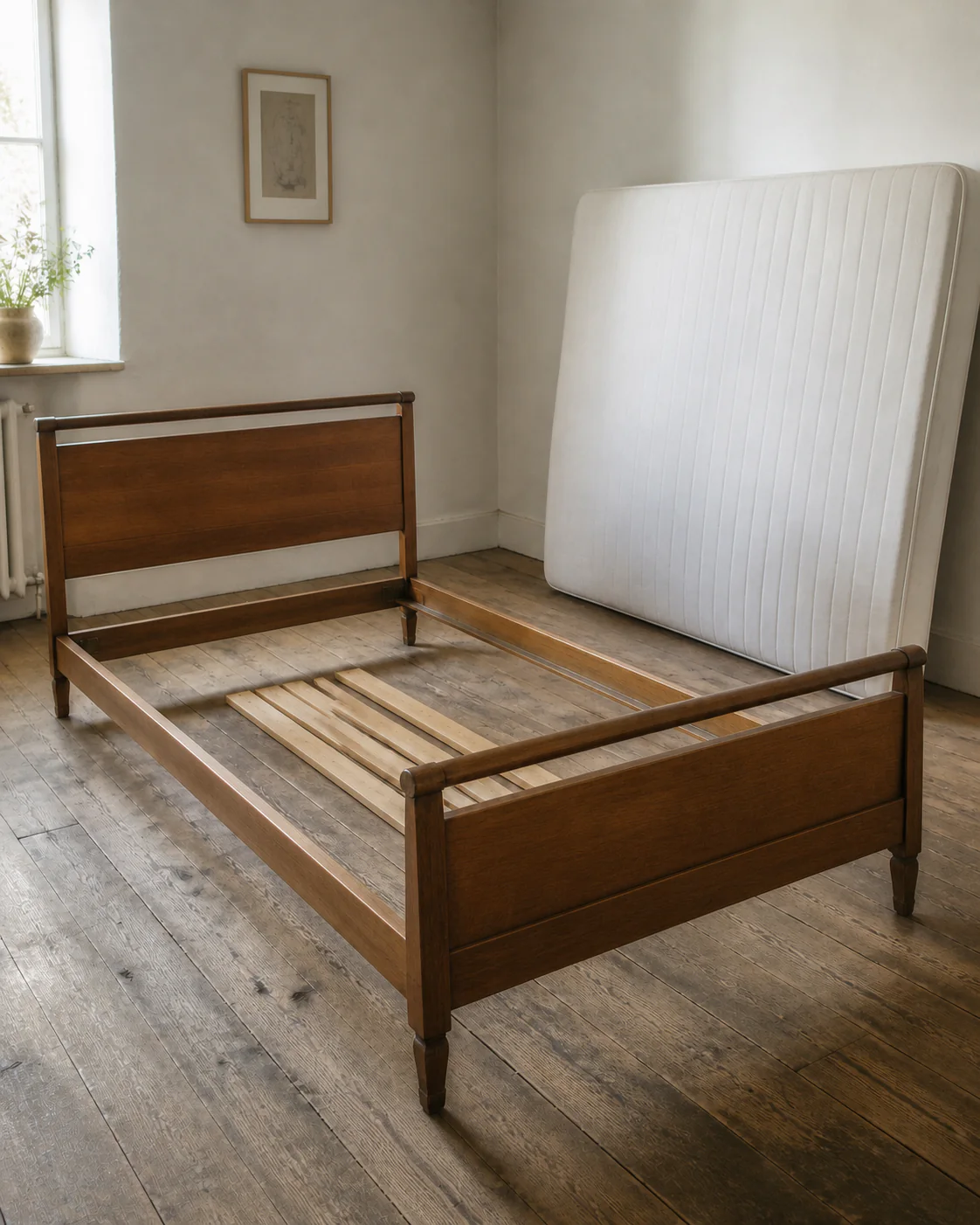
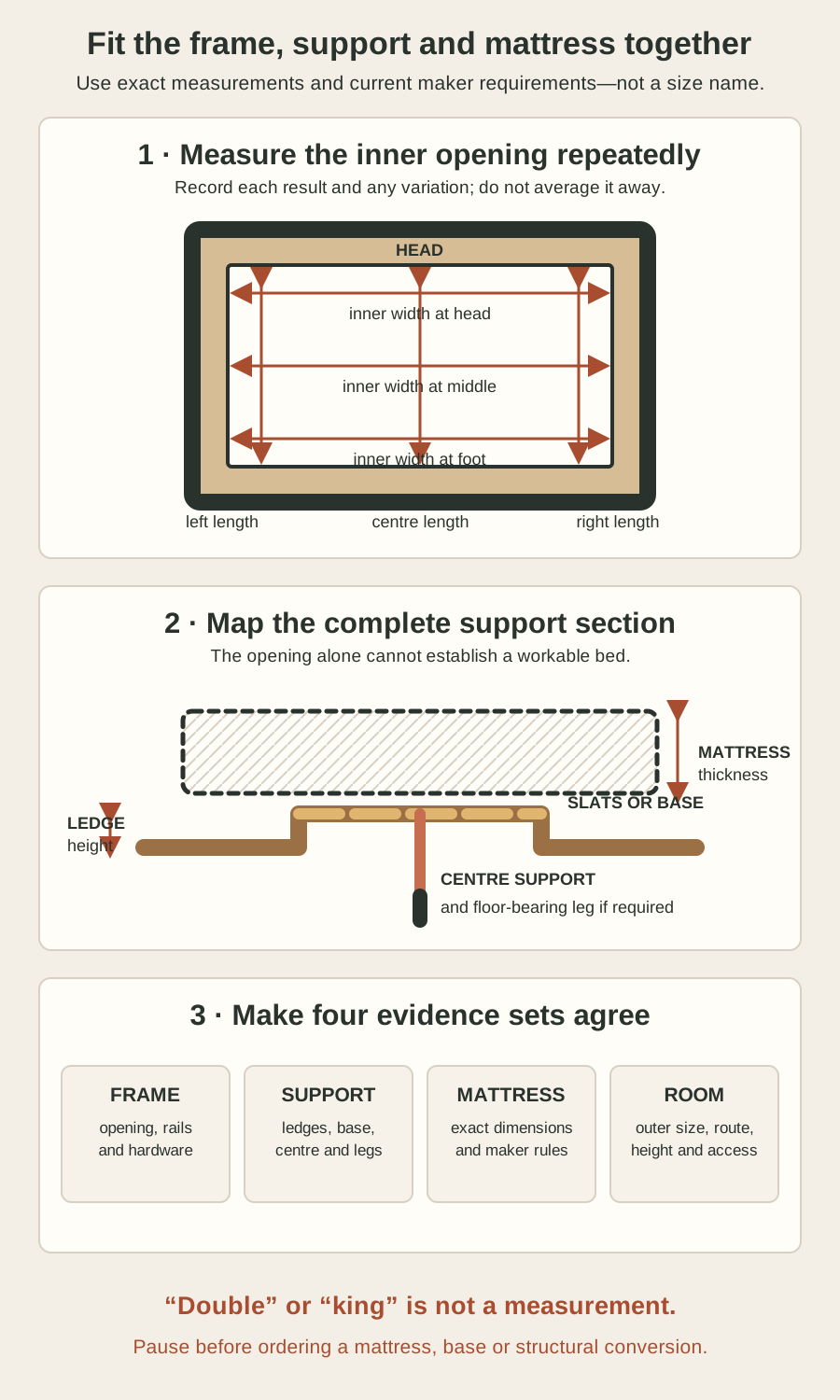
Assemble the frame only when the seller considers that safe and knows the correct hardware and sequence. Measure the clear inner opening, not the outside of the posts or decorative panels. Take the width at the head, middle and foot, then the length down the left, centre and right. Record every result to the nearest practical millimetre or small fraction; do not average away a taper, bow or out-of-square condition.
| Dimension | Where to measure | Why it matters |
|---|---|---|
| Inner width | Clear face to clear face at head, middle and foot, at the level the mattress or base will occupy | Reveals taper, bow and the smallest available width |
| Inner length | Clear face to clear face along left, centre and right, avoiding projecting hardware | Reveals out-of-square ends and the shortest available length |
| Diagonal relationship | Corner to opposite corner in both directions using the same reference points | Supports an out-of-square question without diagnosing its cause |
| Ledge height and width | Top and usable width of both support ledges at several points | Shows where a base or slat actually bears and the resulting support level |
| Hardware projection | Every bolt, hook, cleat or bracket entering the clear opening | Prevents a nominal opening from hiding a local collision |
BS EN 1334:1996 is listed by BSI as the current standard for methods of measuring domestic beds and mattresses and recommended tolerances. The Guide uses the same disciplined principle—define the object and repeatable points—but does not reproduce the paid standard, assign its tolerances or claim that a vintage frame conforms.[4]
Inventory the frame, hardware and support
A headboard and footboard do not make a complete bed. Give every part a temporary identifier and photograph it whole, at both ends and at each connection. Match the left and right side rails to their ends; record hooks, bolts, nuts, washers, pins, brackets and keys; then map the ledges, slats, base, cross rails, centre beam and floor-bearing legs that are included.
Keep each support role explicit
- Side-rail ledgesShow their continuous or interrupted bearing surface, dimensions, attachment and every altered or missing area.
- Slats or separate baseCount and measure the exact included parts; record whether they are original, later, seller-supplied or not included.
- Centre supportShow the beam, cross rails, attachment points and any floor-bearing legs in their assembled relationship.
- Fasteners and connectorsLay out and label the exact hardware, and keep replacement or improvised pieces distinct from documented originals.
Completeness boundary
Do not let a mattress hide missing structure
A styled listing can show a made bed while the support below remains undocumented. Ask for the mattress and bedding removed only if the seller can do so safely and without disturbing a fragile or uncertain assembly.
Match the support to the exact mattress
Bed Advice explains that antique or imported bedsteads may not conform to current UK sizes and that their support can be fixed or sprung slats, a metal grid, woven wire or a separate sprung base. Record what the exact frame was designed to carry and what is present now; do not assume that loose modern slats are a complete substitute.[2]
The National Bed Federation also says there is no single slat-width or slat-gap recommendation for every mattress. Manufacturers should provide requirements for their particular mattress, and an incompatible base may affect the guarantee. Obtain those current requirements in writing before approving the frame or ordering support parts.[3]
| Mattress-maker evidence | Frame or base evidence | Decision |
|---|---|---|
| Exact mattress width, length and thickness | Smallest inner opening, local projections and ledge level | Confirm practical fit and sheet access with the maker or supplier |
| Required base type | Existing slats, grid, board or separate base and how it bears on the frame | Use the documented compatible base or scope a specialist solution |
| Maximum slat spacing and permitted slat dimensions | Count, width, spacing, span, attachment and condition of the exact slats | Approve only against the exact mattress requirements |
| Centre-support and floor-bearing requirements | Beam, cross rails, legs, attachment and floor contact in the assembled bed | Resolve every required support before use |
| Ventilation or warranty conditions | Air path and material of the proposed base | Keep manufacturer terms separate from furniture condition |
Do not force a mattress into a tight opening or accept a large unexplained gap merely because both products share a size name. The appropriate working clearance depends on the exact mattress construction, bedding, frame projections and supplier guidance; there is no honest universal number for every vintage bed.
Measure finished height, room and route
Draw a section from floor to mattress top. Add foot height, rail and ledge height, support or base thickness and the chosen mattress thickness. Then check how much of the side rail, headboard and footboard remains exposed. A mattress can fit the opening yet sit awkwardly high, bury a decorative panel or create an uncomfortable step up.
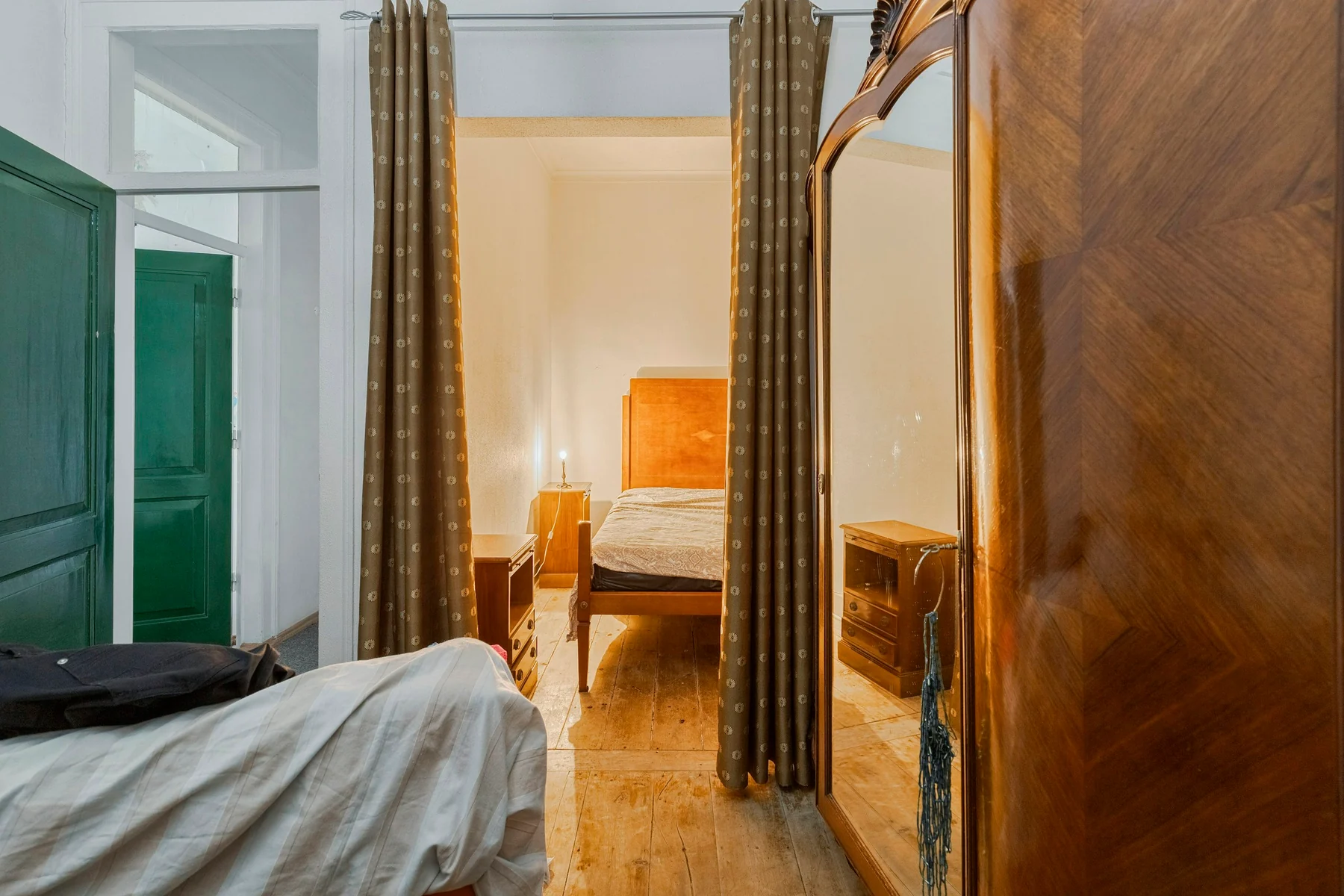
Measure the bed in use
- Outer envelopeRecord maximum overall width, length and height including posts, finials, bolts, brackets and any fixed projection.
- Bedside clearanceLeave the walking, cleaning, door, wardrobe and bedside-furniture space required in the actual room.
- Finished mattress topCompare the calculated height with a familiar bed and confirm that rail and footboard relationships suit the sleepers.
- Route and assembly spaceMeasure the largest non-removable part, stair turns, doors and the floor area needed for a responsible assembly sequence.
Use the delivery-route Guide for protected dimensions and turning envelopes. Ask who assembles the frame at destination and whether the correct hardware and sequence are documented.
Inspect the frame without provoking failure
Photograph the complete frame level on the floor, then each rail end, hook, bolt, bracket, ledge, slat, cross rail, centre support, foot and previous repair. Record splits, looseness reported by the seller, enlarged holes, bent metal, missing material, added blocks, cut rails and refinishing as separate observations. Do not jump, rock, lever or load an uncertain assembly to create evidence.
The Canadian Conservation Institute recommends checking furniture for loose joints, weak areas and old repairs before movement and lifting from sound structural areas rather than vulnerable projections. Apply that conservative boundary to dismantling and transport: a seller should not force a seized connector or lift the complete bed by its headboard to answer a listing question.[6]
| Observation | Ask next | Do not conclude |
|---|---|---|
| One rail connection moves or does not seat fully | Correct hardware, matching opposite joint, assembly history and specialist assessment | That tightening harder or adding a larger fastener is safe |
| Ledge is split, shortened or locally unsupported | Complete extent, previous work and the required support load path | That a new slat or block alone resolves it |
| Slats differ in width, spacing or material | One-row-per-slat record and mattress-maker requirements | Originality, compatibility or strength from appearance |
| Centre beam or leg is absent | Whether the frame originally used another base and what the chosen mattress requires | That every bed of this width needs the same retrofit |
| Old conversion or extension is visible | Full geometry, attachment, date if known and furniture-specialist scope | Reversibility, adequacy or value from one photograph |
Use the general condition Guide to carry each observation, seller report, unknown, likely work and decision consequence into the purchase record.
Scope a base or conversion before payment
When frame and mattress do not agree, separate reversible support work from alteration of the vintage object. A made-to-measure mattress, a self-contained base resting on sound ledges, replacement slats and a structural extension are different projects with different effects on comfort, warranty, fabric, value and future reversibility.
Get a responsible work proposal
- Furniture specialistConfirms the frame, connections, support path, historic fabric and whether proposed work is structurally and conservationally appropriate.
- Mattress or base supplierConfirms exact finished dimensions, required support, ventilation, permitted base and applicable guarantee conditions.
- Carrier or assemblerConfirms component protection, hardware control, route, assembly sequence and who stops if the frame does not go together as documented.
- BuyerApproves cost, appearance, finished height, downtime, reversibility and the uncertainty that remains before purchase.
No trial conversion
Do not drill, cut or improvise to see whether it works
A structural alteration is not a viewing test. Price and review the proposed intervention before payment, and keep any work that affects historic material with the appropriate specialist.
Send one complete vintage-bed request
Message to copy
Ask for the complete frame and support geometry
Hello—could you show the complete bed assembled only if you consider that safe, then label the headboard, footboard, both side rails, every fastener, support ledge, slat or base, cross rail, centre support and leg included? Please measure the clear inner width at head, middle and foot; inner length at left, centre and right; both diagonals; ledge width and height; hardware projections; and the complete outer dimensions. Please photograph every connection, underside and previous repair and say what is original, replaced, altered, missing or untested only as known. Please do not force, load, jump on, drill, cut or improvise parts for the inspection. I will compare the record with the exact mattress maker's current requirements. Thank you.
Buy when the actual opening, complete hardware and support system agree with a documented mattress and base plan, the frame condition suits adult use, and finished height, route and room work in practice. Pause when the size name substitutes for measurements, support is hidden, one component is missing, or a conversion has no responsible scope. Decline when consequential structure or hardware cannot be resolved, the required alteration is unacceptable, or the total mattress, base, specialist and delivery cost no longer fits the purchase.