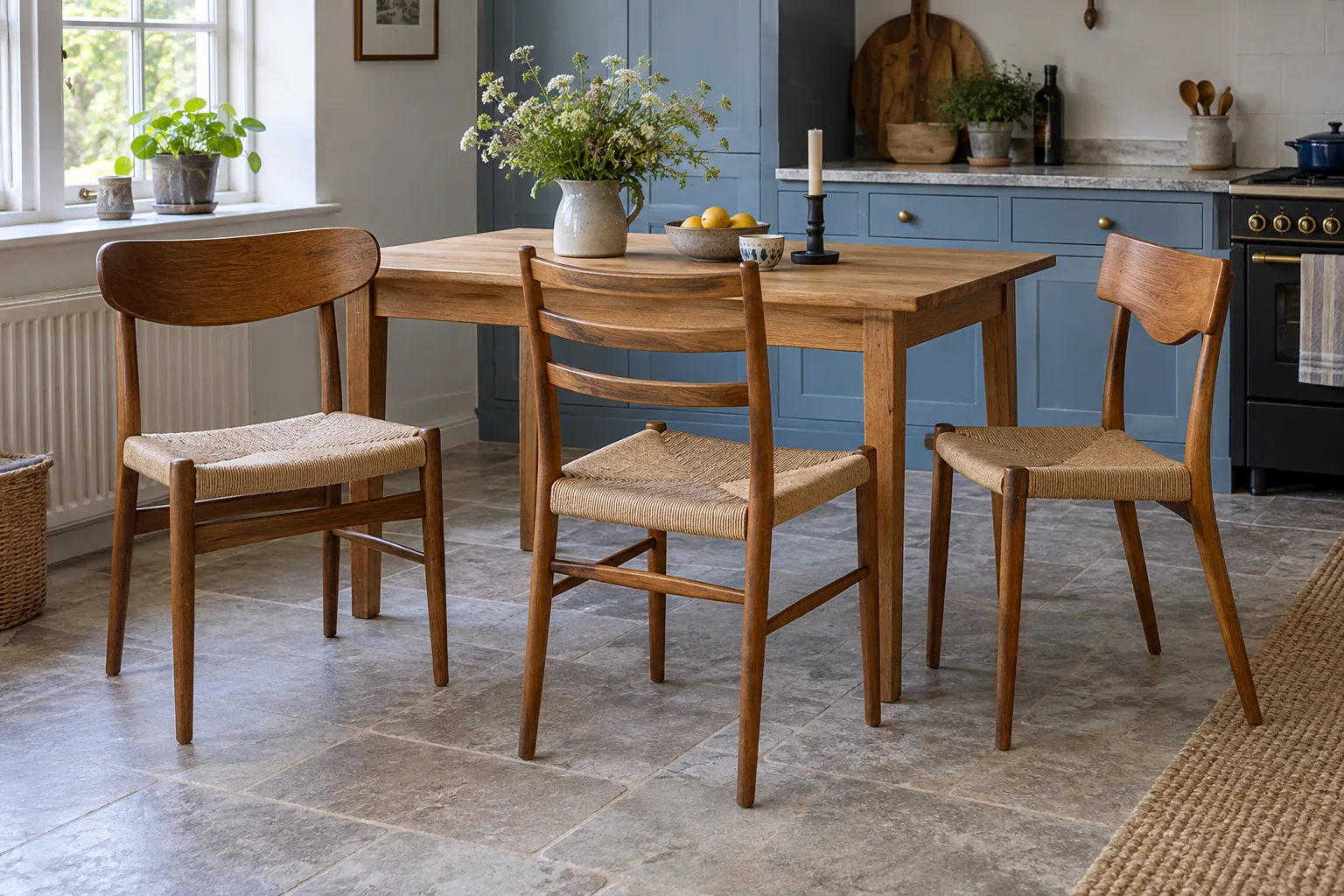
Three chairs with something of their own to offer
A dining chair has two lives: the silhouette you see across the room and the seat you occupy after the plates have been cleared. A beautiful outline earns a place on the shortlist. The second life decides whether you will still like the purchase after a long evening.
CH23 belongs to Wegner’s first 1950 group for Carl Hansen & Søn. The maker highlights its shaped backrest, double-woven seat and arched rear legs, and records its reintroduction in 2017. That gives you a specific design to look for, while making clear that a 1950 design can be a much later chair.[1]
CH36 is a different 1962 Wegner design, with horizontal back members and a cord seat. Carl Hansen also identifies the related chair with arms as CH37. Include that version when arms are part of your brief rather than treating an armless chair and its companion as the same offer.[2]
Fredericia’s J39 reference identifies Børge Mogensen’s 1947 design, a solid-wood frame, paper-cord seat and moulded-veneer back. The broad panel gives a different contact with your back from separate horizontal rails. Its current 49 cm width is a reference to check against an older example, not a measurement to copy into your floor plan.[3]
| Candidate | Reason to try it | Question during the trial |
|---|---|---|
| CH23 | Shaped single back and an open, armless seat. | Does the back meet you comfortably when you lean towards the table and sit back? |
| CH36 / CH37 | A ladder-back outline, with a separate armchair option. | Where do the rails or arms meet your body, and can the chair come close enough? |
| J39 | A broad back panel and restrained rectangular composition. | Do the panel, seat depth and useful width suit you through a whole meal? |
Bring your table into the decision
Measure from the floor to the underside of the apron—the timber running beneath the top—as well as to the tabletop. The first affects thighs and armrests; the second affects where your plate sits relative to your elbows. A thick top with a deep apron can behave very differently from a thin top at the same overall height.
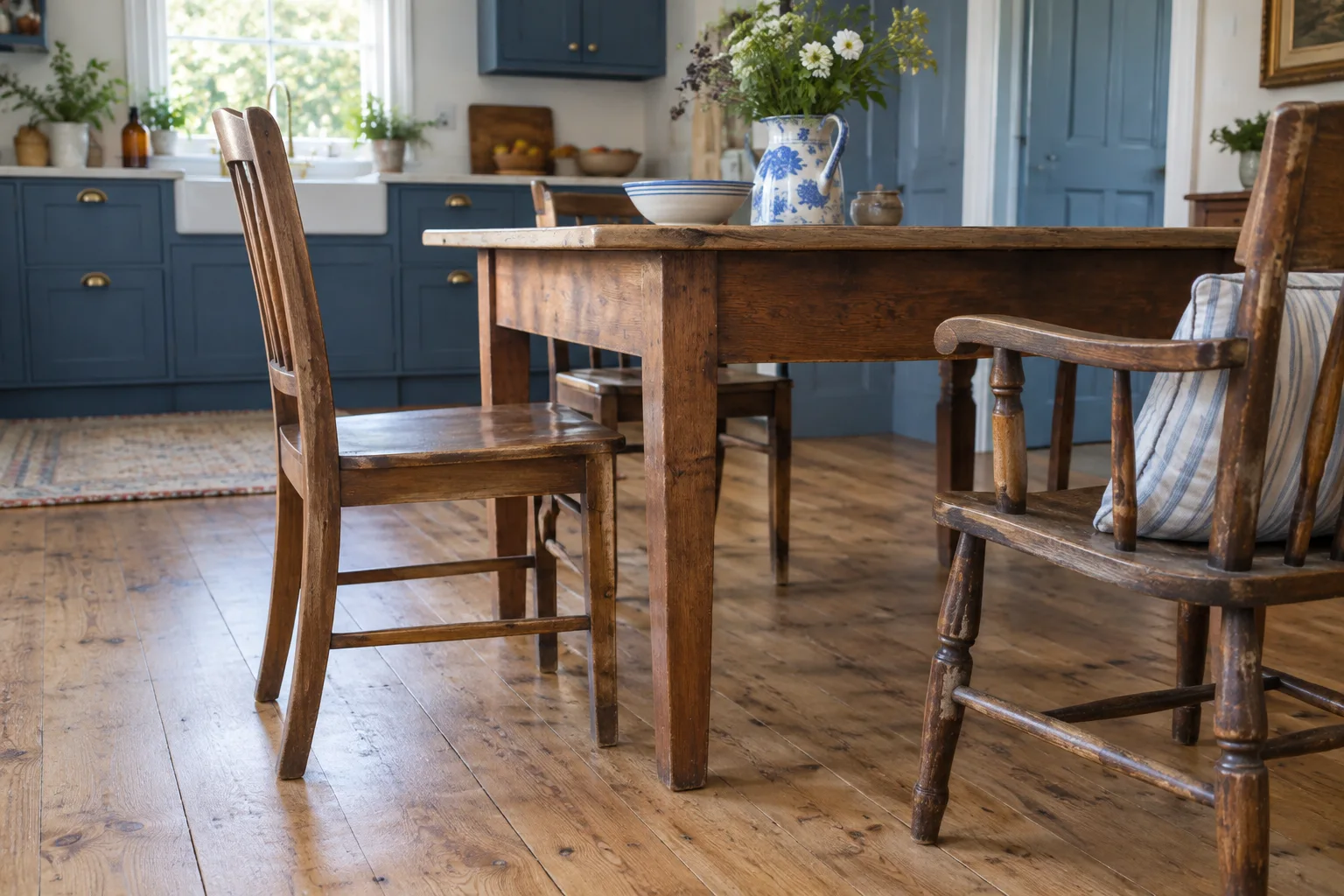
Ask to try the chair beside a table with similar dimensions. Sit normally, bring the chair forward, rest your forearms and turn to speak to someone beside you. Notice whether you keep moving to escape the backrest or perch at the front because the seat feels too deep. Those observations are more useful than deciding that one model must be comfortable because it is famous.
For two chairs along one side, measure the usable opening between the table legs. Two hypothetical 49 cm chairs occupy 98 cm before you allow any room between them or beside the legs. A 110 cm opening leaves just 12 cm to distribute. That arithmetic is a prompt for a physical trial, not a recommended spacing.
Look behind the occupied chair as well. An armless design may tuck away neatly, yet still need substantial room when someone sits down. Try pulling it out and walking past in your actual plan. The chair’s catalogue width cannot describe that movement.
Buy the set you will have, not the best chair in it
A six-chair listing needs six-seat attention. Ask for each chair to be shown and numbered in the photographs. Compare the back shapes, feet, seat heights and cord condition. A darker chair might simply have lived elsewhere; a lower seat might have different weaving or altered legs. Get the explanation before deciding whether the differences bother you.
New cord can be welcome, especially in furniture for daily use. Ask who did the work and whether the frames were assessed first. If some seats remain sound and others need renewal, decide whether you want to accept mixed colour now or budget for a more consistent set later. Reweaving every sound seat merely to remove age is not the only reasonable option.
Handle a chair as you will at home: pull it back, lift it to clean beneath the table and move it to an extra place. A chair that feels light in a photograph may be awkward for the person who rearranges the room. Ask about felt or other floor protection suitable for your floor, without treating pads as a cure for uneven or damaged legs.
Pay for the difference you actually want
Compare like with like: the price of the complete set, agreed frame work, any weaving and delivery. Do not assume that a less instantly recognisable chair will be cheaper. Condition, quantity and production history can overwhelm that assumption. An already repaired set with an honest work record may suit a busy kitchen better than a cheaper set waiting for six appointments.
A useful enquiry
Could you show and measure each chair, including its seat and the back of the frame? Please describe earlier frame or weaving work, identify the model and production evidence, and confirm whether I can try one beside a table of similar height.
Keep your shortlist to two or three genuinely different seats. Choose the broad back you enjoy leaning against, the ladder back that feels right or the armless shape that comes close to your table. The successful alternative to a Wishbone is a chair you prefer using, not simply one with a less familiar name.