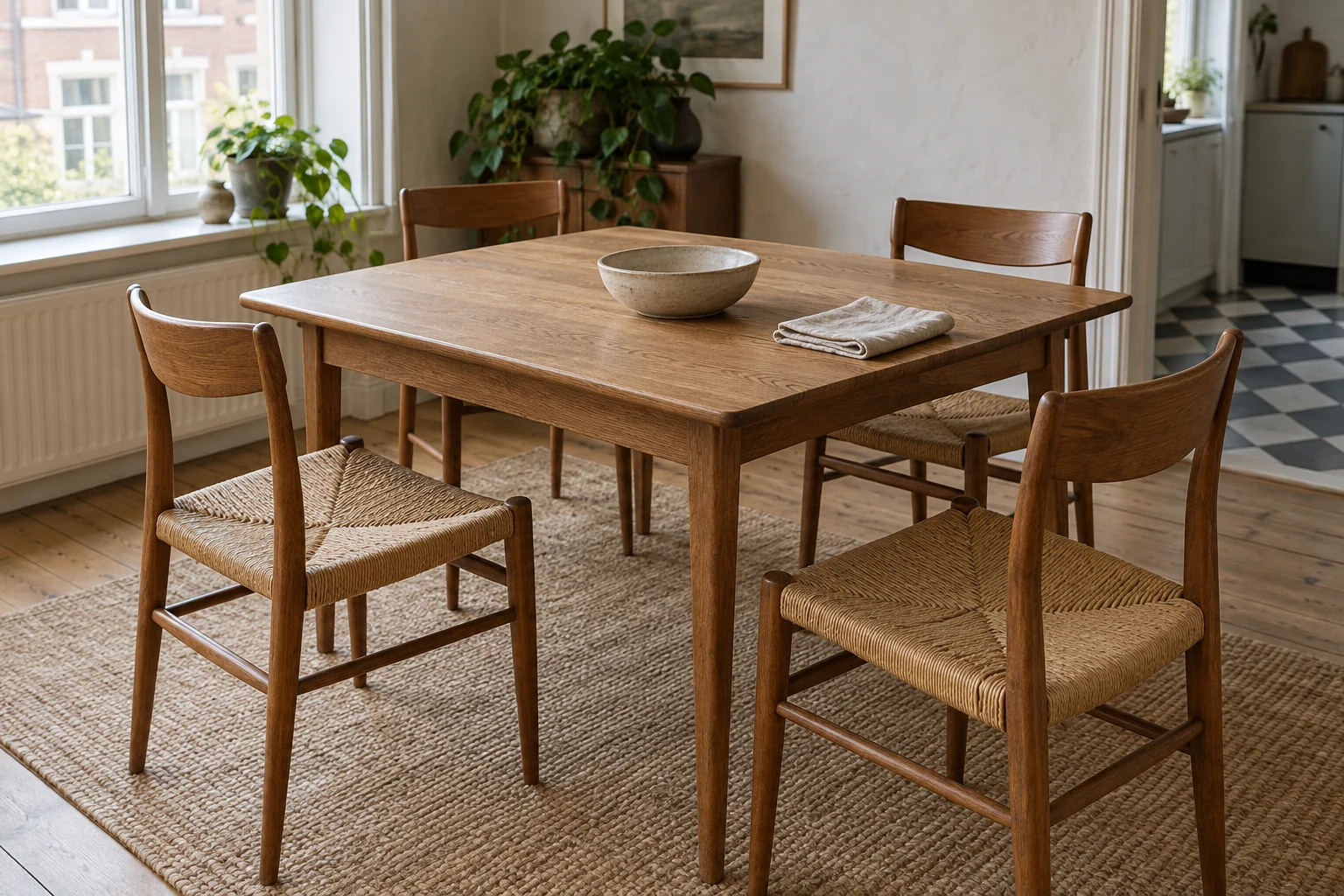
First identify what is being replaced
Two seats can have a similar open pattern while being fitted differently. In hand caning, individual strands pass through holes in the wooden frame. A ready-woven sheet is fitted into a groove. Danish paper cord is another system again. The photograph of the centre is therefore a poor basis for comparing prices: the edge and underside help the workshop identify the work.
Stoelenliefde distinguishes hand caning from its machine-woven cane inserts, called “webbing” on its Dutch site. Here that term means a ready-woven cane sheet, not the straps hidden beneath an upholstered seat. Its sheet-cane service is priced per separate seat or back panel.[1]
If you are still deciding whether the existing seat needs attention, use the woven-seat inspection Guide. This Guide starts with the budgeting question: what has the workshop actually agreed to replace?
Read the unit before comparing the price
These examples show the published basis of the charge. The three Dutch rates come from Stoelenliefde; the Danish rate comes from DKA Design in Kongens Lyngby. Keep currencies separate and request an updated written quote. Transporting chairs to a distant workshop can outweigh an apparent saving.
| Job and provider | Published basis | Scope to confirm |
|---|---|---|
| Sheet cane — Stoelenliefde [1] | €90 for one separate, normal-size seat or back panel | €30 dismantling charge when supplying the whole chair; widths over 45 cm and non-dismantlable models need an enquiry. |
| Hand cane — Stoelenliefde [2] | €3 per frame hole for ordinary work; €4 for recessed work | €20 supplement for a fixed seat. The quoted unit is a hole in the wood. |
| Paper cord — Stoelenliefde [3] | €0.15 per cm² plus €20 for a fixed seat | Use its centre-width × centre-depth method; block patterns add €25–50. |
| CH24 paper cord — DKA Design [4] | From DKK 985 including VAT | Seat reweaving; woodwork, joints and further treatment assessed separately. |
The hand-caning tariff distinguishes ordinary through-hole work from recessed work, often used where the weave should not show on the rear of a backrest. Ask the weaver to classify your panel before multiplying anything.[2]
Stoelenliefde’s reviewed price pages do not state the VAT treatment. Ask whether the final amount includes it. The paper-cord page also specifies a block-pattern supplement, so do not assume that equal seat area means an equal price.[3]
DKA explicitly states that its CH24 starting price includes VAT and covers the seat weave. It assesses loose joints and other woodwork separately. A low starting figure should never stand in for a confirmed whole-chair repair.[4]
Count the frame holes, not the pattern
For a per-hole quote, count the drilled attachment holes around the wooden frame. Do not count the many little openings across the woven surface. Send a clear perimeter photograph with your count so the workshop can correct it. Do this without pulling brittle strands out to expose the wood.
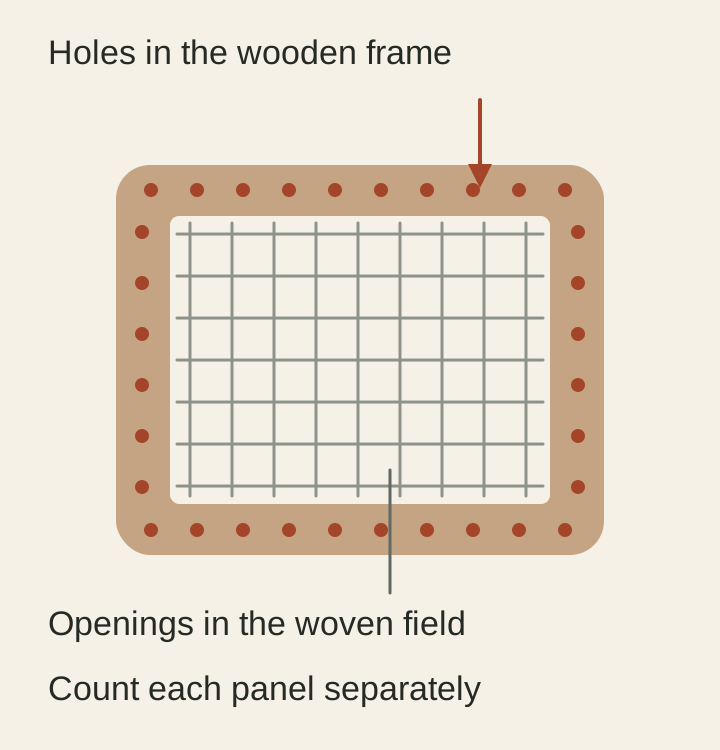
Worked example: suppose a fixed seat has 80 frame holes and the workshop confirms that its ordinary €3 tariff applies. The arithmetic is 80 × €3 + €20 = €260. Four equivalent seats would be €1,040 before any additional agreed work, transport and clarification of tax. These are assumed chairs, not an inspected set or an invoice.
For the paper-cord formula, suppose the centre measurements are 40 × 40 cm. That gives 1,600 cm² × €0.15 + €20 = €260 per seat. The identical answer is a coincidence of these inputs. It does not make the two weaving methods interchangeable, and 40 × 40 cm is not a standard size for every Danish chair.
What a seat price leaves out
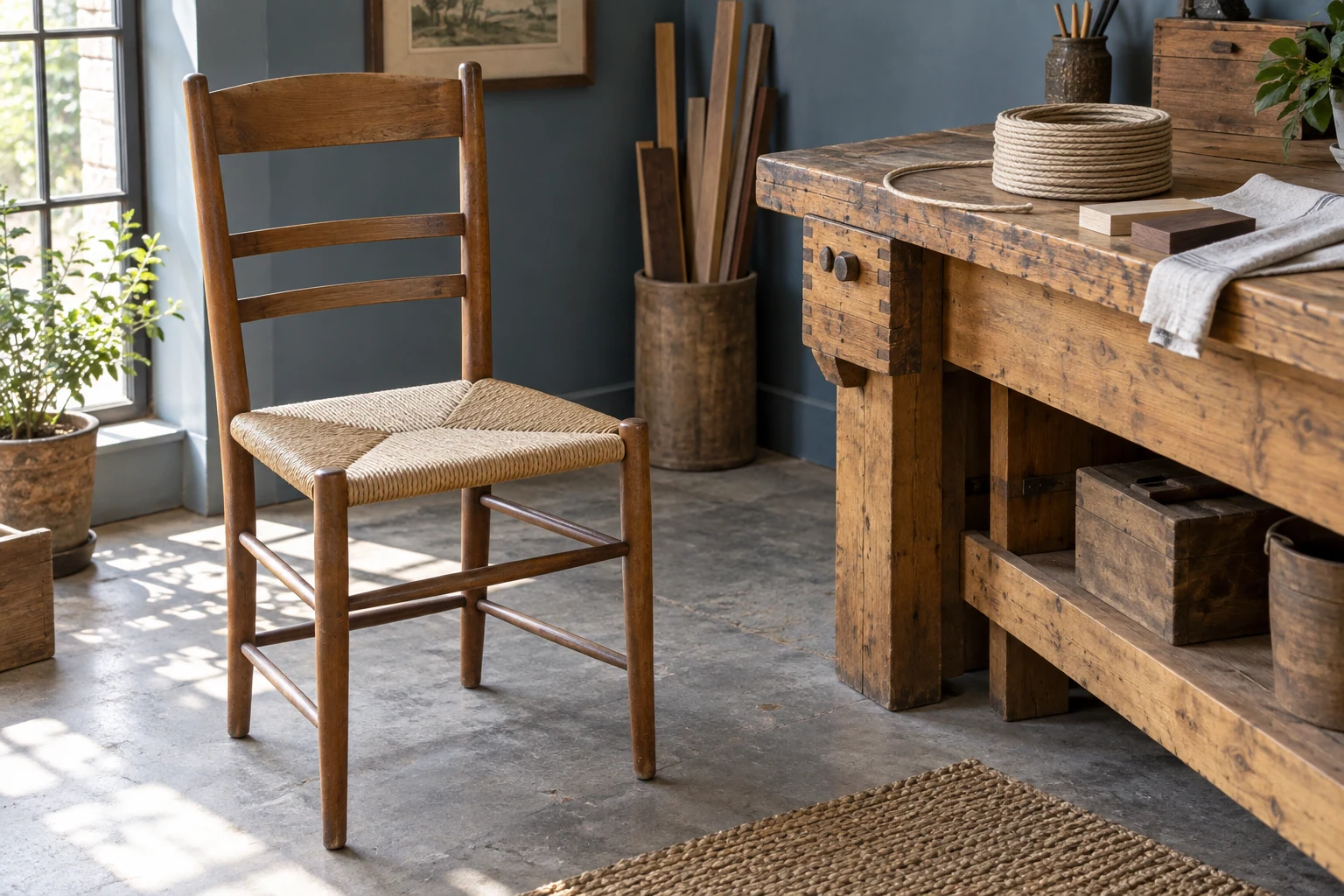
A sound new weave needs an appropriate frame. Ask the workshop to assess loose joints, cracks near the attachment and earlier alterations before agreeing to the seat work. Renewing the surface alone does not resolve those problems. If the frame needs another specialist first, include the additional journey and waiting time.
Clarify whether removal of the old material, dismantling, reassembly and finishing are included. Do not take a chair apart just to reach a lower advertised rate; first confirm that its construction permits removal and that the workshop wants to receive it that way. Photograph the existing pattern before work starts.
Then agree how the finished seat should relate to the remaining chairs. New cane or cord may differ in colour from the older seats. Decide whether that difference is acceptable, whether only the failed panels need renewing, or whether you want a priced option for the whole set. A visual mismatch is a choice to discuss, not proof that every surviving seat needs replacement.
Put the whole set back into the purchase
Number the chairs in your notes and give each a line for seat work, back work and frame work. Four advertised chairs might mean four straightforward seats, two seats and two backs, or one unusually expensive frame repair. Multiplying the best-looking chair’s quote can miss the very item that changes the decision.
Consider an explicitly illustrative purchase at €400 for four chairs. If all four need the €260 hand-caning job above, purchase plus seat work is already €1,440. Delivery, any frame repairs and unresolved tax treatment are still outside that figure. Compare that finished total with a set whose relevant work is documented and whose current condition you have checked.
Keep two decisions separate: whether these are the chairs you want, and whether this is the right offer. A worthwhile design or a family association can justify restoration without making it the cheapest route to four usable seats. The useful budget makes that choice visible.
A message for the workshop
I am considering this set of [number] chairs. Here are numbered whole-chair, seat-edge and underside photographs, plus [frame-hole counts / your requested measurements]. Please confirm the weaving method and quote each seat or back panel, frame repairs, removal, reassembly, tax and transport separately. Could you also state the material, pattern, expected colour relationship and current lead time?