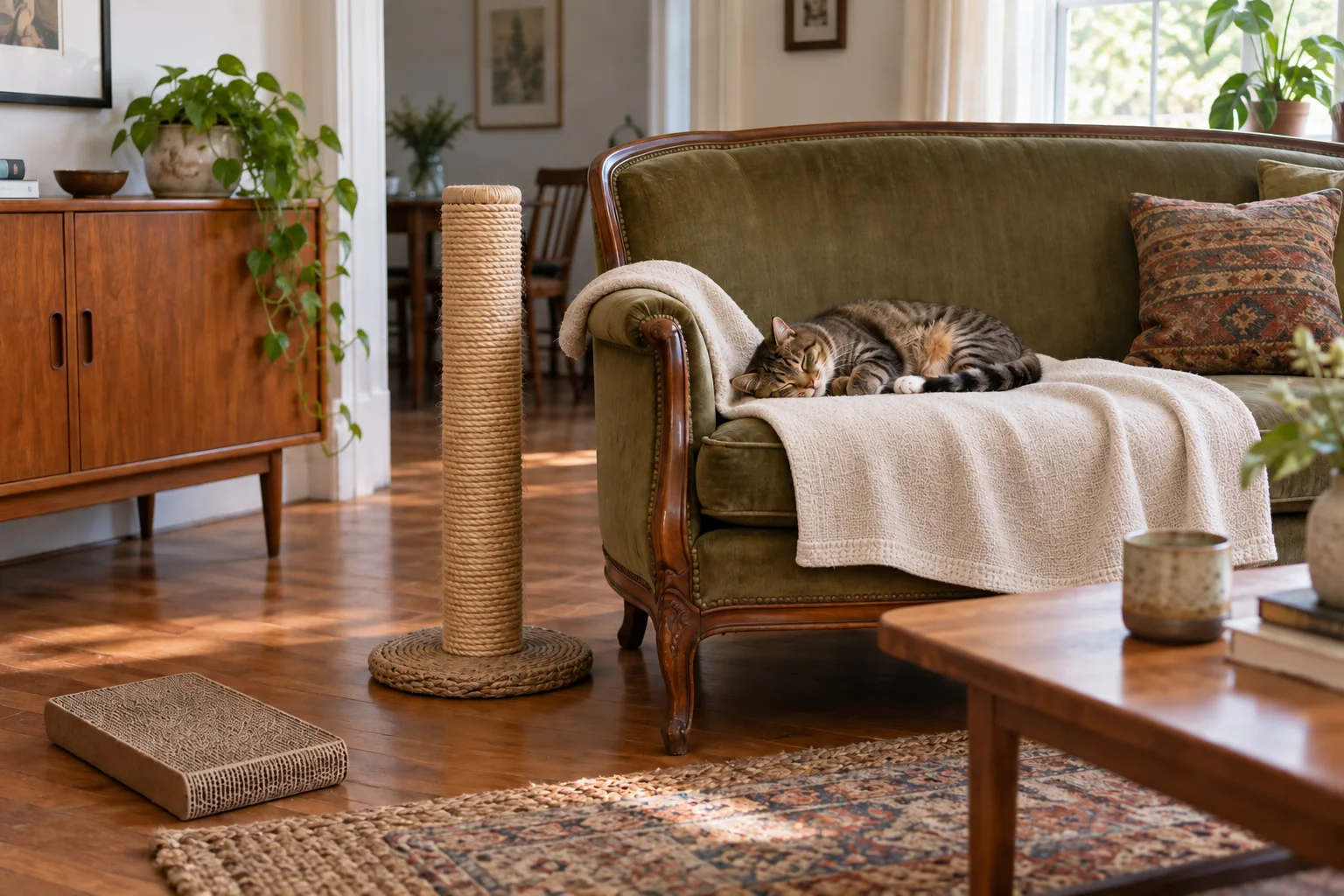
The sofa corner already tells you something
Watch where your cat sleeps, stretches and scratches over a few ordinary days. Is the favourite surface an upright corner, a horizontal mat or the edge of a loose cover? Where does it go after waking? That is more useful for choosing a room arrangement than a generic list of “pet-friendly” fabrics.
Cats Protection describes scratching as normal behaviour, including claw maintenance and communication. Its guidance recommends stable scratching provision suited to the cat: a tall enough post for a full stretch or a horizontal surface where that is preferred. The aim is to provide an appropriate outlet.[1]
Build that provision into the room before the new sofa arrives. A post that you can tolerate only behind a rarely opened door is unlikely to solve a problem at the favourite living-room corner. Make its footprint part of your furniture plan.
Compare what happens if one part gets damaged
Picture two chairs you like: an exposed wooden frame with loose cushions, and a chair covered continuously over its arms and seat. If the favourite sleeping cushion needs a new cover, the first can offer a separate, identifiable job. If the cat scratches an arm front, the second may need a larger upholstery job. The timber on the first chair remains exposed too. Choose the consequence you can live with, rather than a label saying pet-friendly.
| Furniture detail | What to establish before buying |
|---|---|
| Loose cushions | Are covers intended to come off, how are they cleaned, and can one be remade? |
| Fully upholstered arms | What would repairing a damaged arm involve, and how much adjoining cloth would be affected? |
| Exposed timber | Would you accept visible scratches? Ask about its finish before adding any adhesive protector. |
Look at exposed loops, loose seams, fragile trim and the landing places your cat favours. Discuss them with the upholsterer without deliberately snagging the cloth. Velvet, leather and microfibre are not universally claw-proof.
Kvadrat describes Martindale testing as rubbing fabric against a standard wool textile under a specified load. That is an abrasion test, not a claw test. A high rub count therefore cannot settle how a cat will interact with an old cover, its seams or its backing.[2]
If one visible scratch would spoil the purchase for you, choose a less delicate piece for daily shared use or keep that special chair in a room with controlled access.
Put the alternative where the habit happens
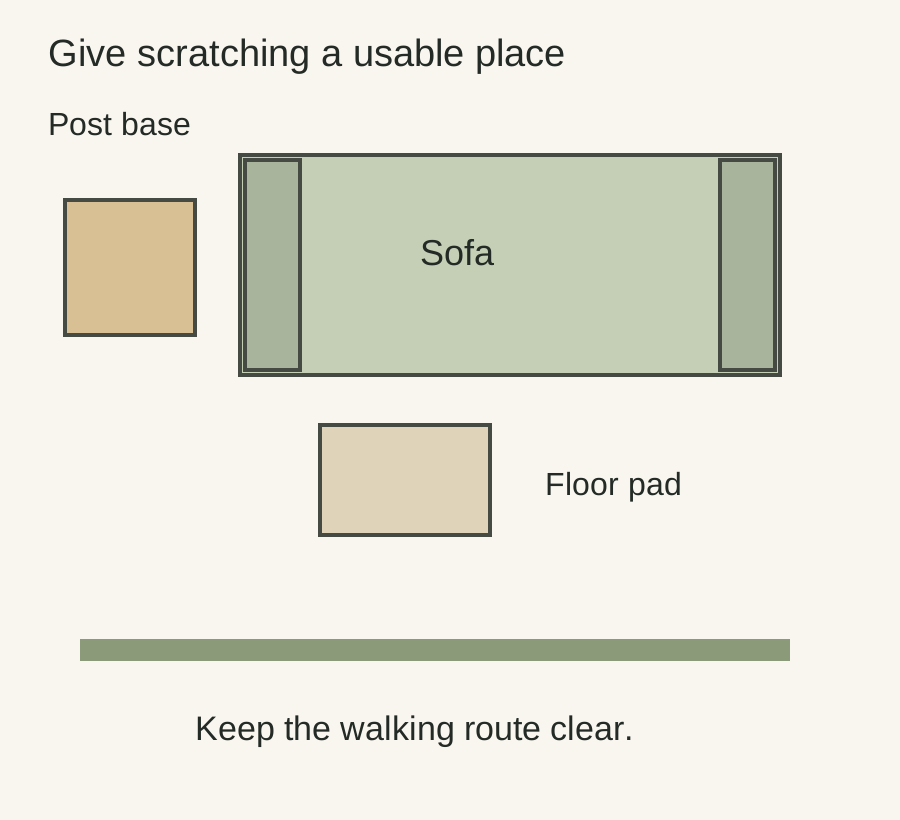
Cats Protection recommends placing a scratching post near an existing scratching area and rewarding its use. Follow the cat’s preference rather than assuming any post is suitable. Keep the base stable and leave enough space to approach and stretch.[1]
In a small room, mark out the sofa, the post’s actual base and your walking route together. A scratcher squeezed into the gap behind an arm may be less usable than a slightly smaller sofa with space beside it. A horizontal pad needs its own place on the floor too.
A washable throw on a favourite sleeping cushion can simplify hair management when it stays in place and the material suits the upholstery beneath. It is not a barrier against every scratch or spill. Choose one without loose ties or dangling fringe, and check the chair underneath as part of ordinary care.
Make “easy to clean” a specific promise
Ask the seller or upholsterer whether each cover is designed to come off, how it is cleaned, and whether replacements can still be made. Request the actual fabric information where available. A zip alone does not establish that a cushion cover can go in the washing machine.
Keep one simple care note with the piece: the known textile, permitted cleaning method, supplier and any replacement pattern or invoice. If a pet has already damaged the cloth, price the appropriate repair before buying rather than assuming a throw settles it.
Do not start with sticky protectors, staples or a guessed chemical deterrent on old timber or upholstery. The Canadian Conservation Institute warns that furniture finishes can be damaged by unsuitable treatments. Discuss anything that will contact the surface with a suitable furniture or textile specialist first.[3]
For removable protection that changes the look of a chair, compare a fitted loose cover with reupholstery.
Let the furniture do its everyday job
Picture an ordinary evening: you sit down, the cat takes its usual place, you can reach the lamp and nobody has to move the scratching post. That is the arrangement to buy for. A pristine showroom photograph tells you little about whether it will work.
If scratching changes suddenly or remains a problem, use Cats Protection’s advice and appropriate professional help rather than escalating punishment or treating the furniture as the whole explanation. For the buying decision, favour a piece with an acceptable care burden and a realistic future if one panel gets damaged.