Choose the seat before choosing the colour
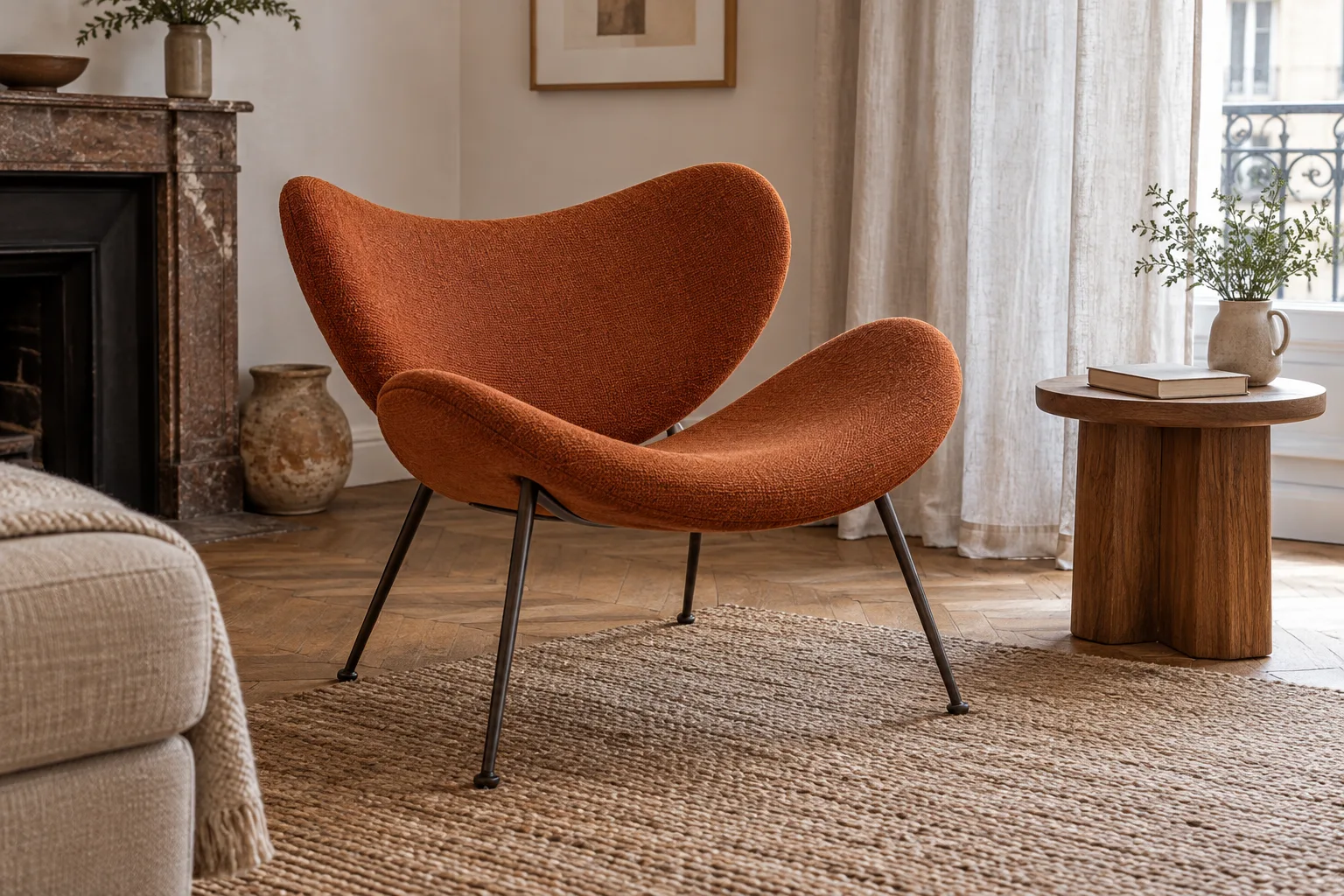
Orange, mushroom, tulip: the names make these chairs sound like a small grocery list. In a room, their differences are much more useful than the joke. One leaves open space below its shells, one reads as a continuous soft volume, and one stands on a base that can be fixed or swivelling. Think about which of those relationships you want beside the sofa.
Artifort’s current references make a useful starting comparison. Orange Slice F437 has a stated seat height of 41 cm, while the F437B variant is 44 cm. Mushroom F560 is listed at 40 cm and Tulip Midi at 43 cm. These figures belong to current references checked on 9 September 2026; measure the older example and try its existing foam rather than assigning it a catalogue height.[1][2][3]
| Model to investigate | What to try in person |
|---|---|
| Orange Slice | How the raised shell edges meet your body; feet on the floor; reaching the side table. |
| Mushroom | The seat’s depth and firmness; sitting down and standing up in your normal way. |
| Tulip Midi | Back and arm position; whether the actual base swivels; clearance while turning. |
Use the chair as you intend to use it. Sit with a book, turn towards the person beside you and put your cup down on a table at a realistic height. Give the trial more than a quick showroom perch. If you need firm arms to push against or support high behind your head, establish that in the actual chair; a sculptural curve does not promise either.
Orange Slice: the gap between the shells matters
The separate curved seat and back are the visual attraction. They let light through the chair and can work well beside a more solid sofa. The open leg area can also help a small seating group feel less crowded, even though you still need to measure the widest part of the chair.
Artifort identifies the Orange Slice family as the F437 chair, an F437B height variant and a matching P437 footstool. Its current chair base is four-legged steel with powder-coated or chrome finishes. This is useful for naming the offer, but a matching colour or a familiar base finish cannot establish when an older chair was made.[1]
Look at both shells from the side and behind. Ask about earlier upholstery, how the chair feels under ordinary sitting and whether anything is loose at the connections. A new cover can be a practical advantage; it should not conceal an unresolved shell or attachment problem. If a footstool is included, check its identity and condition separately.
When comparing upholstery work, ask for previous examples on the same model. Pay attention to the clarity of the curves and the way the cover follows the shell edge. A neatly upholstered generic chair is not proof that a workshop can reproduce the shape you liked here.
Mushroom: the upholstery is the outline
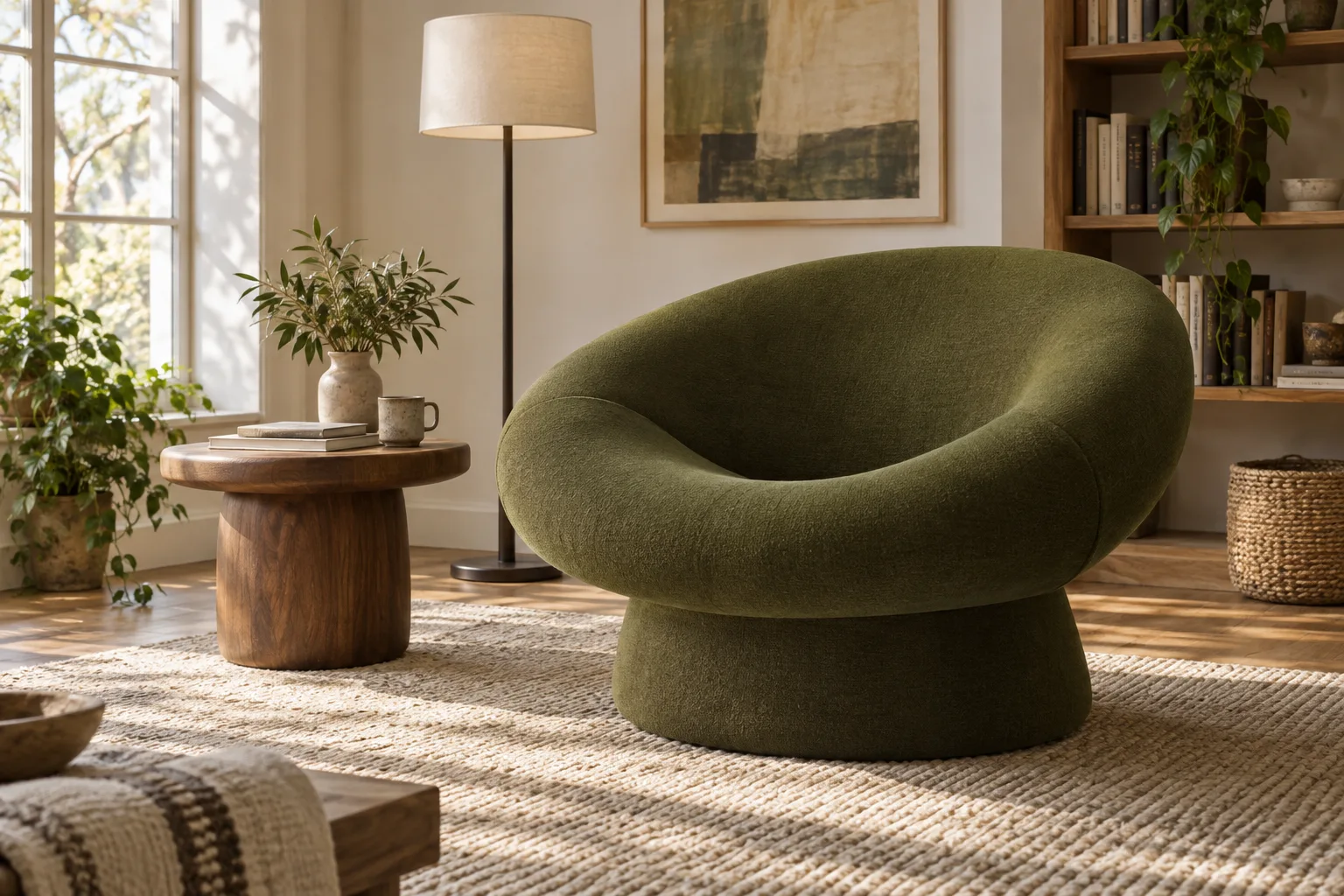
Mushroom puts almost the entire visual experience into one upholstered form. Artifort describes a steel frame covered with foam and a stretch-fabric construction; the current family distinguishes Mushroom F560 from Big Mushroom F562 and the smaller Junior. “Mushroom chair” alone is therefore not enough to tell you which size is being offered.[2]
Try the actual seat, especially if the surface looks freshly recovered. Compare how deeply you settle, whether the support feels even and whether you can get up comfortably. Ask what work was done beneath the fabric. Replacing only the cover and renewing the filling are different interventions, even when the listing calls both “reupholstered”.
Do not choose a textile from colour alone. A shaped stretch cover asks different things of a fabric from a loose rectangular cushion. Tell the upholsterer that keeping the model’s form matters to you, and ask which fabrics they will accept for that result. Get their assessment before buying a length of cloth on sale.
A small rub at the base may be an acceptable trace of use. An uneven seat, exposed structure or a tear spreading where the cover is under tension asks a different question. Record those concerns without assuming that the whole chair must be rebuilt—or that new fabric will solve them.
Tulip Midi: check what happens below the seat
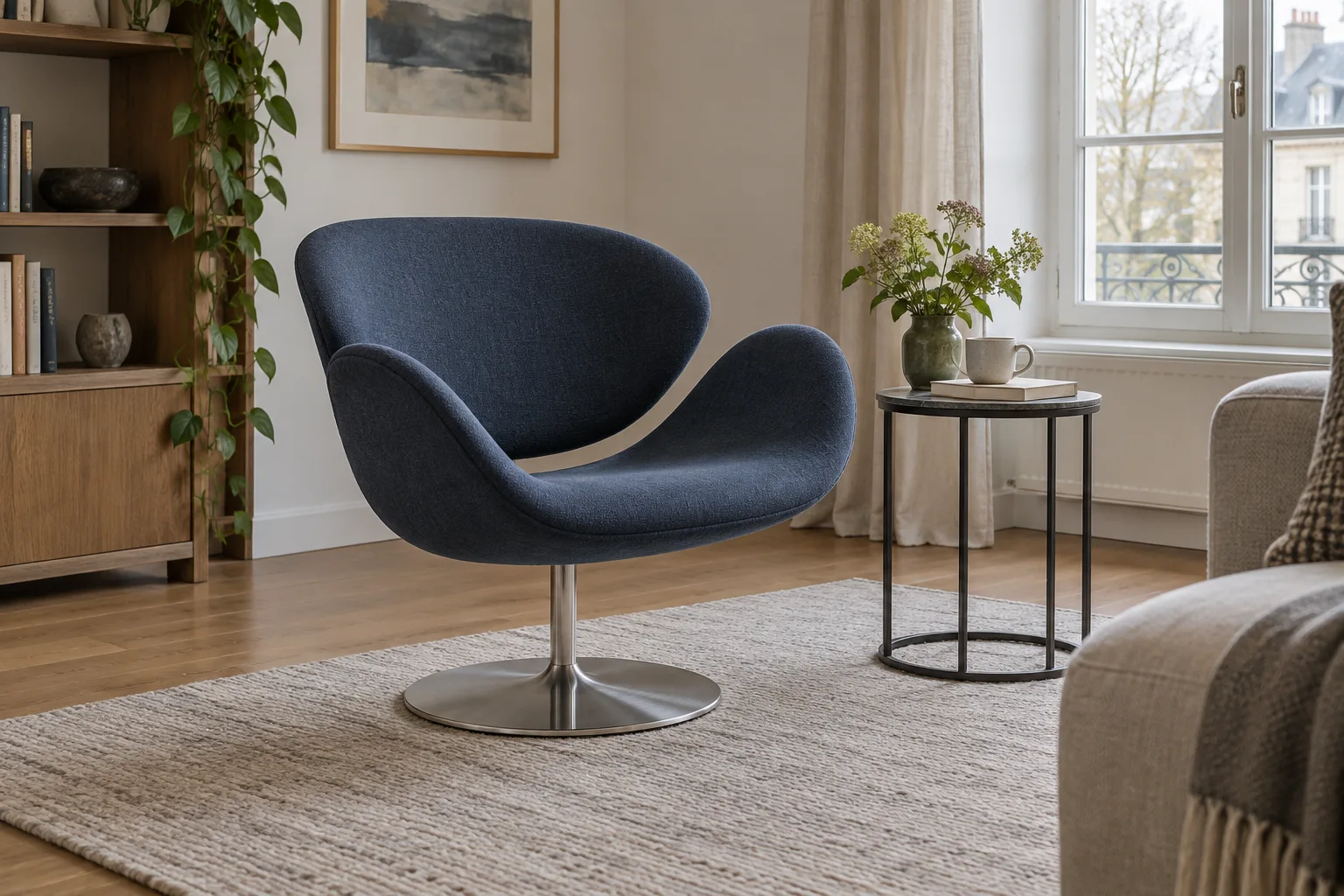
Tulip Midi sits between the Little Tulip dining chair and the taller Tulip lounge chairs in Artifort’s family. The current offering includes a non-swivelling cross base and a swivelling disc base. Ask the seller to identify the actual arrangement rather than assuming every pedestal-like chair will turn.[3]
Artifort explicitly pairs a 1960 design date with a 2016 reintroduction for Tulip Midi. That is a useful warning against a common listing shortcut: “designed in 1960” does not mean “manufactured in 1960”. A later authorised chair may suit you perfectly, but an earlier-production premium needs evidence for the offered piece.[3]
Try the movement gently in normal use. Ask about looseness, scraping, unwanted rocking or any earlier work on the base and seat connections. Keep the floor surface in the comparison: a base that sits happily on a flat showroom floor may meet a rug edge at home. Do not confuse intended swivelling with unexplained movement at a connection.
Mark the outer seat outline, not just the disc, on your room plan. Allow for the direction you turn to speak, read or get up. A chair can stand neatly beside a table while its arm catches that table when the seat rotates. The useful measurement is the occupied chair in motion.
Price the shape you want to keep
There is an established maker service to investigate before writing off a worn chair. Artifort’s reupholstery page asks for photographs, dimensions and the desired covering, and describes work on older and discontinued designs. It says foam is topped up or replaced, and base refinishing can be discussed separately. Ask for the scope that applies to your example.[4]
On 9 September 2026, Artifort gives an indicative average of around 60% of a new design’s price for its reupholstery process. That is the maker’s broad guide, not a quotation or a promise of resale value. The same page limits paid home collection to the Netherlands and Belgium, from the ground floor. Confirm your location, access and transport before using the service in a budget.[4]
Compare three possibilities: keep the current upholstery if it suits you, buy the chair and commission the agreed work, or buy an already refurbished example with a clear work record. Include the purchase, workshop quote, delivery and any base work in the comparison. Ask which additional findings could change the quote once the chair is opened.
Ask the workshop
Here are the complete chair, dimensions, labels and current upholstery. Which model and size do you believe it is, what needs doing to preserve its shape and support, which fabrics are suitable, and what are the separate costs for upholstery, base work and transport?
Choose the chair whose compromises you understand. An Orange Slice might give you the airy corner you wanted; a Mushroom may make the room feel softer; a Tulip Midi may suit the way you turn between reading and conversation. The right purchase is the one you want to sit in after the colour stops being a novelty.