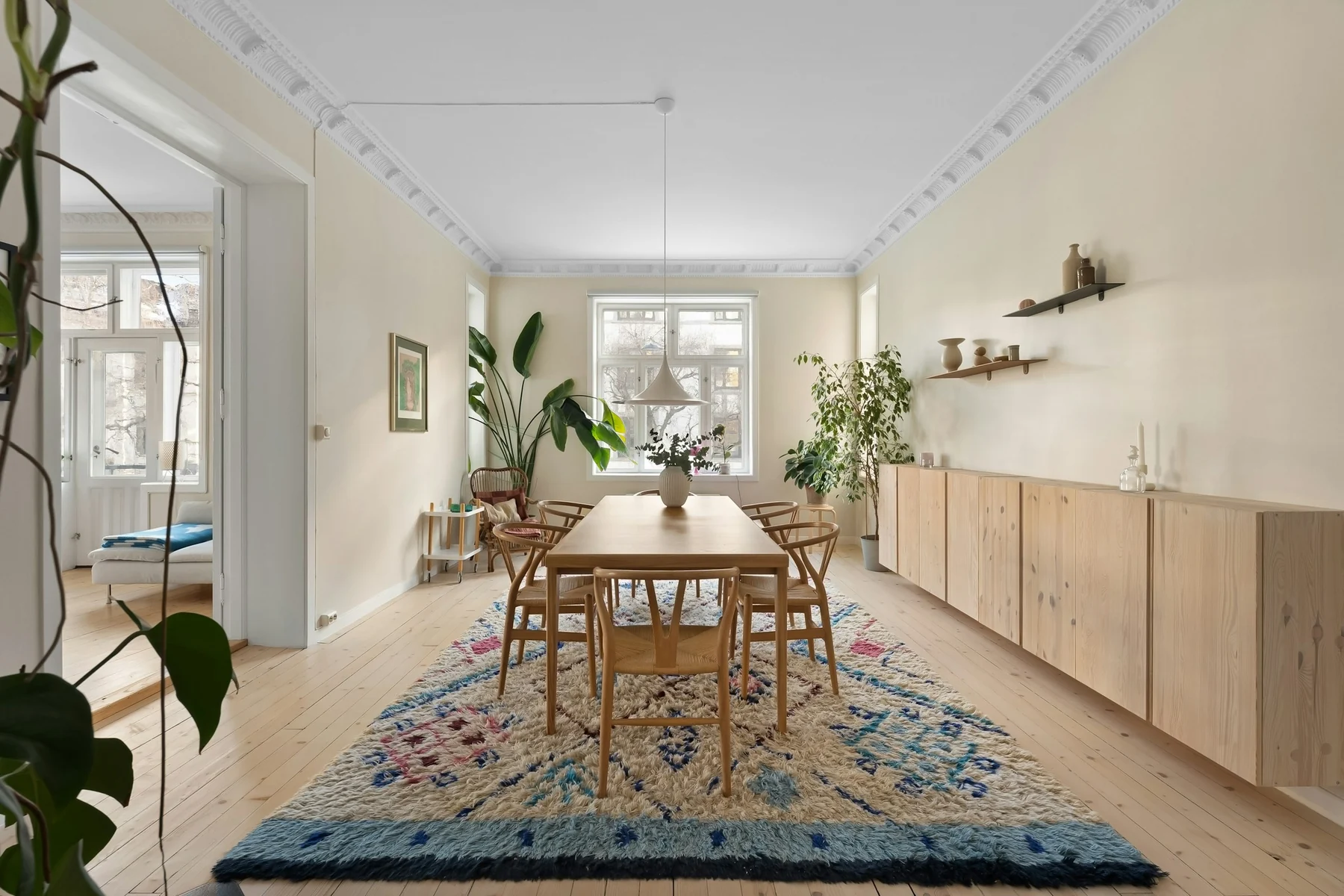
Measure from the table to the pulled-out chair feet
IKEA suggests roughly 60–70 cm beyond the table on each side as a starting point for a dining rug. Use that guideline to shortlist sizes, then measure your own chair movement before deciding. The right margin is the one that works with the furniture and people at your table.[1]
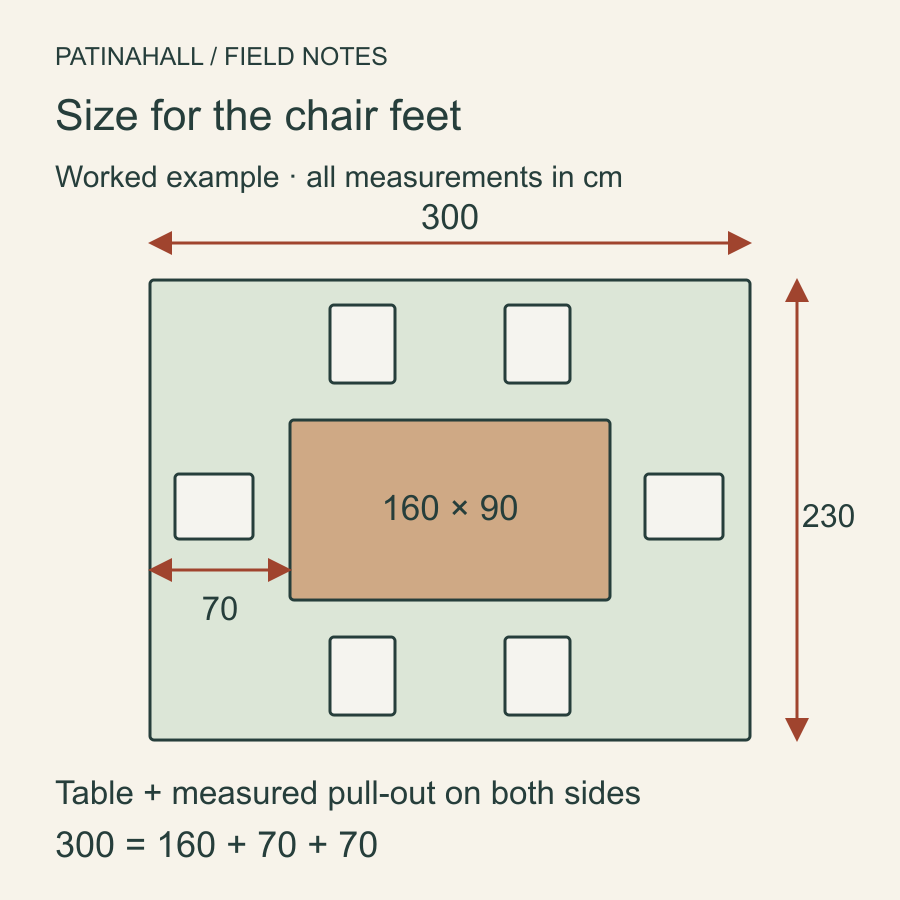
Mohawk Home recommends pulling the chairs out as you would to sit down and measuring between the rear chair legs. This matters with vintage sets: a splayed rear leg, a bulky end chair or a chair that cannot tuck under the apron may occupy more floor than its seat suggests. Measure the farthest foot rather than stopping at the backrest.[2]
- Record table length and width in the arrangement you use most often.
- Pull out each sound chair normally; do not test a chair whose stability is in doubt.
- Measure from the table edge to the farthest chair foot at both ends and both sides.
- Allow some room beyond those feet so they do not stop exactly on the rug edge.
Write down different margins where the arrangement is uneven. A large armchair at one end need not move as far as a smaller chair at the other. For a round table, measure the full circle reached by the outermost feet; if you choose a rectangular rug, check its shorter dimension too.
Work through the size before shopping
For a rectangular arrangement, add the two end margins to table length and the two side margins to table width. These are minimum dimensions for the measured arrangement, including whatever extra edge allowance you recorded. They are not the dimensions of the whole dining area: walking space beyond the chairs is a separate check.
Imagine a 160 × 90 cm table. Your chair check gives a 70 cm margin on every side. The calculation is 160 + 70 + 70 = 300 cm long, and 90 + 70 + 70 = 230 cm wide. A 200 × 300 cm rug has enough length but is 30 cm short across its width.
| Rug dimensions | What the numbers tell you |
|---|---|
| 200 × 300 cm | Too narrow, even with the 300 cm side along the table. |
| 240 × 340 cm | Covers this example footprint; test the room next. |
| 250 × 350 cm | Also covers it; more rug is not useful if a door catches it. |
Treat shop dimensions as orientation-free until you have drawn the rug in plan: a label reading 240 × 340 means the same rectangle as 340 × 240. A six-seater or eight-seater label tells you less. Tables with the same place count can have different widths, bases and chair positions.
Check the longest table you expect to use
Add every leaf you expect to use and repeat the footprint calculation. In the example, one 60 cm leaf makes the table 220 cm long. Keeping the same 70 cm end margins now requires 360 cm of rug length. The earlier 340 cm candidate is too short for that measured arrangement.
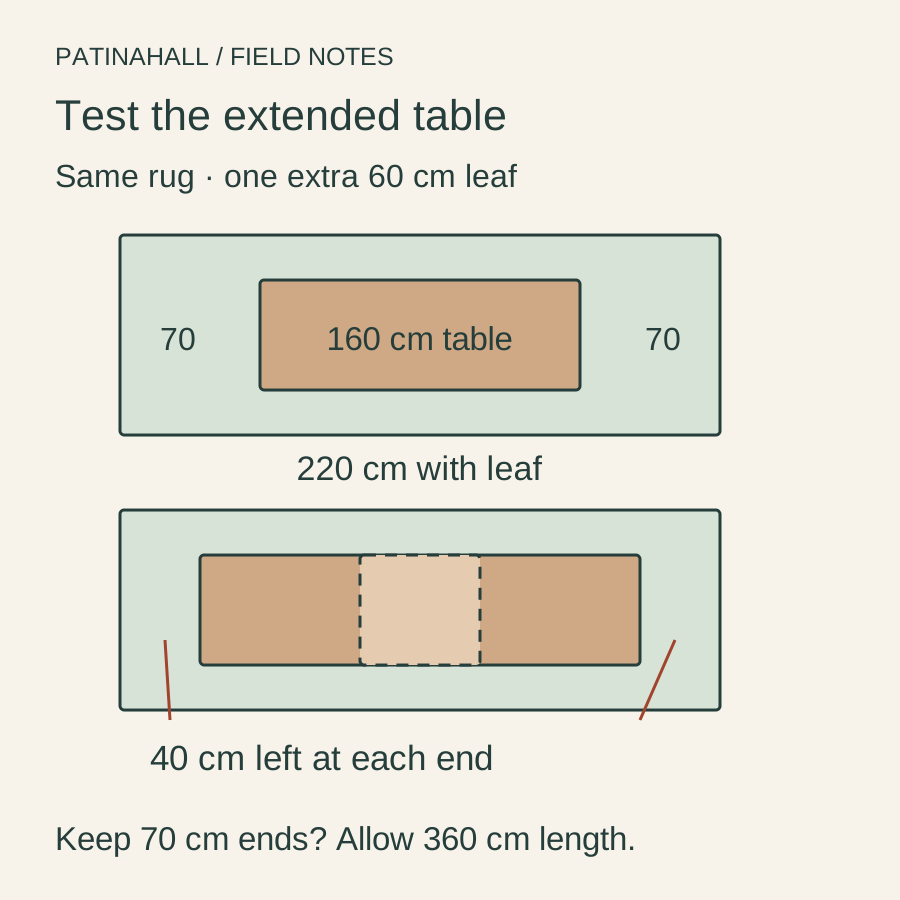
Also check how the table extends. Some tops move while the base stays centred; others move legs or unfold a section. A pedestal that remains centred does not mean the chairs remain inside the same outline. Include an end chair even if it appears only on holidays.
If the longest arrangement cannot fit a suitable rug in the room, choose a deliberate alternative. You might keep the dining floor bare, use a different room for the fully extended table, or agree a manageable rug-removal plan before guests arrive. Moving a loaded table or dragging fragile furniture to roll up a rug is not an occasional-use solution.
Our Guide to measuring a dining table covers table states, occupied places and room access in more detail.
Look at pile, edges and the actual second-hand rug
IKEA recommends a short-pile dining rug because chairs are easier to move and crumbs are easier to remove. That is a useful starting point, but the exact weave and chair feet still need to work together. A thin rug with curled edges can be more awkward than its thickness suggests.[1]
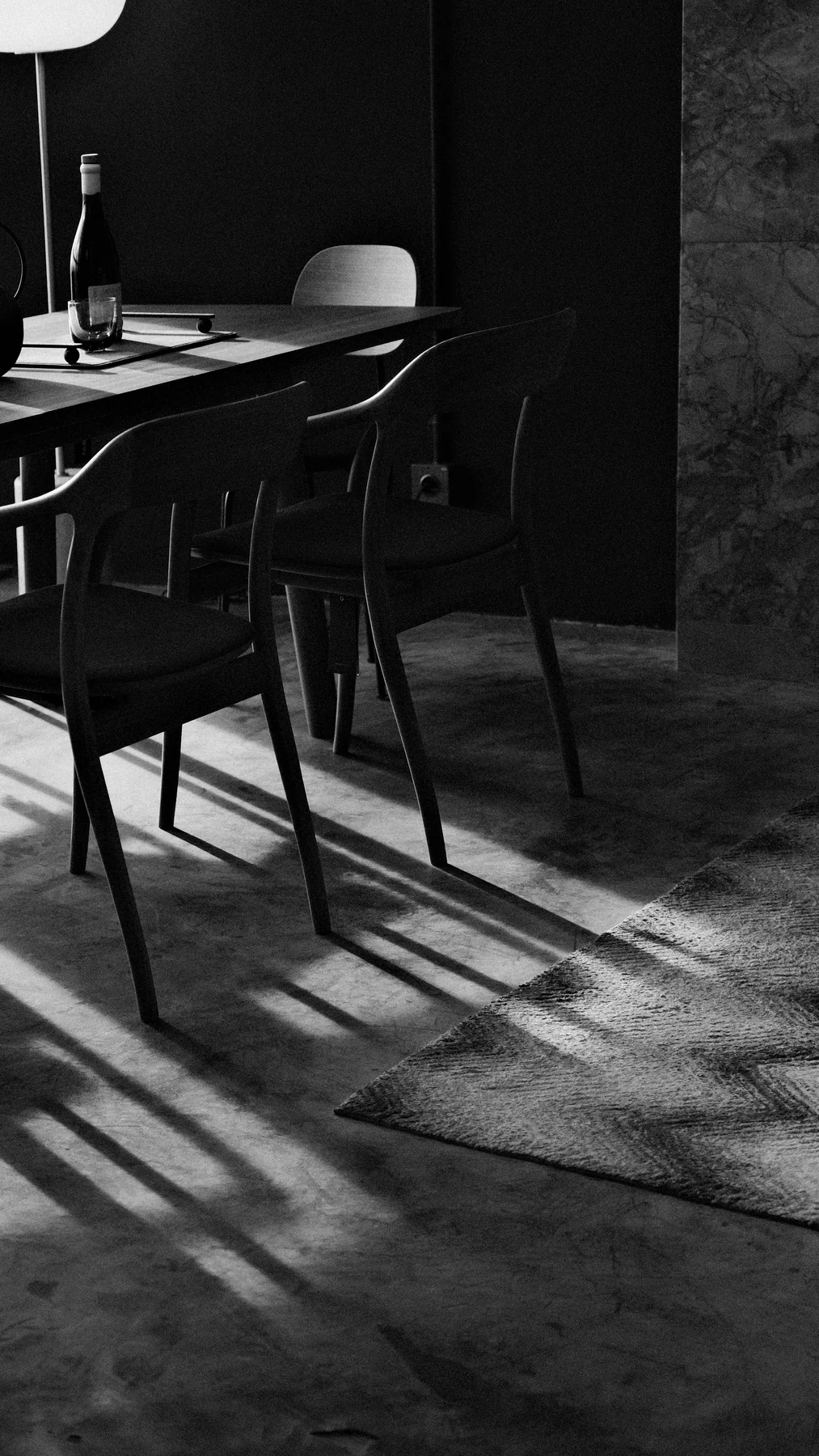
For a vintage or second-hand rug, ask for current measurements along both sides, a view of the entire rug laid flat and photographs of the back, corners and worn areas. Establish whether the quoted length includes fringe. Treat a fringe as an edge detail to keep clear of moving chair feet, rather than extra usable support area.
A worn patch under a table may be visually unobtrusive; a split or raised repair in a chair path has a different consequence. Ask whether the rug lies flat, sheds, has backing damage or has received repairs or cleaning. Photos cannot tell you exactly how a chair will move across it or settle a persistent odour.
Ask the rug or underlay supplier about compatibility with your exact floor finish and any underfloor heating. Include the underlay in your thickness check at doors. Do not assume that every rubber-backed pad is suitable for every floor, or that a cleaner safe for one rug is safe for a faded, repaired or unidentified textile.
Make a room-size trial with the chairs in use
Mark the proposed rug outline using a floor-safe method, such as measuring between existing reference points. If you use removable tape, first confirm that it is suitable for the finish. Keep temporary markers out of the route and remove them after the check.
Open the sideboard doors and room door. Pull out the end chairs and walk the normal route past them. The rug’s job is to support the dining arrangement; its edge should not solve one problem by creating another where someone steps through a doorway.
For an uneven old floor, inspect the furniture and rug together. A thick pile can hide a rocking foot without correcting it, and a soft surface may change how a chair moves. Resolve the furniture’s condition on its own merits before treating a rug as part of the answer.
If the chair arrangement itself is still uncertain, start with choosing vintage dining chairs before ordering the rug.
Ask for the details a size label cannot give
Message to copy
Could you confirm the rug’s actual length and width, whether those measurements include fringe, and the pile plus backing thickness? Please send full front and back views and details of the corners, edges, repairs and worn areas. Does it lie flat, and what is known about its material and recent cleaning? I need a usable footprint of [length × width] under dining chairs; please also advise which underlay suits [floor and heating type].
Choose the rug when its measured surface covers the moving chairs and still works with the doors and routes around them. If only the tucked-in arrangement fits, change the size or the room plan before paying. The right rug should stay quietly under the meal.