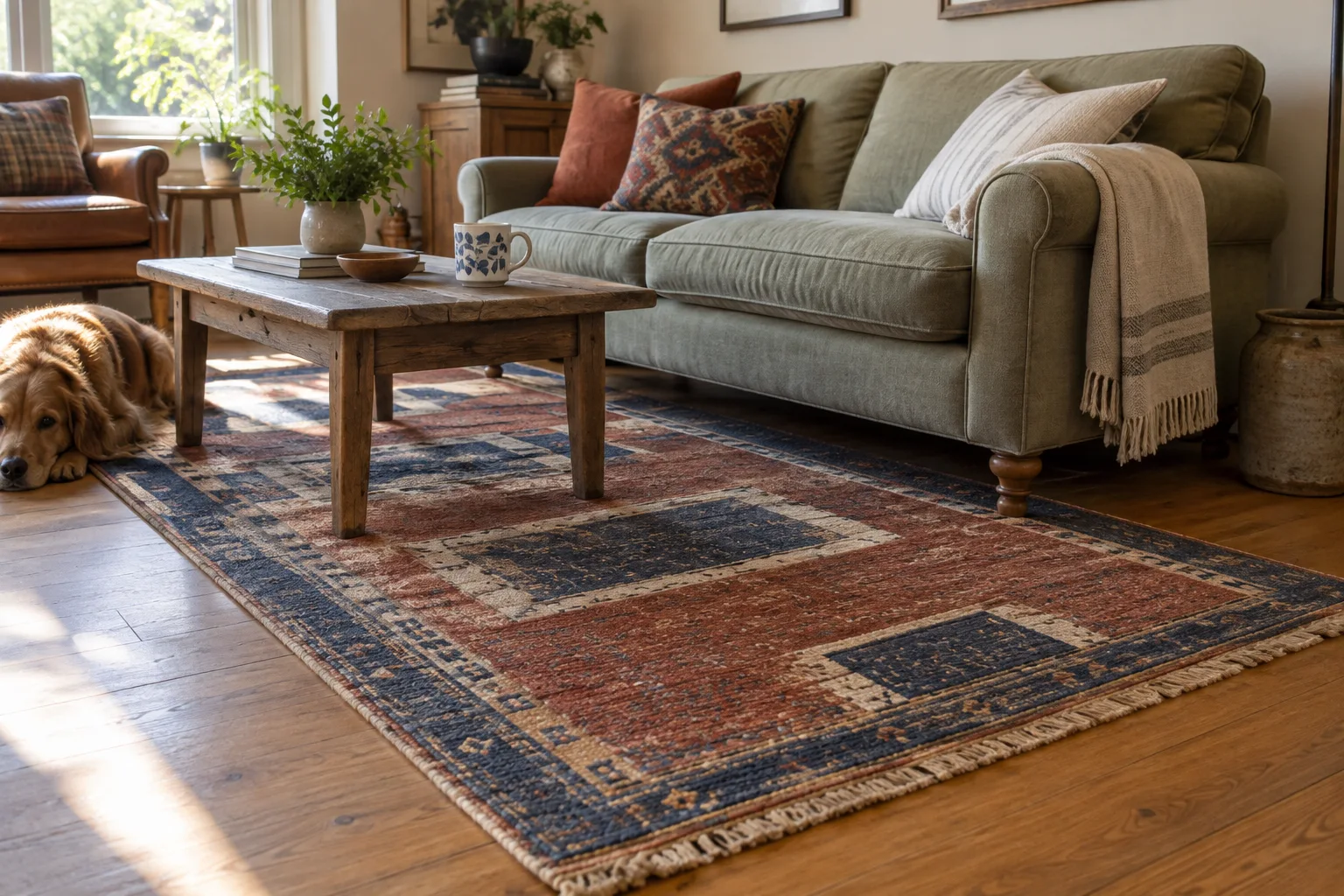
Kilim, knotted pile or braids?
A flatwoven kilim has its pattern in the woven structure rather than a cut-pile surface. A knotted pile rug has yarn tied into a foundation, with the pile forming the walking surface. The Met’s weaving resource distinguishes flatwoven tapestry, knotted pile and wrapped-weft techniques; “flat rug” is too broad to identify all of them.[1]
| Construction | What to look at | Useful room question |
|---|---|---|
| Flatwoven kilim | Both faces, joins between colour areas and edge stability | Will its thickness, grip and texture suit the route and furniture? |
| Knotted pile | Pile wear, exposed foundation, back and ends | Do you want this pile underfoot, and can it clear doors? |
| Sewn braided rug | The fabric braids and the sewing joining adjacent rows | Does it lie flat, and are the connections secure? |
Braided rugs use lengths of braided material joined into a larger surface. BrianAdler’s documentary photograph of a rug being sewn shows the distinction between the braids and the joining operation. An old-looking oval pattern alone cannot establish that a rug is handmade, old or entirely wool.[4]
Look at the structure before the pattern
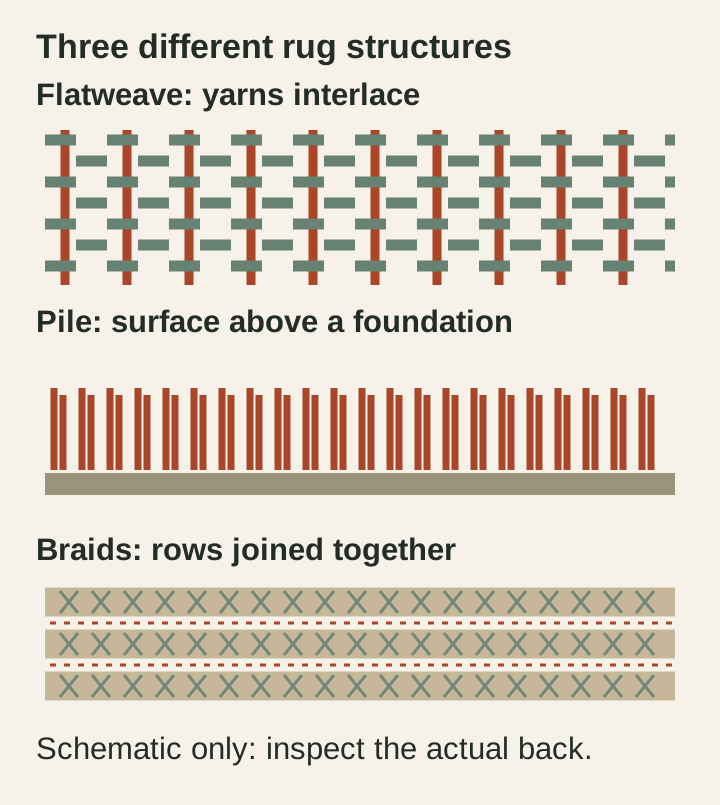
Request the complete front, the complete back, one corner and each end. For a pile rug, ask for a close view where the pile is thinnest. For a flatweave, examine apparent openings in relation to the weave; ask a rug specialist whether they are intentional joins, damage or both. For braids, follow several rows of stitching and ask about resewing.
A backing fabric may conceal the construction. It may have a legitimate purpose, but then the photographs cannot settle what lies beneath. Ask who applied it, when and why. Do not peel it off in a seller’s room or accept “reversible” as a substitute for seeing both faces.
Fringes deserve their own photograph. They may be part of the foundation or a separate applied element. The implications of trimming or repair differ. Have a specialist identify the construction before deciding that shortening an untidy fringe is harmless.
A rug is not always a neat rectangle
Measure the usable body in both directions, with fringes recorded separately. Note any variation between opposite sides, bowed edges or corners that do not lie flat. Tape the outline in the room and test the door swing, chair movement and usual walking route. Include the thickness of the rug and any suitable underlay.
For a dining room, use the dedicated rug-under-table Guide to check chair pull-back. For a sitting room, decide whether the rug should connect the front feet of the seating or form a smaller zone. The right outline is the one that works with your actual furniture, not a stock size chosen before you measured.
Ask for photographs in ordinary daylight from both ends. A pile rug can appear different when viewed in opposite directions. That should prompt a comparison of views rather than an assumption that one half has been recoloured.
The centre can be the least expensive problem
Look for local wear, breaks in the foundation, loose edges, patches, repeated staining and a smell reported by someone who has actually handled the rug. Ask about water exposure, animals, previous cleaning and pest treatment. A seller’s “freshly cleaned” description needs a date, service and account of any remaining issues.
Do not pull loose yarns, flex a brittle area or wet-test colours during collection. A fragile rug may need a different handling method even if it is affordable. CCI’s care guidance addresses support, cleaning and rolling; its preservation advice is particularly relevant when a rug is older or weakened.[2]
A worn area can be acceptable if you like it and the structure is suitable for the intended use. A repair that keeps a rug serviceable is different from one you cannot identify or whose stability nobody will discuss. Decide which kind of purchase you are making.
A 2 × 3 metre rug has 6 m² to clean
Checked on 10 September 2026, Galerie Hamming van Seventer publishes cleaning from €35 per m² for a standard hand-knotted wool rug, with the final price dependent on size, condition, stains and restoration needs. This is one provider’s starting price for a specified service, not a quote for every braid, kilim or fibre.[3]
At that starting rate, a 2 × 3 metre example gives 6 × €35 = €210. Add an illustrative €180 purchase and the subtotal is €390 before any collection, underlay, repairs or other charges. Confirm VAT treatment and the complete written quote. If a damaged edge needs separate work, enter that as a real additional line rather than assuming it is part of washing.
Ask whether the cleaner accepts your exact construction and condition. Washing can remove dirt; it cannot promise to reverse fading, replace missing material or make a weak foundation sound. Treat unusually confident stain-removal promises as questions to clarify, not reasons to skip the inspection.
Make the purchase and care plan together
Ask the seller and cleaner
Please confirm body dimensions excluding fringe, construction, stated fibres and any repairs, odour, water exposure or pest history. I need complete front and back views plus all edges. For cleaning, please quote this exact rug, including assessment, tax, collection, return and separately priced repairs, and explain any limits before treatment.
Choose the rug when the structure suits the room and the complete cost still makes sense. Let an interesting old pattern be the reason you enjoy it, rather than the reason you overlook the part that holds it together.