Start with the 3107 you are being offered
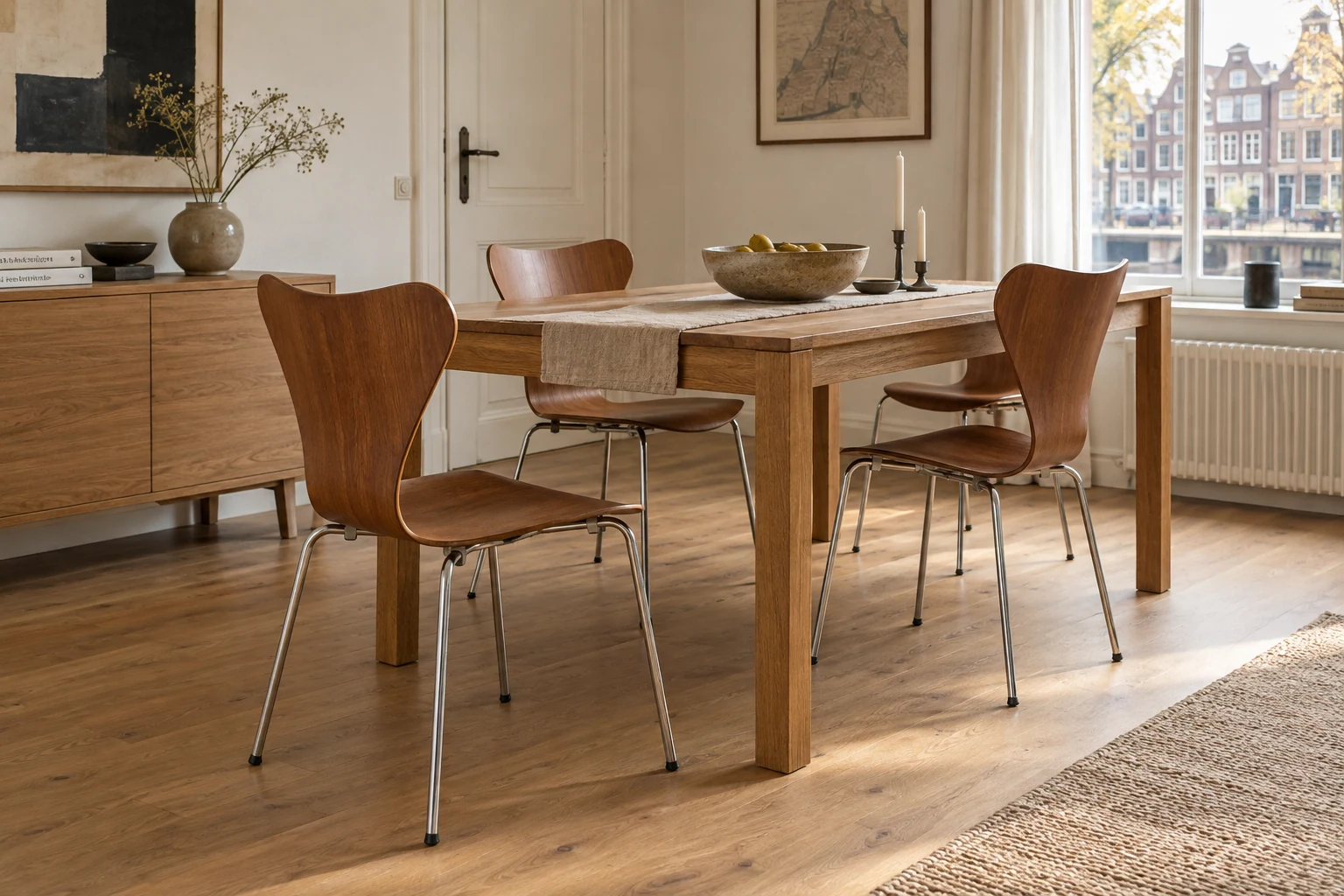
Fritz Hansen identifies the armless 3107 as part of Arne Jacobsen’s Series 7 family, introduced in 1955. Its current account describes a shell made from nine layers of pressure-moulded veneer and a tubular-steel base mounted beneath the seat through a circular disc. That explains why the underside matters as much as the familiar butterfly outline.[1]
Use that record as a model reference, not a date stamp for the seller’s chair. Ask for a whole view, an underside view and any label or stamped information in its actual position. Keep the claimed production date separate from the design date. A later base, new finish or renewed upholstery should be described rather than hidden inside the word “original”.
Also establish which version you want. The armless 3107, an armchair and a chair on an office base do different jobs. If the offer has upholstery, find out whether it was supplied that way or added later. A name shared across a family does not make all its chairs interchangeable around your table.
Look at the shell before the colour
Start with the narrow transition between seat and back, the exposed perimeter and the underside around the mounting area. Ask for clear photographs of any split, opening between layers, added plate, unusual fastener or repaired area. You are collecting the location and extent of a concern; the photographs alone cannot establish its strength.
An edge scuff and a separation in the plywood are different findings. Likewise, a finish scratch is not the same as a crack running through the shell. Do not ask the seller to bend the back repeatedly to demonstrate that it is “still flexible”. The maker’s description of designed flexibility is not a method for testing an old chair.
The base deserves a separate look. Record distortion, missing feet, corrosion and any reported movement at the seat connection. If a chair feels insecure, stop the trial and have the assembly assessed. A fresh coat of paint or new fabric can improve appearance while leaving that question unanswered.
For arranging useful views of a suspect area, use the furniture photograph Guide. Keep the whole chair in the record so a close-up cannot become detached from the piece it belongs to.
Measure the seat, not the top of the back
The current 3107 configuration inspected on Fritz Hansen’s site has a 46 cm seat height. That is one current specification, not a measurement to assign to an older set. Replacement bases, different versions and added upholstery are reasons to measure the actual furniture.[1]
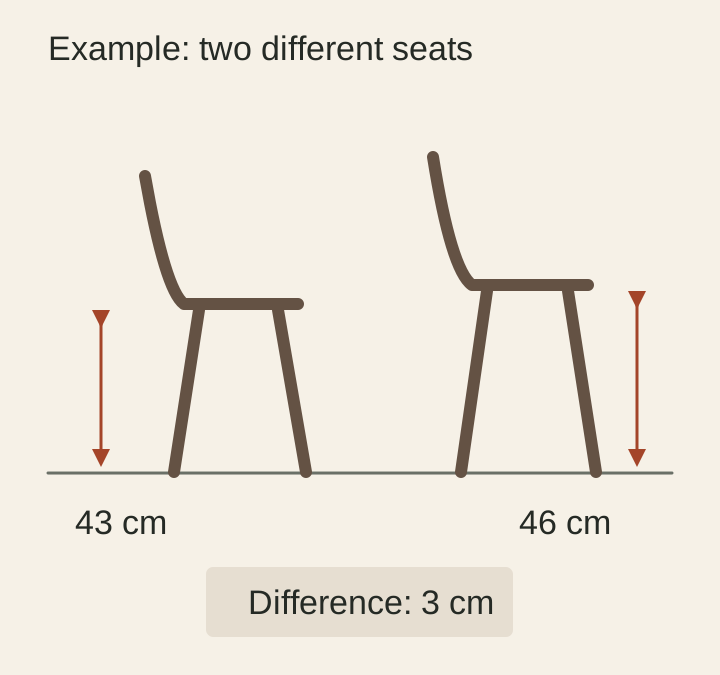
Imagine a six-chair offer: four seats measure 46 cm and two measure 43 cm. That 3 cm difference may matter more at dinner than a slight colour mismatch. Try the lower pair with the intended users and table. Ask why they differ before deciding whether the grouping suits you.
Measure width and the position of the legs too. On the 3107, the maker notes that the legs project just beyond the seat. Your drawing should therefore include the base when checking neighbouring chairs and the table legs. A seat-width calculation alone can miss the collision.[1]
Make a mixed set look deliberate
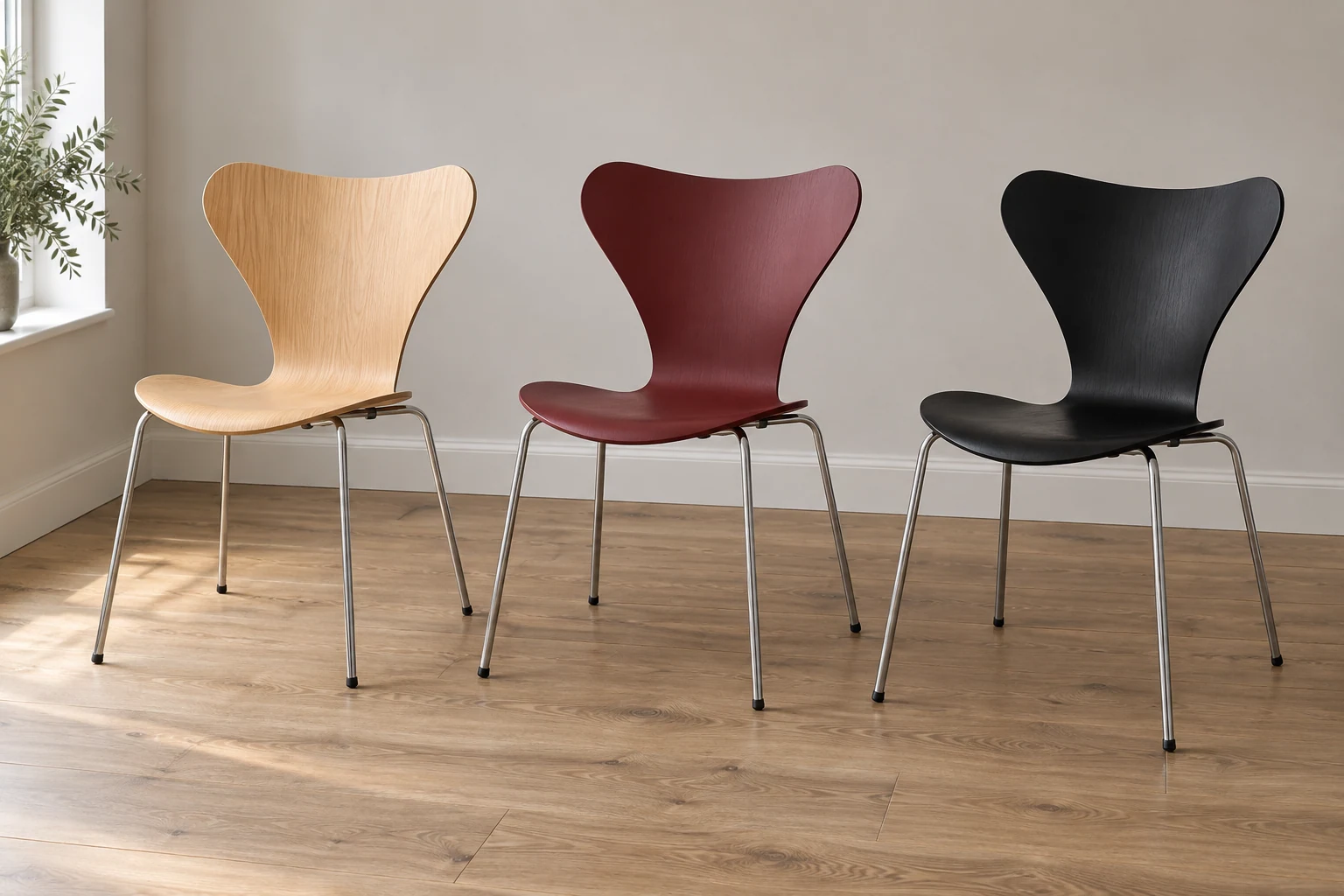
A mixed set can be part of the pleasure of buying used Series 7 chairs. You might repeat one colour on opposite sides of the table, or use a darker pair at the ends. The consistent outline gives you a clear starting point without demanding that every surface look newly matched.
| Record | What to compare across the set |
|---|---|
| Shell and finish | Visible wear, splits, repairs, repainting and any added upholstery. |
| Base and feet | Form, height, distortion, missing glides and disclosed replacements. |
| Sitting position | Actual seat height and width, then a trial at the table. |
| Object history | Marks in place, purchase records and dates or scope of work. |
| Remaining work | Which chair needs it, who will do it and the complete price. |
Photograph the group together and number it in your notes. If chair 4 has a repair and chair 6 has a different base, those facts should still be clear on collection day. A single photograph of the best example cannot describe the whole purchase.
Check what ReNEW actually offers
Fritz Hansen’s ReNEW material describes a 2024 project involving 100 Series 7 chairs, including chairs used by Topsøe since 1983. The work included updating low bases and changing colours. This is a useful documented example of why the appearance and sitting height of an old chair need not describe its original configuration.[2]
The service distinction matters. The Refurbish programme is described as serving commercial clients in Europe, with options for chairs dating back to 1955. The same ReNEW account says spare parts are offered to private and commercial customers and includes Jacobsen stacking chairs from 1968. Do not read the earlier date as a promise of a full factory restoration for your private purchase.[2]
The separate Repair page also identifies stacking chairs from 1968 within its scope. Send the actual chair record to Fritz Hansen or a suitable repairer and ask which parts and work they can supply. A programme description does not guarantee that a particular damaged shell is repairable or that any advertised spare fits.[3]
Buy the set you can actually use
Compare the total for the useful set: purchase, necessary repair, replacement feet or other confirmed parts, upholstery if wanted, and collection. If one chair remains unresolved, decide whether the remaining number still works for your table. A cheap sixth chair is not helpful if your purchase depends on six usable seats.
A message for the seller
Could you number the chairs and send the whole set, each underside and any marks in place? Please give the seat heights and note which shells, bases, feet, finishes or upholstery have been repaired or replaced. For any chair that moves or has a split, I would like the repair details and an assessment before arranging a normal seating trial.