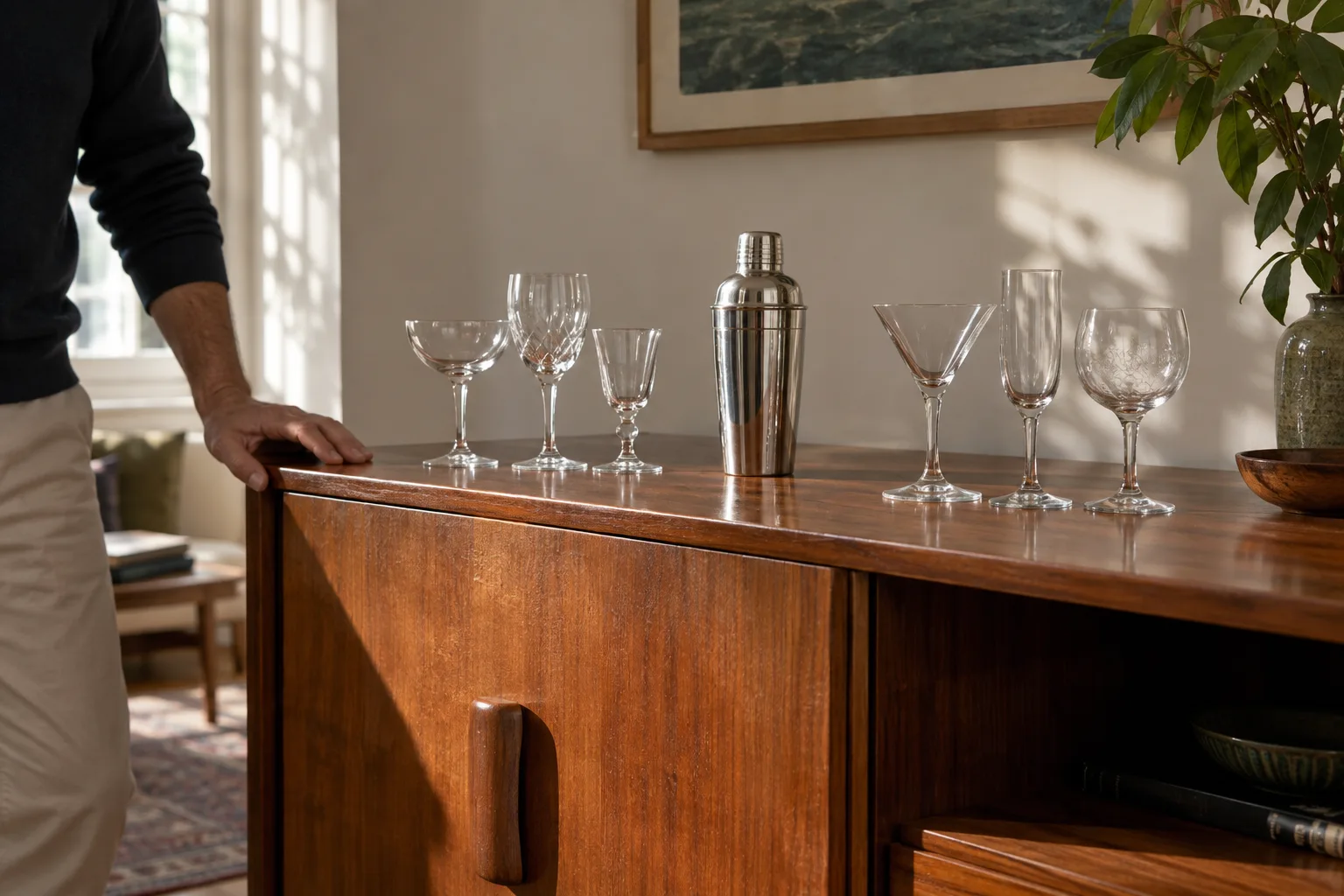
Start with what you pour
For a small household, a few practical glasses and a working shaker may be more useful than a boxed service with several shapes you never use. Write down the largest group you usually host. Decide whether matching examples matter to you or whether a deliberately mixed group would be easier to live with.
Compare the bowl and usable capacity of each glass. Two glasses of equal height can take quite different quantities. Ask the seller for dimensions and an existing capacity specification where available. Do not ask them to fill fragile or uncertain pieces simply to satisfy a measurement request.
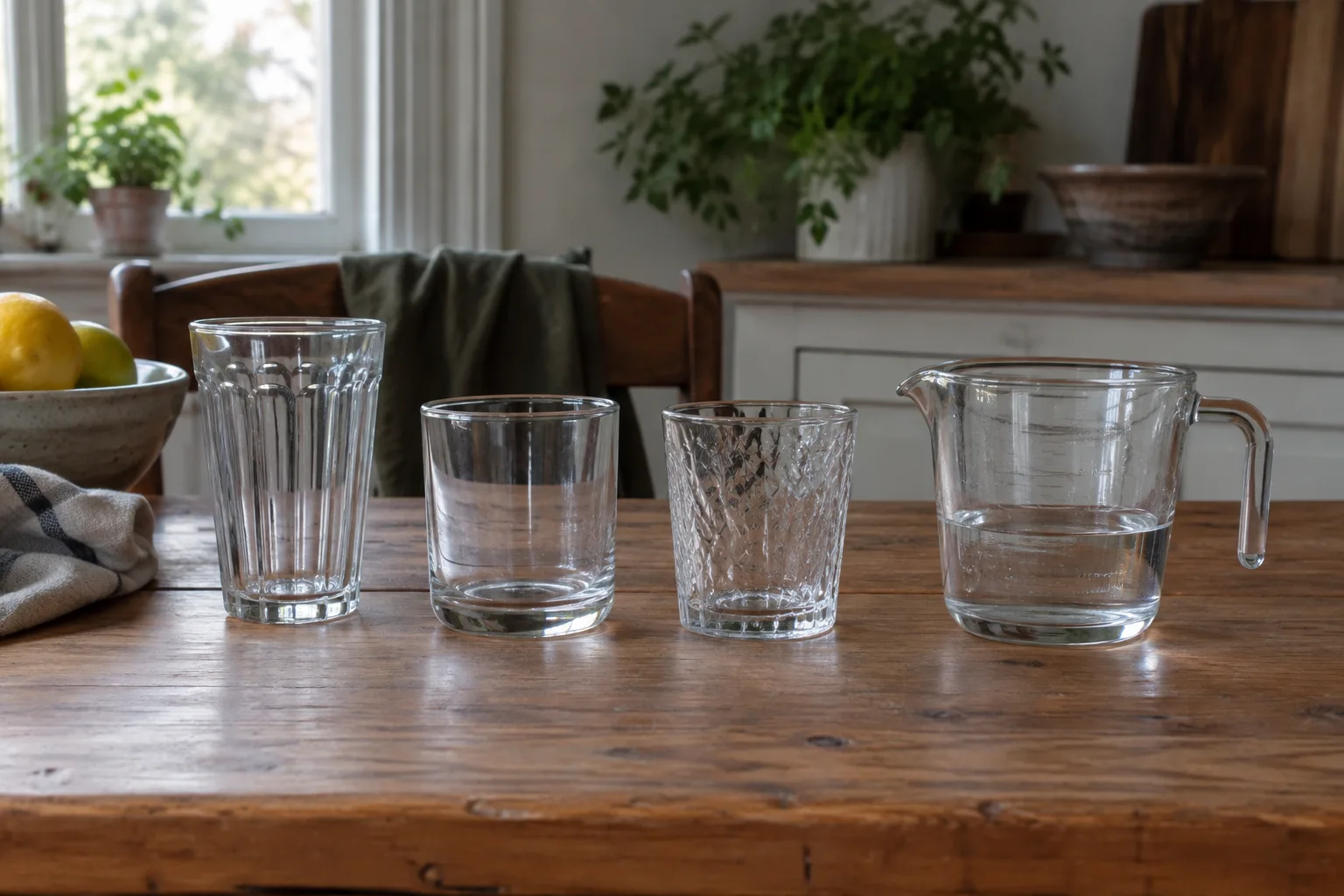
If you mix glasses, make the choice visible: similar drinking purpose and a comfortable range of sizes, with enough difference that guests can tell them apart. A near-match sold as a complete original set deserves closer scrutiny.
Inventory the set before comparing prices
| Type | Listed count | Inspection result to establish |
|---|---|---|
| Small stemmed glasses | 4 | Are all four the same bowl and capacity? |
| Tumblers | 4 | One rim chip and one loose repair would leave two for use. |
| Stoppered bottle | 1 | Is the stopper appropriate, and is the intended use established? |
| Shaker | 1 | Do the parts belong together and separate normally? |
This is a hypothetical inventory, not a condition report on the pictured objects. Use it to calculate what you are really buying. If two glasses are display-only, compare the price with six usable glasses plus two decorative objects, not with an immaculate service for eight.
Search for replacements before making completeness a condition of the purchase. An exact stem profile, foot diameter or engraved pattern can matter more than a broadly similar silhouette. Check whether an available replacement is the same size and production version.
Rims and joins matter more than sparkle
Ask for each rim in clear light, the stem-to-bowl and stem-to-foot areas, the base and any decorated surface. Record chips, cracks, repairs and abrasion without running a finger around a potentially sharp edge. A fine line may need professional examination; neither a ringing sound nor a good photograph proves an object is sound.
For shakers and other tools, identify the components and material or coating where documented. Ask whether the lid, strainer and cap fit and separate under ordinary use. Do not force a stuck lid or assume a polished exterior tells you the condition inside.
CCI describes ceramics and glass as hard but brittle, with cleaning choices affected by decoration and condition. A visibly repaired or fragile piece should not be treated like a modern dishwasher-safe glass.[2]
Display and drink use are different purchases
Health Canada notes that distinguishing lead crystal, lead-free crystal and ordinary glass can be difficult. It recommends lead-free tableware and lead-free storage, and limits any use of lead crystal to occasional serving rather than storage. The separate crystal Guide explains this decision in more detail.[1]
Do not infer food-contact suitability from a brand name, the word “vintage” or a seller’s account that the family always used it. Ask for the exact product documentation if use matters. A decorative finish around the rim also deserves a specific enquiry; attractive gilding is not a material test.
A useful set enquiry
Please list every included piece by type, dimensions and known capacity. Which are matched originals, replacements, chipped or repaired? Please show the rims, stems, feet, marks and tool interiors. What documentation supports the maker, material and intended use? I am buying for [serving/display], so those distinctions affect my offer.
Choose the set you will comfortably use and maintain. If a remarkable decanter belongs on the shelf rather than in the drinks routine, that can still be a good role for it.