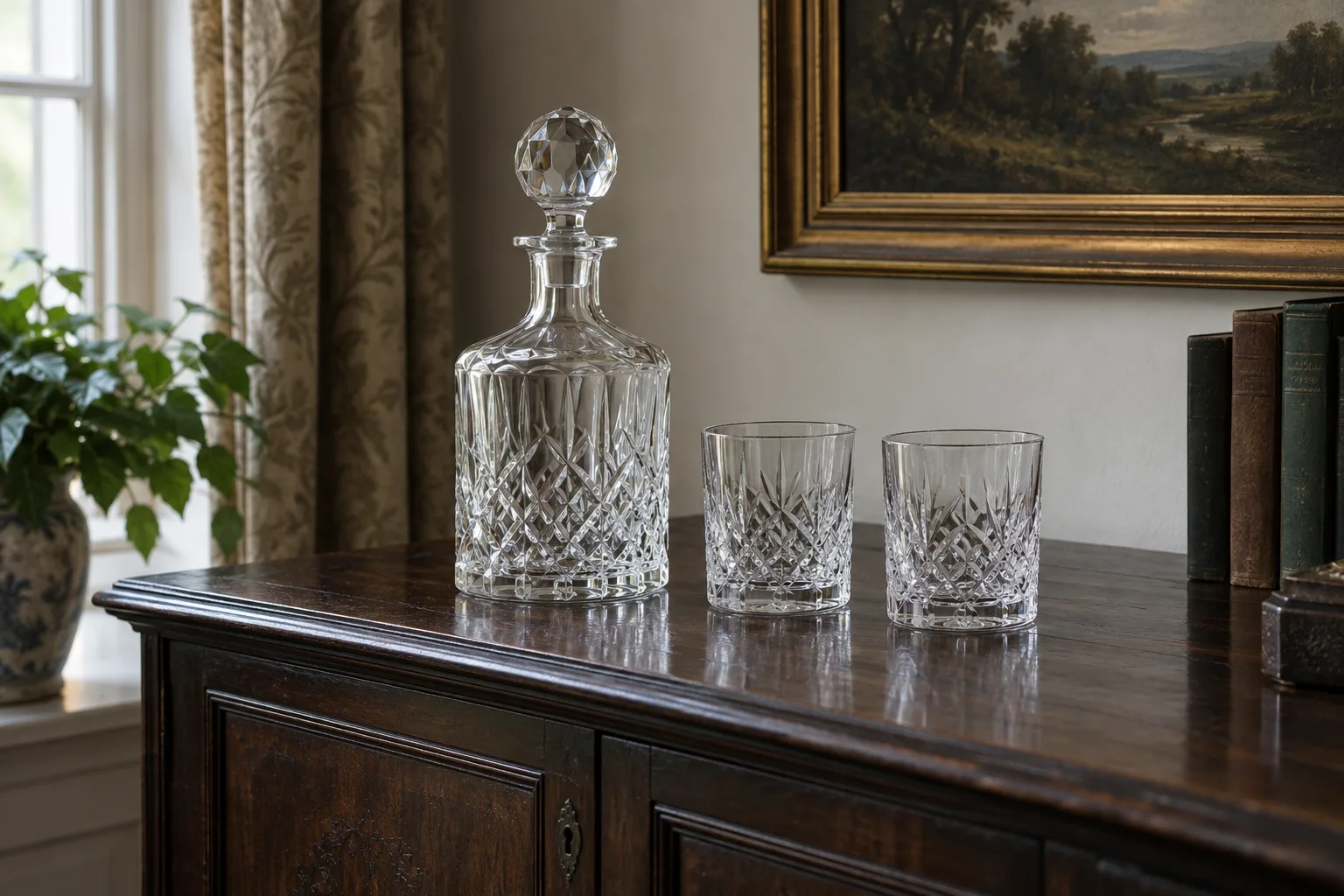
Crystal is a description to investigate
A seller may use “crystal” for several kinds of glassware. Begin with the maker, exact range and any material specification. Ask whether the information belongs to this production period: a current lead-free version does not establish the composition of an older object with the same familiar name.
Weight, sparkle, a resonant ring and a sticker can help describe an object, but none supplies a lead-content or migration result for it. An unlabelled inherited decanter may simply remain unconfirmed. That is enough information to choose a different storage vessel without pretending to have identified its composition.
The time in contact changes the decision
Health Canada explains that the amount of lead transferred can depend on the food or drink and the contact time, with acidic contents and longer storage increasing concern. Its advice particularly emphasises lead-free tableware for infants, children and pregnant people. If you are concerned about past exposure, discuss it with a clinician rather than trying to calculate a personal dose from the object’s appearance.[1]
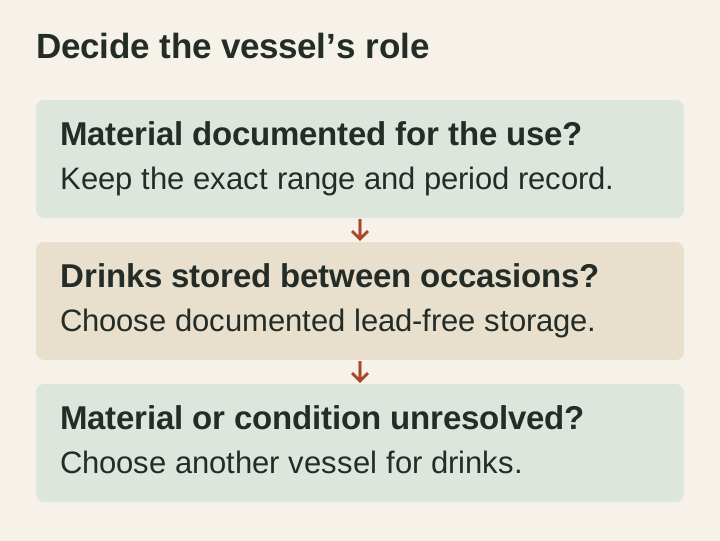
| Intended use | Practical decision |
|---|---|
| Keep spirits in a decanter between occasions | Use a documented lead-free container with an appropriate closure. |
| Occasional serving from confirmed lead crystal | Read the current official and maker guidance; this is not a zero-exposure claim. |
| Routine drinks for children or pregnancy | Choose documented lead-free tableware. |
| Unknown old glass, no reliable material record | Use another vessel for drinks; retain this one for display if you wish. |
There is no minute-by-minute safe-use timer in this Guide. The ordinary household solution is to remove the uncertainty from the routine. Keep the bottle or another suitable vessel in service and enjoy the old glass as an object.
A wash cannot supply missing material evidence
Cleaning can remove dirt. It cannot establish composition, certify a repaired vessel for use or turn an unsuitable storage container into a suitable one. Do not rely on a home swab result as a complete assessment of what may migrate into a drink. If testing is important, ask an appropriate laboratory what question its method can answer for this exact object.
CCI’s glass and ceramics guidance distinguishes stable objects from pieces with fragile decoration, deterioration or repairs. Those conditions affect whether and how cleaning should happen. Avoid soaking an old decorated or repaired object on the assumption that all clear glass tolerates the same treatment.[2]
A stuck stopper creates a different problem: force may damage the neck or stopper. Ask a glass conservator about a valuable or fragile piece. Opening it is not urgent if its intended role is display.
Keep the object and the decision together
Write down the maker claim, known range, approximate production information, condition and the source of any material statement. If you choose display-only use, keep that note with the object so a future owner does not mistake an empty drinks-shaped vessel for a recommended storage bottle.
Ask before buying for use
I want this [glass/decanter] for [specific use]. Do you have documentation for the material and production version, and are there chips, cracks, repairs or deteriorating decoration? Please distinguish what is documented from what is assumed. If the material cannot be established, I will assess it as a display object.
The most useful decision may be simple: buy the beautiful piece if you want to look at it, and choose a well-documented modern vessel for the drink. You do not have to settle a laboratory question to set up a sensible home routine.