The most useful photograph may be below the top
Travertine can give an ordinary room a wonderfully quiet centre: a broad pale surface, visible variation and a base that feels almost architectural. Online photographs tend to linger on that surface. The more consequential buying question is often underneath it.
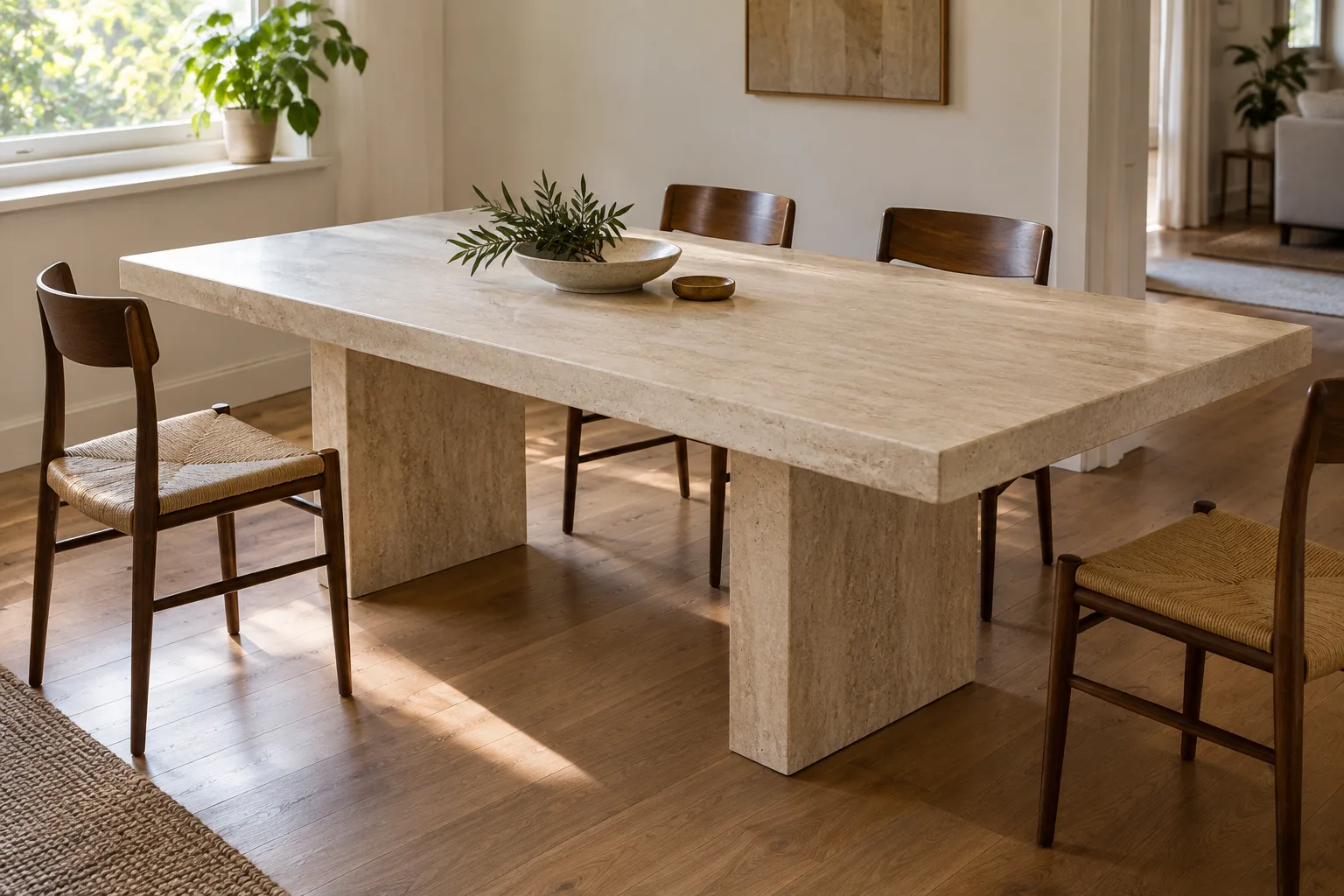
Ask for a complete side view and an accessible underside view taken safely by the seller. You want to understand the support arrangement: where the top bears on the base, whether fittings or locating features are present, and whether any parts have been changed. Do not ask someone to tilt a heavy table precariously to get the picture.
| Part | Question to resolve |
|---|---|
| Top | Stone throughout, stone facing over a core, or another construction? What supports that description? |
| Base | How many parts, of which materials, and are they the intended set for this top? |
| Connection | How are the top and supports located or joined? Are the relevant fittings and instructions present? |
| Earlier work | Have breaks, joints, supports, fillings or surface finishes been repaired or replaced? |
A thick-looking edge is not a complete construction record. Ask whether its visible depth is the slab thickness or includes an edge treatment or built-up construction. Likewise, a stone-faced base should be described as such. Facing is a construction choice to evaluate, not a reason to call the whole table false.
A joint can be the design
Agapecasa’s account of Angelo Mangiarotti’s 1971 Eros tables explains a visible gravity joint, with truncated-cone legs and the weight of marble contributing to the system. It is a specific engineered relationship between geometry and material. It does not establish that an anonymous pale table is Eros, or that any heavy top is safe on any similar-looking base.[1]
That example changes the questions worth asking. If the offered table is attributed to a particular design, compare its actual connection with the appropriate documented reference. If it is unmarked, ask for a plain explanation of its own assembly rather than importing a famous designer’s explanation.
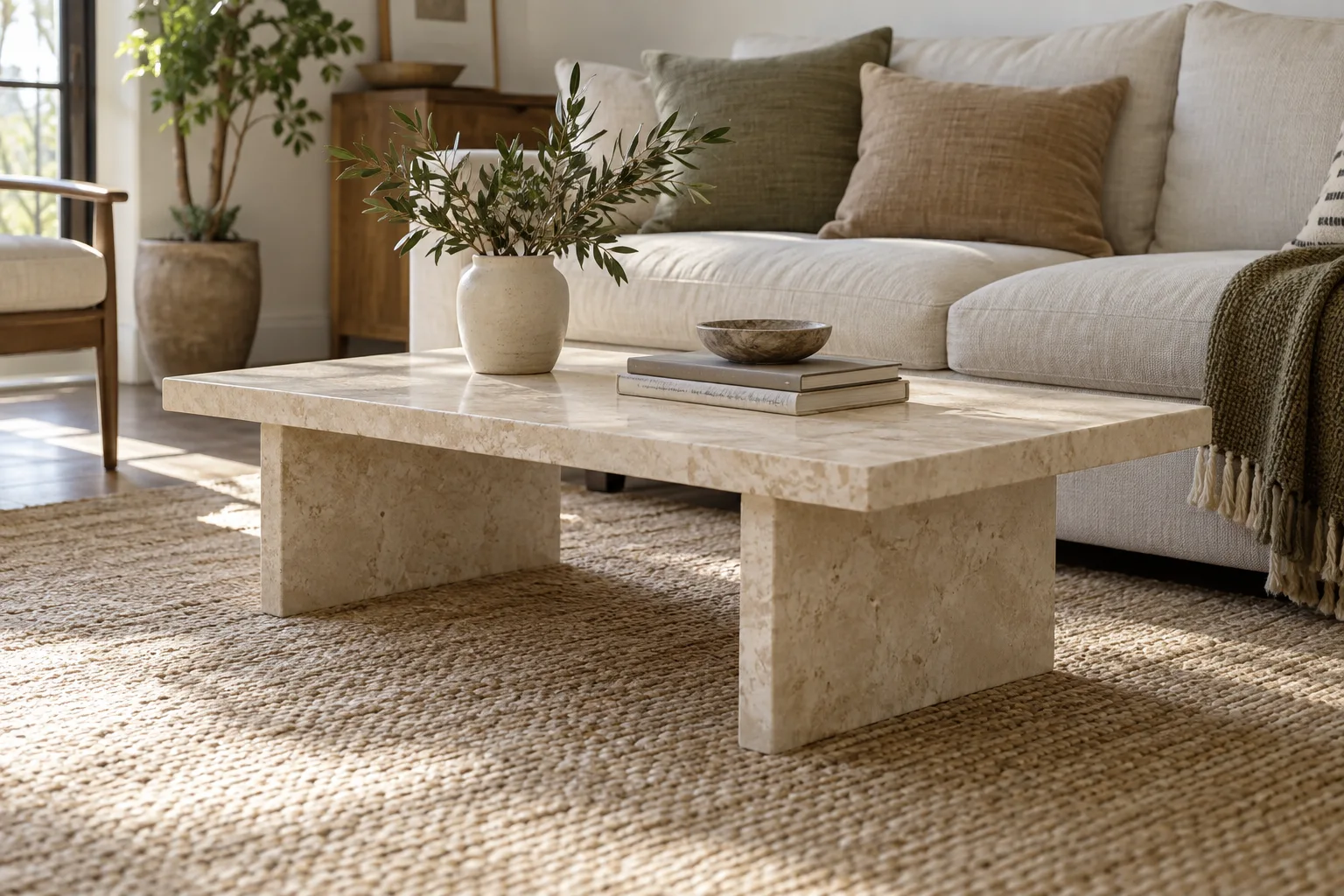
A seller may say that a top simply lifts off. Confirm how the components are meant to sit together and whether anything is missing. Have uncertain stability or repaired load-bearing areas assessed by a suitable furniture or stone specialist. Weight should not become the reason to skip that assessment.
Do not plan to improve the table by substituting a larger top, moving its supports or adding improvised adhesive. A change in span, bearing or balance is a new structural question. Ask the specialist to assess the complete proposed arrangement before treating it as a harmless styling adjustment.
What does “Italian travertine table” establish?
The phrase can bundle together a stone description, the country where the furniture was made, a period and sometimes a designer’s name. Ask the seller to separate those claims. Evidence for the material does not automatically establish where the table was manufactured; an Italian purchase receipt may record a sale without identifying the maker.
For a named design, ask for the relevant model reference and the evidence linking this example to it. Compare the whole form, dimensions, supports and construction. A visual resemblance is a starting point for research, especially where similar stone furniture was sold without a prominent designer attribution.
An unmarked table can still be a good purchase. Decide whether its proportions and condition justify the price without an unproven name. If the claimed designer is what makes the price acceptable, resolve that claim before buying rather than hoping to document it afterwards.
For pits, stains, chips and earlier surface repairs, use our stone-top inspection guide. Keep that condition assessment alongside the construction record, so an attractive top does not distract from a doubtful support.
Ask which finish or treatment is known. The Natural Stone Institute distinguishes stains from acid etching and cautions that sealing does not make stone stain-proof. Do not buy on the assumption that a coating will turn an unknown old top into a maintenance-free kitchen surface.[2]
Give the base as much room as the chairs
For a dining table, draw the supports on the floor plan as well as the outer top. Try a chair at the end and along the side. A broad slab base can meet your feet or prevent a chair coming close even when the tabletop looks generously sized.
For a coffee table, check the overhang from your usual seat and the path around its corners. Ask whether the placement gives you the reach you want without bringing a heavy edge into the main route across the room. A photograph of the table alone cannot show either relationship.
Before arranging delivery
Please identify each component and explain the intended assembly, known repairs and any removable parts. Can a specialist carrier confirm the handling, packing, access and reassembly method for this particular table, including responsibility for the final placement?
Get that handling plan and price before committing. Measure access using the actual components the carrier expects to move, without assuming that separable pieces are easy pieces. The table becomes a practical purchase when its construction is understood, its place works and the journey into that place has been priced.