
Begin with the job, viewing side and exact room
Write what the screen must do and from where it will be seen. A dressing screen may need seated and standing privacy from one route; a backdrop needs a coherent face from the camera or desk; a divider may be visible from both rooms; a screen hiding storage still needs ordinary access behind it. The useful height and width come from that task, not from a generic room-divider size.
Photograph or sketch the intended area from every ordinary viewing position. Mark the floor, nearby doors, furniture, radiators or other heat sources, windows, curtains and the route people use. Decide whether the screen will remain in one shape or be opened and folded regularly; repeated movement makes hinge and covering evidence more important.
Write the room brief
- PurposePrivacy, visual zoning, backdrop, concealment or another exact job.
- ViewersWho needs the screen to block or reveal what, from which seated, standing or doorway position?
- Visible facesWhether one face, both faces and the outer edges belong to the finished room.
- MovementA fixed display shape, occasional repositioning or regular folding and opening.
- Household settingFloor, busy route, doors, curtains, direct light, heat and any ordinary contact risk.
Room boundary
Privacy is a sight-line test, not a width label
Trace the real viewer, screen and background relationship at the heights and positions that matter. A product photograph cannot promise privacy, stability or usefulness in another room.
Inventory the complete multi-panel object
Ask for one photograph showing the complete screen in a safe working shape, then give every leaf a stable identifier from left to right on a chosen face. Keep that order through the front, reverse, edges, top, lower corners, feet and hinge close-ups. If the panels detach by design, identify each physical panel and every pin, cap, foot, latch, stay or cover supplied with it.
The Met records Four-leaf folding screen 69.9.1 as one object made from carved and gilded walnut and poplar with silk-covered panels. Its catalogue gives both overall dimensions and an individual panel width. That exact record is a useful model for keeping object, panel count, material and measurement fields distinct; it does not describe another screen.[1]
| Record | Show on every panel | Keep unresolved |
|---|---|---|
| Identity | Panel number, order, top/bottom and face A/face B | Whether a detached or altered panel began with this screen |
| Frame | Rails, stiles, corners, feet, losses, repairs and movement reported by the seller | Hidden joinery and present structural capacity |
| Panel field | Material as known, attachment, tension, tears, punctures, stains, fading and losses | Fibre, coating, cause or treatment from appearance alone |
| Hinges | Location, direction, pins, fasteners, missing parts, repairs and useful travel | Originality, remaining life or safe adjustment |
| Loose parts | Every removable pin, cap, foot, stay, bag, cover or later support included | Compatibility of an untested or unidentified part |
A repeated decorative pattern can make leaves look interchangeable when they are not. Keep orientation and hinge sequence explicit. A missing panel, reversed hinge or later replacement may still make a useful screen, but the offer and the shape it can form must be described honestly.
Observe every hinge and fold without forcing it
Begin with the screen supported in the shape the seller already uses on a clear, level area. Watch the whole object while one joint changes slightly under ordinary handling. Record which way each hinge moves, whether alternating folds are possible, where useful travel stops and whether the panels sag, twist, meet or pull on their covering. Do not use a buying inspection to discover a maximum by pressure.
The Met's handling manual gives a carefully sequenced method for one specific type of six-panel East Asian screen and treats folds and hinges as structural, damage-sensitive parts. That procedure is not a consumer instruction for this object class; its useful lesson is that screen type and construction determine handling, so an unknown Western hinge, textile panel or paper joint should not inherit another screen's method.[2]
Canadian Conservation Institute guidance asks handlers to identify and immobilise free-moving attached sections, including hinged elements, before movement. For a buyer, this supports an inventory and carrier question—not permission to strap, clamp or improvise on an exact fragile screen.[3]
Inspection boundary
Not operated is a valid result
Stop at resistance, frame movement, hinge pull, tearing, flaking decoration or uncertainty about support. Do not oil, bend, tighten, remove pins, reverse a panel or force the object flat. Record which joint was not operated and give the next decision to an appropriate furniture or conservation professional.
Measure the closed bundle, reported span and working shape
Ask what every advertised dimension means. Overall height is usually straightforward only after feet, finials and meaningful variation are included. Width may mean all leaves laid in one line, the distance across a displayed zigzag, the sum of panel widths or a catalogue convention. Depth may mean frame thickness rather than the floor area created by angled leaves.
| State | Measure | Decision it supports |
|---|---|---|
| Closed or transport bundle | Maximum height, width and depth in the carrier-accepted state | Protected route, package and temporary support |
| Reported or permitted span | End-to-end width only in a state the exact hinges reach without force | Understanding the listing record, not assuming self-standing use |
| Chosen working shape | Maximum height plus straight room width and front-to-back depth | Floor footprint, sight line, furniture and circulation |
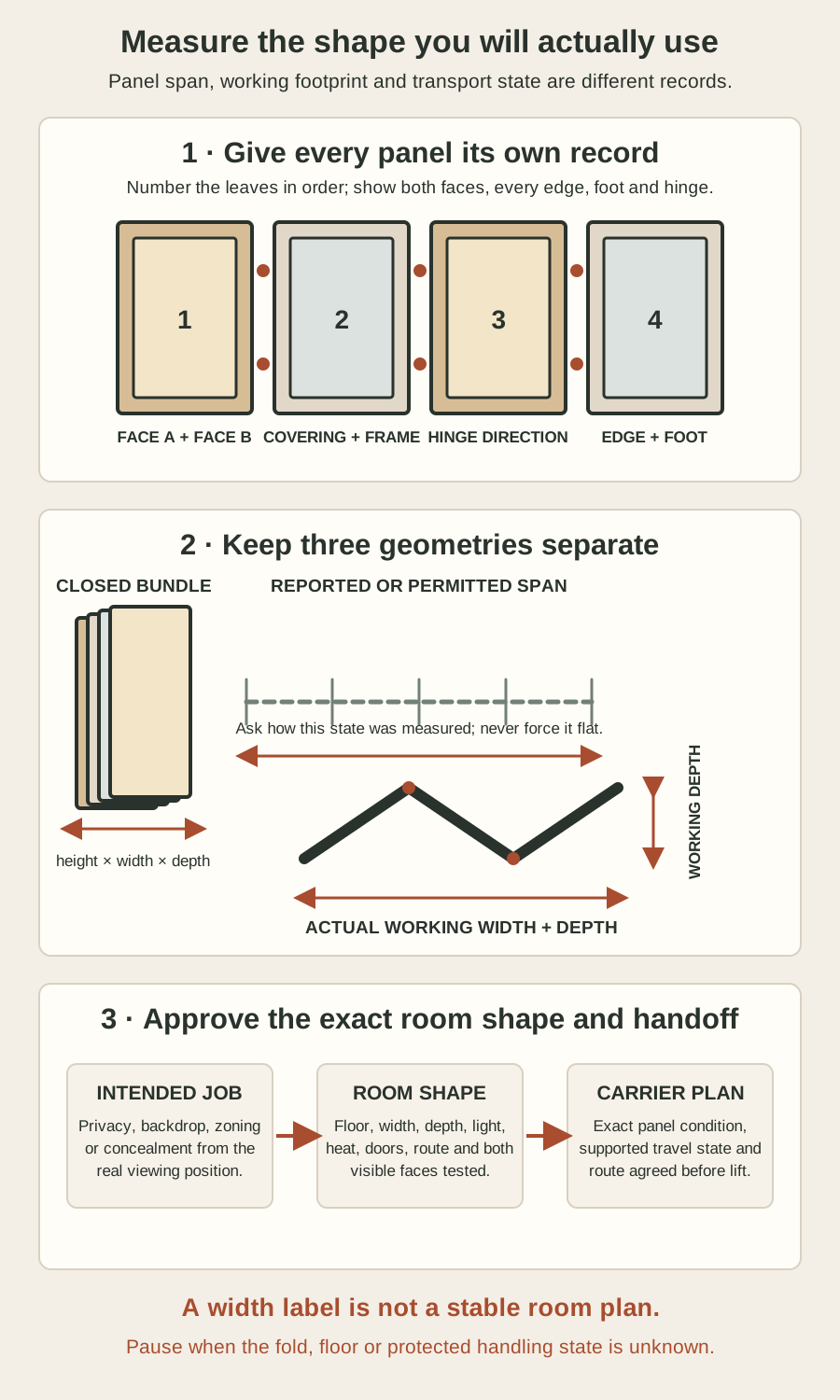
Measure the working shape from the room's axes: straight across the area it blocks and straight out into the room at its deepest point. Do not calculate the result from panel width and an assumed angle. Form the exact acceptable shape without force, place it on paper or low-tack floor markers, and record that configuration in a top view and whole-object photograph.
Inspect both faces, frames, coverings and floor contact
A screen is often photographed from its strongest face. Ask for the reverse under the same neutral light and compare panel by panel. Follow each frame from top corner to foot, then follow the panel field where it meets the frame. The important observation is not whether every old surface is perfect, but whether the present materials stay coherent through standing, folding and transport.
Read the complete material assembly
- Frames and cornersOpen joints, splits, missing decoration, added fasteners, finish loss and seller-reported movement.
- Textile, paper, leather or other fieldsTears, punctures, tide lines, fading, slackness, lifting edges, patches and what remains unidentified.
- Attachment lineTacks, trim, adhesive, stitching, channels or later strips only as safely visible, without lifting them.
- Hinges and fastenersPulling, distortion, missing pins, mixed hardware, enlarged holes, paint bridges and repairs on both sides.
- Feet and lower edgesWear, chips, moisture marks, replacement glides and actual contact on the inspection floor.
CCI furniture guidance recommends checking loose joints before movement and treats extensive repair or cleaning as conservation work. It also notes that light and changing moisture can damage wood and finishes. Apply that boundary to the exact mix of wood, textile, paper, leather, metal or paint in the screen rather than choosing a product from appearance alone.[4]
Material boundary
A photograph can show change, not prescribe treatment
Do not wet-clean, polish, vacuum, tape, stretch, glue or retouch a screen during purchase inspection. Powdering, lifting, damp or mould-like growth, active pest concern, torn load-sensitive material or unstable decoration needs the appropriate professional decision before movement.
Test the exact working shape in the real room
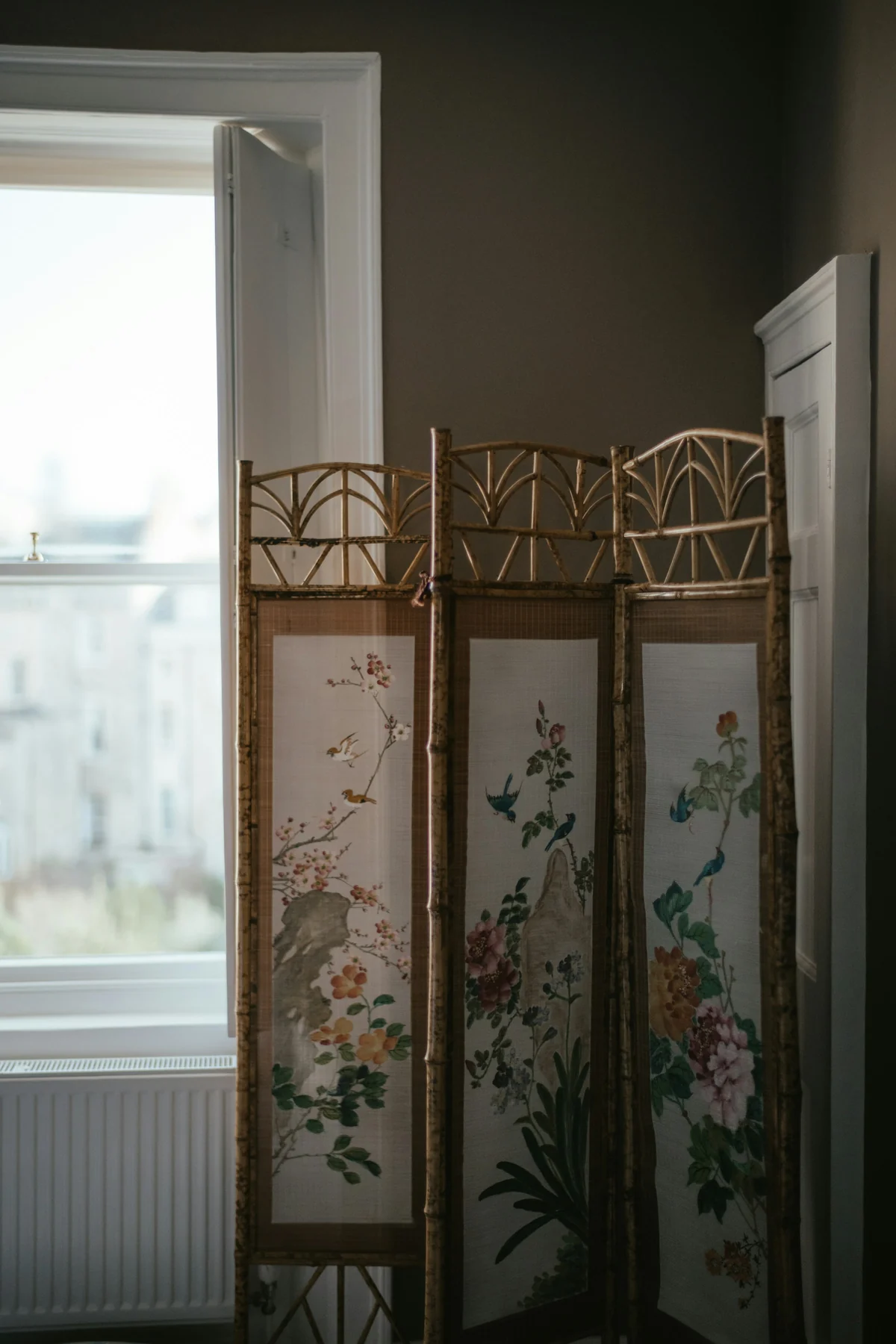
Lay out the recorded zigzag footprint with paper or low-tack floor markers. Add the screen's full height on a room sketch, then repeat the important sight lines from both sides. Check whether a passer-by sees over, around or through it, whether a seated person still has the intended privacy, and whether changing daylight makes an open or thin panel behave differently.
Review the occupied state
- FloorThe exact surface, changes in level, rug edges, thresholds and all panel feet within the chosen shape.
- Sight lineRelevant seated and standing viewers, doorway approaches and both end gaps.
- Openings and circulationDoor swings, drawers, curtains, cleaning access and the route around both ends.
- Light and heatDirect sun, strong backlight, radiators, fireplaces, vents and lamps in ordinary use.
- Contact riskBusy routes, bags, chairs and household activity that could meet projecting feet or panel edges.
Do not conduct a tip test or treat a wider zigzag as a stability certificate. If the screen cannot stand in the required shape on the intended floor without improvised restraint, the room decision has failed until an appropriate professional plan changes it. Leaning a freestanding screen against a wall or tying it to furniture creates another installation and evidence question; it is not an automatic fix.
Separate room fit from protected transport
CCI handling guidance says large objects should be lifted rather than dragged, with enough prepared handlers using strong areas near the base. A folding screen adds attached moving sections and potentially fragile panel fields, so the exact handholds, support and travel state belong to the carrier who has reviewed this object—not to a generic rule in a listing.[3]
Give the carrier the panel inventory, complete front and reverse, hinge and foot condition, closed and working dimensions, collection floor and route, destination route and every loose component. Use the delivery-route Guide for doors, turns, stairs, lifts, protected dimensions and responsibility at each transition.
Do not assume a screen travels fully folded, open, horizontal, upright or with panels separated because another example did. Ask the carrier which state protects the exact hinges, fields and decoration; how it remains supported before and after the lift; and who stops if the condition or route differs at collection.
Two proofs
A room shape and a transport shape can fail independently
Approve use only after the exact screen works on the real floor. Approve collection only after a responsible carrier accepts the protected object and complete route. One measurement cannot answer both.
Send one complete folding-screen request
Message to copy
Ask for every panel, shape and unknown
Hello—I'm considering this folding screen for [privacy/zoning/backdrop] in a space [width × depth × height]. Could you number the panels in order and show the complete screen, both faces, every outer edge, top, lower corners, feet and all hinges, together with any loose pins, caps, stays, covers or supports included? Please describe the panel and frame materials only as known and identify tears, lifting, stains, loose decoration, frame movement, repairs, altered hardware or joints that were not operated. Without forcing it flat, could you show the hinge directions and the working shape you regard as usable, then measure the closed bundle and that shape's maximum height, straight room width and front-to-back depth? Please do not oil, tighten, clean, dismantle or force anything for the inspection. I will agree the protected travel state and route with a carrier. Thank you.
Ask for whole, context and close views with the photograph-request Guide. Use the same panel numbers in the seller's reply, carrier brief and arrival check so damage or a missing part is not hidden by a new fold.
Buy when the exact working shape performs the intended job, both faces and every panel are understood enough, ordinary age and disclosed work suit the purchase, and the floor, route and carrier plan agree. Pause when one width substitutes for configuration, a weak reverse or hinge is omitted, the screen needs force or improvised restraint, or fragile material lacks a responsible assessment. Decline when the usable shape, contact risk, condition, access or total professional work makes it wrong for the room.