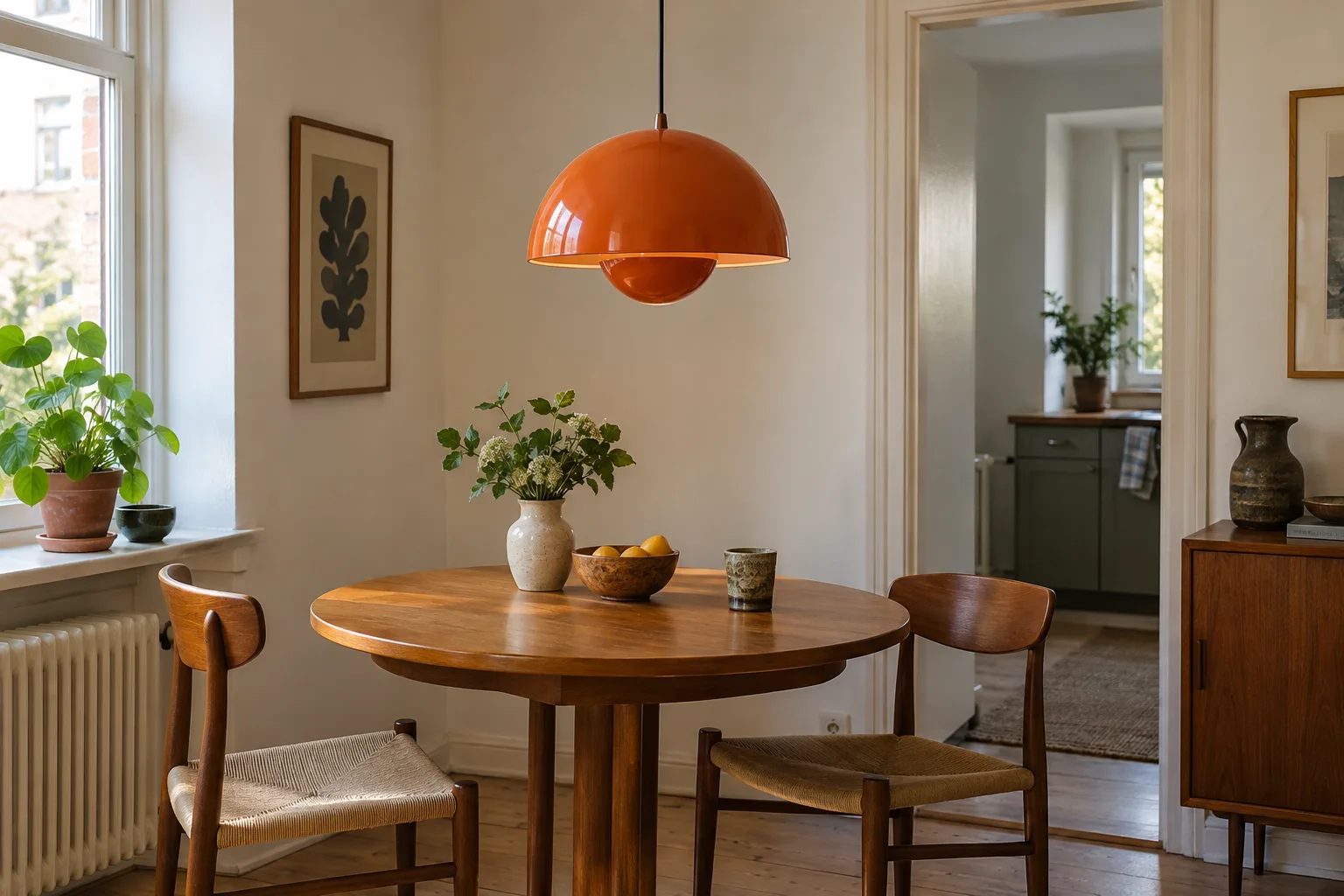
The small lower bowl earns its place
A Flowerpot can turn an ordinary dining corner into a place you want to sit. From across the room, the upper hemisphere reads as a simple patch of colour. Move closer and the smaller bowl below it explains why the lamp has a more deliberate shape than a generic dome pendant.
Verner Panton Design dates Flowerpot to 1968 and describes two hemispheres, with the upper twice the diameter of the lower. The lower part screens the bulb. This is a useful reason to inspect the whole assembly: a missing or substituted bowl changes more than the silhouette.[1]
Ask for a front view at the lamp’s level and a view from beneath while it is safely unpowered. Check whether the lower bowl is present, centred and held by the expected arrangement for that version. A dramatic photograph taken from above can conceal precisely the part you need to see.
Do not ask a seller to dismantle the shade or operate a doubtful fitting just to produce a photograph. A complete unpowered view and an account of known work are a useful start; uncertain mounting or electrical condition belongs with an appropriate lighting professional.
A design date is not a production date
The Panton estate’s history lists Louis Poulsen, Unique Interior for 2008–2011, and &Tradition from 2011 among the producers. That gives you a documentary framework for a seller’s claim. It does not mean that a lamp without papers can be assigned to one period by colour alone.[1]
| Listing wording | Ask for this distinction |
|---|---|
| “1968 Flowerpot” | Does 1968 describe the design, or is there evidence dating this lamp? |
| “Original orange finish” | What establishes that the finish is original to this example, rather than later paint? |
| “Vintage Louis Poulsen” | Which identification and ownership records support the producer and period? |
| “Restored and rewired” | Which parts and finishes changed, who completed the electrical work, and what is documented? |
Use dimensions carefully too. The estate’s historical overview includes a 22 cm diameter reference, while its named VP1 pendant page identifies a 23 cm version. That difference is a reason to match the reference to the actual model and producer. One centimetre by itself is not a dating method.[1][2]
If the seller’s evidence supports an authorised later production, assess it on that basis. It may be exactly the colour and condition you want. Paying an older-production premium requires a supported older-production claim, not just a photograph that feels like the seventies.
Compare the parts you will live with
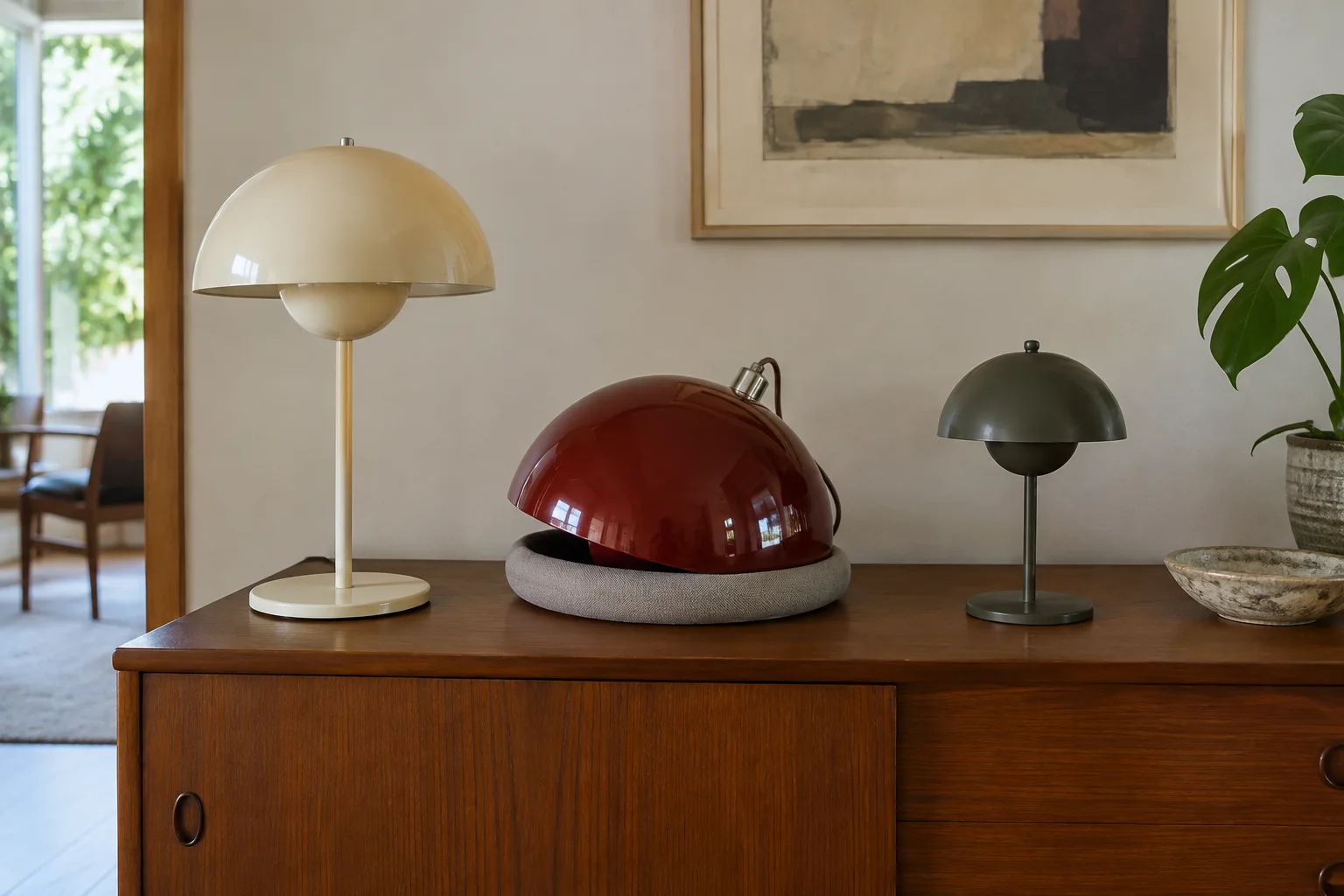
Look around the shade rim, the attachment points and the top opening for visible dents, distortion and earlier repairs. Ask whether the cord, canopy, socket, internal supports or lower bowl have been replaced. Replacement service parts can be sensible, but the description should say what remains from the offered production.
Consider the finish across the complete lamp. A little visible age may suit the room; a badly distorted hemisphere may bother you every time you sit beneath it. Do not assume that repainting will reproduce an earlier enamel surface or that an apparently simple bowl will be easy to replace.
For a table version, include the stand, base and cable exit in the assessment. Compare it with a reference for that table model rather than carrying over the dimensions and parts of a pendant. Similar shade geometry does not make their supporting assemblies interchangeable.
Price any missing component before buying. Send the service supplier the identification, measured dimensions and photographs of the existing assembly. Ask for confirmation that the proposed part is intended for it. A bowl with approximately the right diameter can still have the wrong fixing or position.
Choose its place before its colour
For a pendant, test the proposed position against the table and the views across the room. Think about where the lower bowl will sit in your sightline when seated. A lamp that looks beautifully proportioned in a close photograph may be too small for the composition you have in mind, or hang in the way when people stand.
For a table lamp, measure the useful surface and the surrounding shelf or wall. Include the whole base and cable route. If the lamp is meant for reading, arrange a trial with an appropriate, serviced example; a glowing coloured shade is not by itself evidence of comfortable task lighting.
Before agreeing electrical work, use our vintage lamp rewiring quote guide to turn “ready to use” into a documented service brief.
Before you buy
Please identify the version and claimed producer, show the complete upper and lower shade assembly, and list replacement parts or finish work. What evidence supports the production period, and what professional electrical work has been completed or remains necessary?
Choose the example whose colour you enjoy, whose assembly is complete and whose history is described honestly. Those three things can coincide in an older lamp or a later authorised one. The useful comparison is between the actual offers, including the work needed to hang or place them at home.