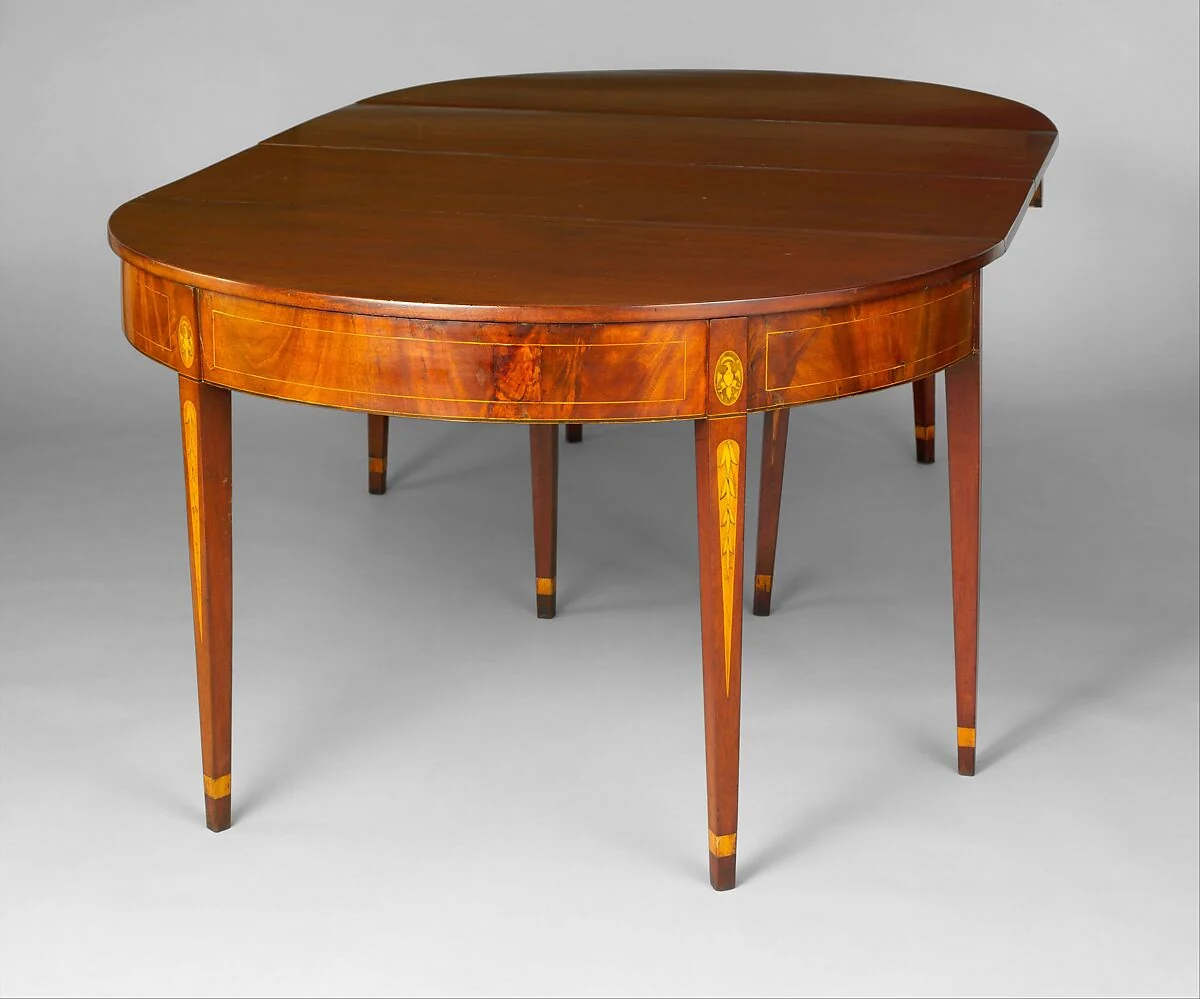
Look beneath the leaf
A drop leaf is hinged to the fixed top. “Gateleg” describes a moving leg support that swings out beneath a leaf; other drop-leaf designs use a different bracket or support. Listing titles can be imprecise, so ask for an underside view and a demonstration of the actual furniture.
The Met’s table 19.13.2 has two demi-lune sections, each with a hinged leg supporting a rectangular drop leaf. It is a useful reminder that folding dining furniture can be a multi-part assembly, rather than one small centre with two identical wings.[2]
Count the supports and inspect their attachment points. A raised leaf should not depend on somebody holding it while the seller takes a photograph. If a support is missing, bent or failing to reach its intended position, the table needs assessment before use.
Rehearse the half-open table
The one-leaf arrangement is often the reason for buying this form. Put your everyday chair where you expect to sit and check the hanging leaf, moving leg, stretcher and apron. Does the chair approach straight on? Can your feet rest naturally? Can the second person get in without moving the table?
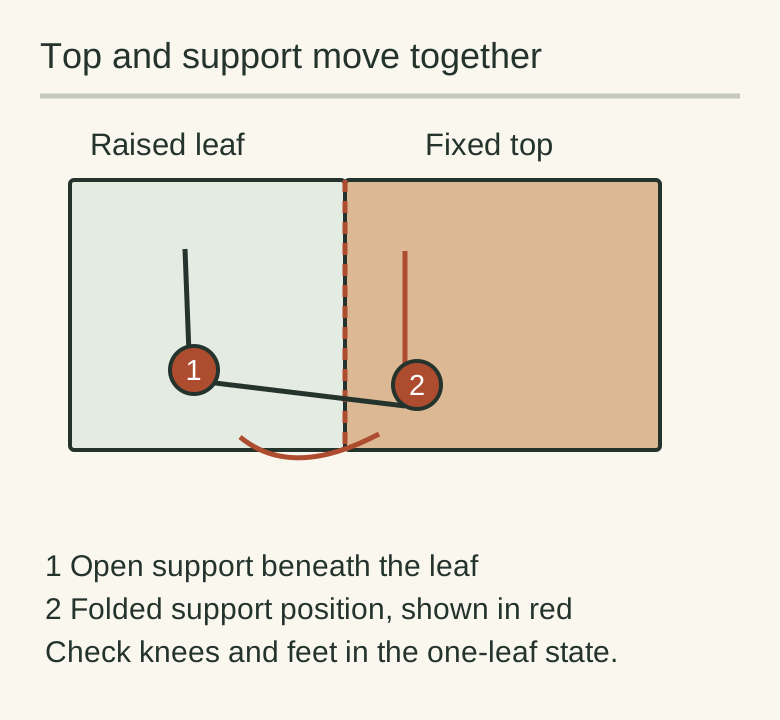
A folded table used against a wall may have projecting hinges, feet or a curved top. Measure the furthest projection rather than the central top alone. Include the space needed to pull it out before opening it.
Read dimensions as separate facts
Ercol’s current 7384 fact sheet lists width as 62–120 cm, depth as 110 cm, height as 73 cm, a 63 cm leg gap and 71 cm clearance underneath. These are different measurements for that specified product, not dimensions to transfer to an older table with a similar outline.[1]
For a vintage candidate, make your own equivalent record. If the seller provides only the open top size, ask for the closed depth and clear leg openings. The position of an apron can matter more to an armchair than the overall top height.
| Arrangement | Check alongside the top size |
|---|---|
| Both leaves down | Furthest projection, stable resting position and stored-chair plan. |
| One leaf raised | Intended support position, knees, feet and access to the second seat. |
| Both leaves raised | All supports in place, full chair arrangement and surrounding route. |
Inspect hinges without forcing the fit
Ask the seller to operate the empty table slowly. Watch the hinge line, support movement and final alignment. Look for split screw positions, extra holes, replaced hinges and worn contact areas. An old repair may be serviceable, but it should be visible in the record.
Do not lift or drag the piece by a leaf. Do not use a person leaning on the edge as a stability test. If the leaf sags or the base shifts unexpectedly during ordinary operation, stop and obtain an appropriate repair opinion.
Surface differences between the centre and leaves are common enough to expect during viewing: the parts may have spent very different amounts of time exposed. Judge the open table in consistent light so that a colour change is not mistaken for a structural problem, or vice versa.
Choose it for a repeatable routine
Ask the seller
Please show both leaves down, one up and both up, including the supports underneath. What is the maximum projection in each state, how much clear space is between the legs, and have hinges or supports been repaired or replaced?
Before paying, repeat the daily sequence in your room with a simple footprint mock-up: pull out, open, place chairs, sit and pack away. If that routine is cumbersome, the table’s clever folded dimensions may not be the space saving you need.