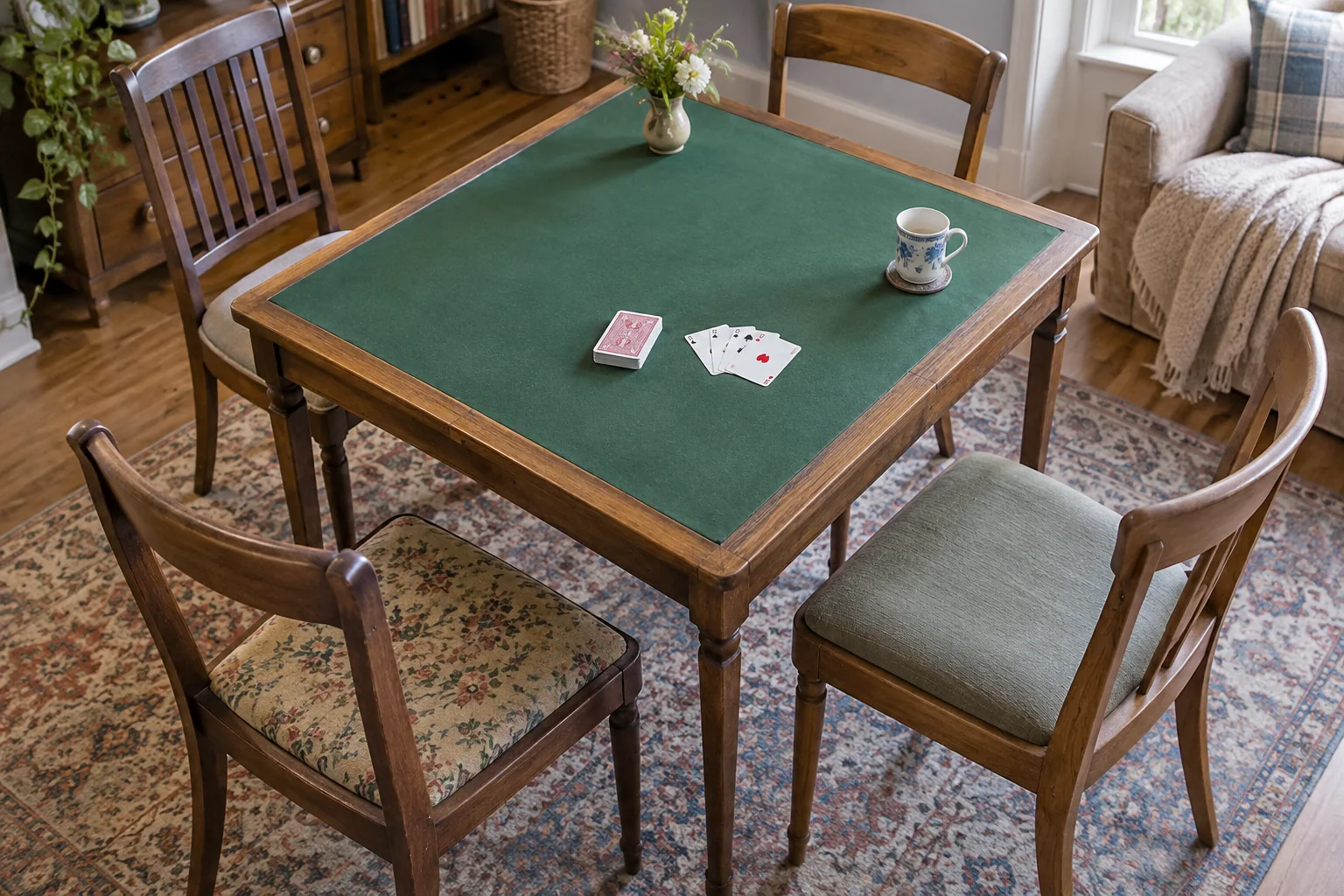
Does the top turn, unfold or need another support?
Case Auctions records a Federal games table whose hinged top opens into a nearly square surface and swivels to reveal storage. A separate walnut table advertised through Antiques Atlas also has a hinged and swivelling top, with a newly fitted green playing inset. These records describe particular mechanisms and surfaces, not a universal opening instruction.[1][2]
Ask the owner to show the empty table opening slowly by its normal method, including the underside and the final support position. Watch where the moving top passes the wall, a lamp or another piece of furniture. A mechanism that functions only after dragging the table into the room needs that floor space in your plan.
Identify stops, hinges, pivot points and any supporting leg or bracket. Do not let someone hold a leaf in place while calling the table fully open. If the owner does not know the mechanism or a part catches, pause for an assessment rather than trying a plausible direction.
Measure the game, not just the outside edge
Set out your board, cards, score sheet and pieces on another surface, leaving the room your hands need. Measure that arrangement. Compare it with the clear playing area inside the table’s border and across any centre seam.
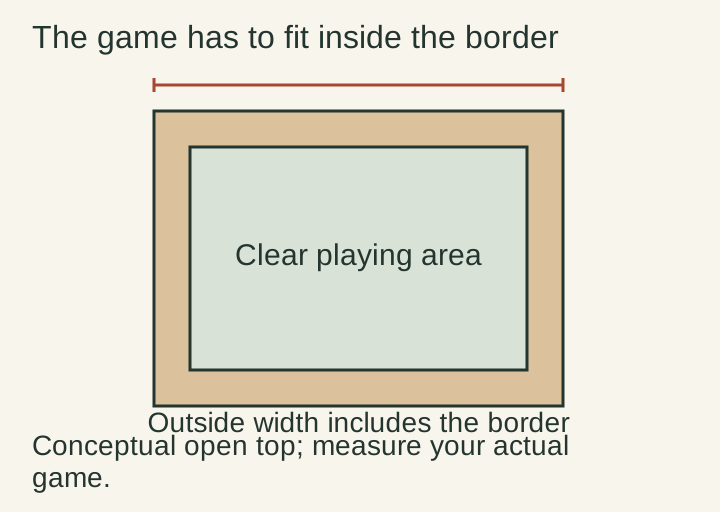
The Case Auctions example is recorded at 32¾ × 32½ inches fully extended, approximately 83.2 × 82.6 cm. Those outside dimensions describe one table, not its unobstructed playing inset. A deep wooden surround can make the usable area materially smaller.[1]
New cloth may be a welcome practical improvement. The Antiques Atlas record explicitly describes its green inset as new. Ask the same question of your candidate: what is original, what has been replaced, and does the surface lie flat enough for the game? A fresh top should be described as a replacement rather than evidence of unusually pristine age.[2]
The best view is from the player’s chair
Try the intended chairs around the supported table if its condition permits. Check the apron, legs, stretcher and stored mechanism against your knees. A chair that fits under one edge may meet a different obstruction on the next.
Inspect the hinge areas for splits, extra holes, replaced fittings and repairs through the top. Ask for the underside of any repaired line. The Case Auctions record discloses an old repair running across its flip top; that is exactly the sort of information a glossy closed view can miss.[1]
Keep surface wear and support problems separate. A worn playing cloth might be replaceable after a confirmed quote. An unsupported leaf, moving base or damaged hinge position needs assessment before use. Do not lean on the open edge to test whether it holds.
Plan somewhere for everything that moves
Mark the open tabletop and occupied chairs, then leave a route for someone to stand and pass behind another player. Put the closed-state ornaments somewhere too. If every game starts by relocating a lamp, vase and six books, decide whether that ritual suits you.
Ask the seller
Could you show the complete opening and closing sequence, the underside supports and all hinge or pivot repairs? Please measure the closed footprint, fully open top, clear playing area and knee space on each side, and identify any replaced cloth or fittings.
Choose a table that opens predictably, sits comfortably with your chairs and holds your actual game. A clever fold is useful when it makes an ordinary evening easier.