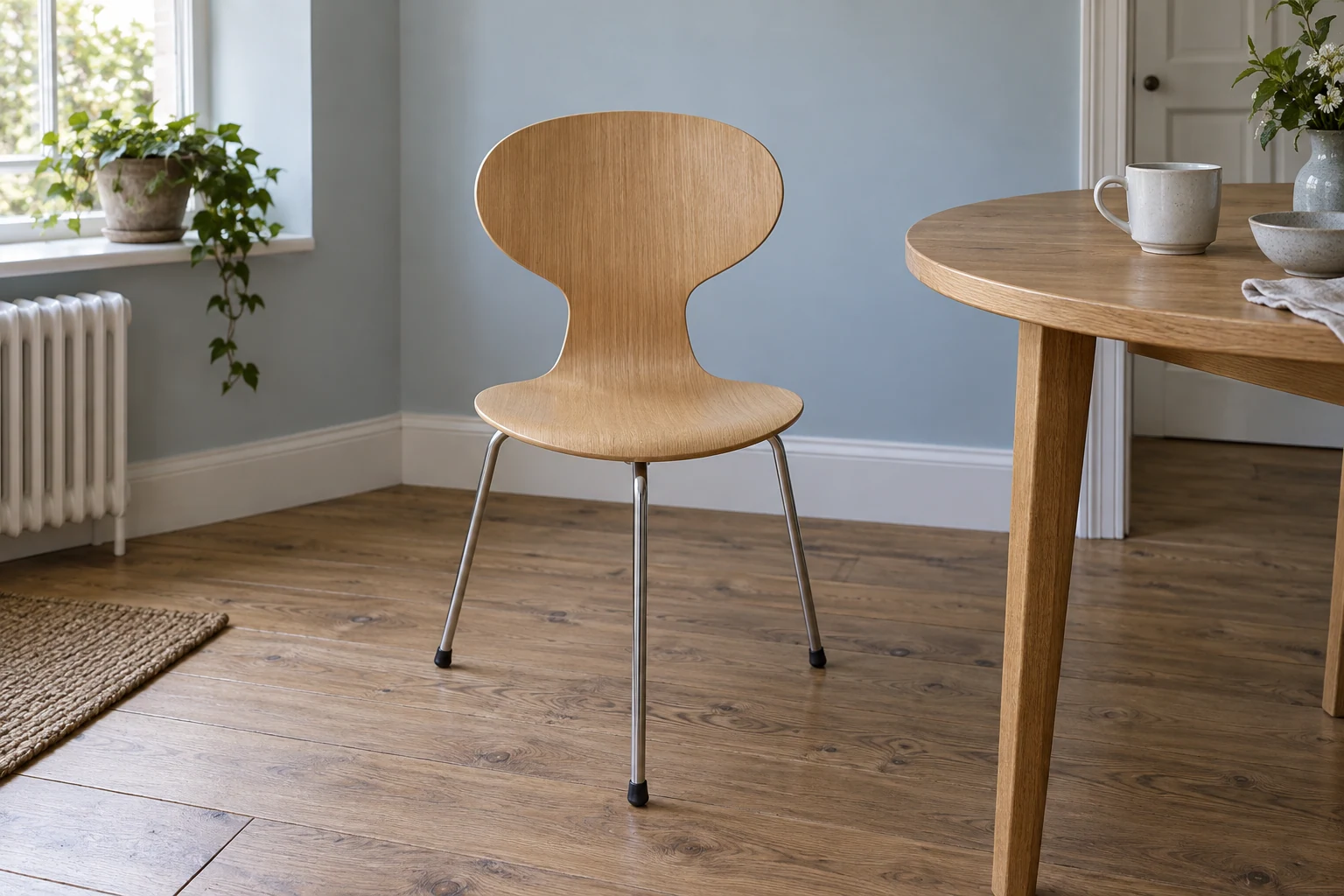
Two models with one familiar shell
The Ant makes a dining area feel open: its slender base and pinched waist leave space around the seat and back. Arne Jacobsen’s archive dates its introduction to October 1952. The three-legged version came first; the four-legged version became standard after Jacobsen’s death in 1971. That last distinction matters: it does not establish that no four-legged examples existed earlier.[1]
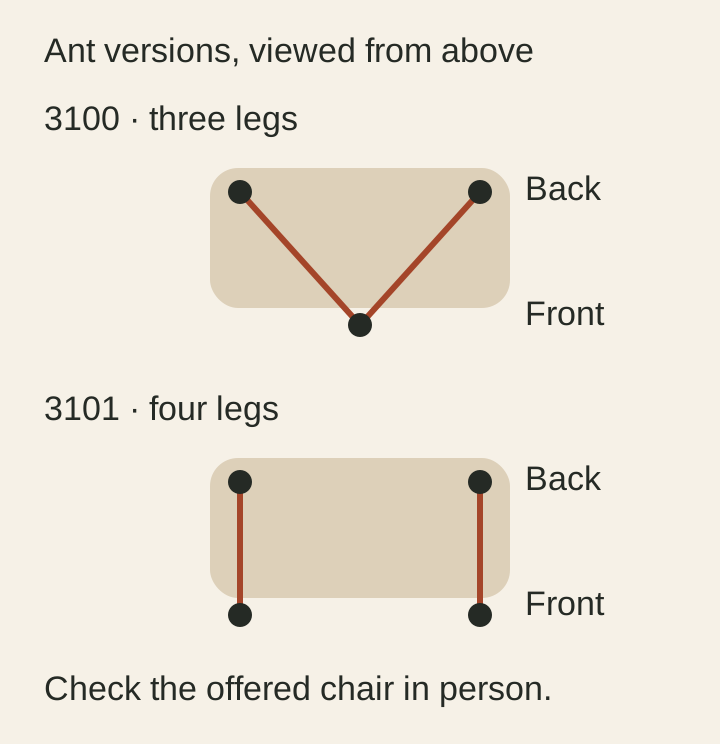
Fritz Hansen still offers the three-legged 3100 and four-legged 3101. If a listing calls a chair “original three-leg 1952 Ant”, the shape alone supports neither the year of manufacture nor the claim of original parts. A newly made 3100 is also a three-legged Ant.[2][3]
| Model | Legs | What it tells you |
|---|---|---|
| 3100 | Three | The three-legged version, including current production. |
| 3101 | Four | The four-legged version, also currently made. |
Choose it at the table
Begin with a normal seated trial on an apparently sound chair, on a level floor. Sit down, reach towards your place setting and get up in your usual way. Notice whether the narrow back supports you where you want it to, and whether the seat edge feels comfortable. An attractive silhouette cannot tell you how it meets your body.
If possible, compare both versions at the same table. Look at where your feet naturally rest and how you pull the chair in. Choose the one that works for you; counting legs is not a safety assessment of an old chair. Do not deliberately lean it onto two legs or conduct a tipping test.
For a remote purchase, ask for the actual seat height and the seller’s account of any movement, repairs or uneven feet. Measure your table’s underside as well as its top. A taller seat may look right in a photograph but leave too little room for your legs under a deep apron.
Inspect the waist and the base attachment
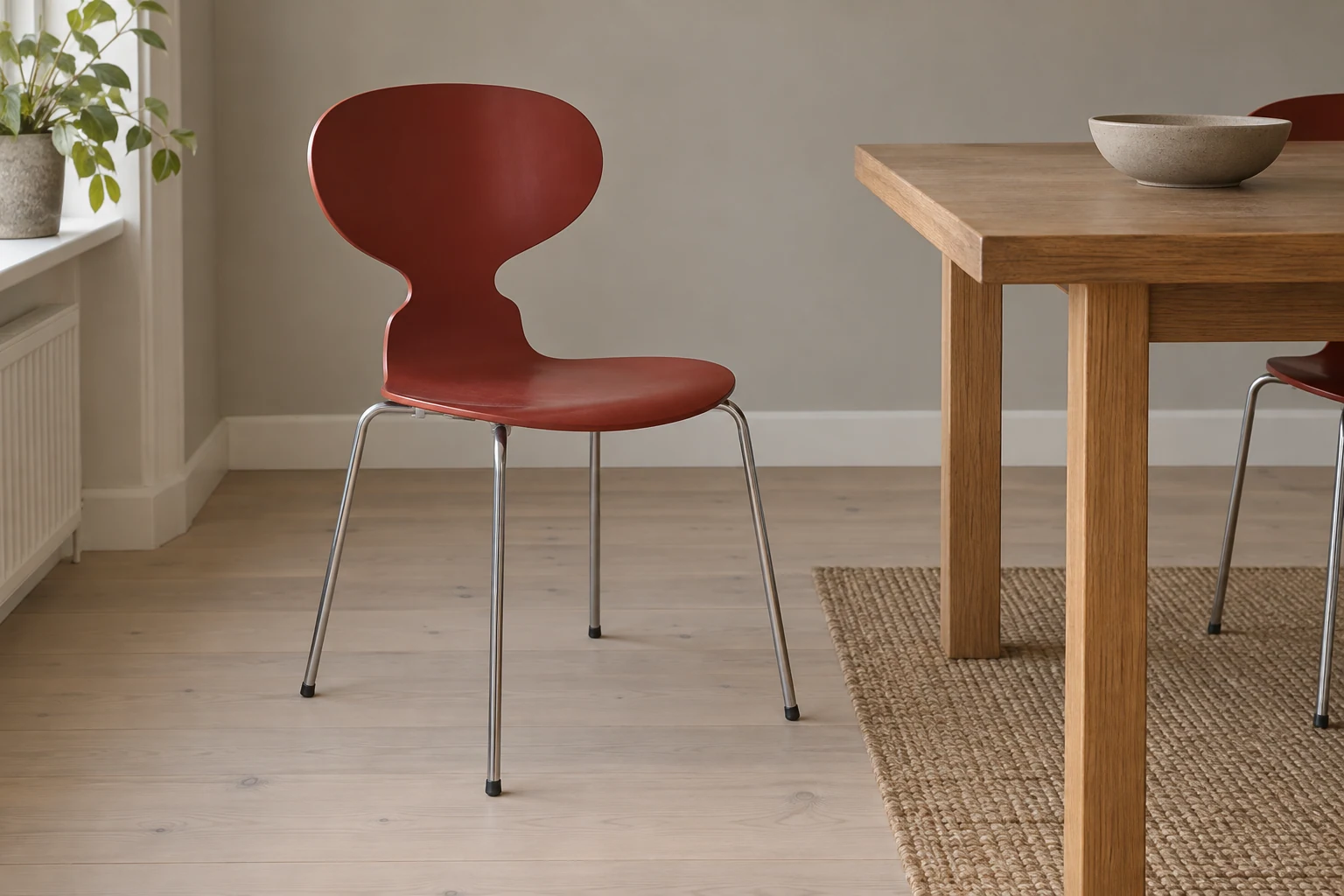
Fritz Hansen describes the current shell as nine layers of pressure-moulded veneer. It is a shaped laminate, not a solid board. On the offered chair, request views of the front and rear of the narrow waist, the shell edges and the entire underside where the base is attached.[3]
Look for open seams between layers, cracks through the waist, areas that appear lifted, and patches around the base attachment. A small scuff in the finish and a split through the shell require different decisions. Ask a restorer familiar with moulded chairs to assess a suspected structural problem before a sitting trial or purchase.
Do not ask the seller to flex the back to demonstrate strength. A short video of ordinary handling can answer whether a visible movement occurs, but it cannot establish the remaining life of the shell. If movement is reported between shell and base, find out what is moving before treating it as a simple tightening job.
For a group, examine every underside. Compare feet, bases, fixing arrangements and any reported replacements. A genuine shell may have had another base fitted, and a neatly repainted set may contain chairs with different repair histories. Establish what matters to you: a consistent set to use, a documented period group, or both.
Pay for the evidence you actually have
Request marks in context, rather than a cropped label alone. Put a claimed production date beside purchase records, dated photographs or other documents the seller actually has. An unresolved date should stay unresolved in your comparison. The manufacturer’s current pages are useful model references, not certificates for a second-hand chair.
For the longer design story, read the Ant Chair Library page. For buying, keep the question narrower: does this chair offer the version, comfort, condition and history you are paying for?
A message for the seller
Are these 3100 or 3101 chairs, and what supports the production date? Please show every chair together, each complete underside, the shell waist front and back, and any marks in place. Have shells, bases, feet or fixings been replaced? Please measure the actual seat height and describe any movement or repairs.