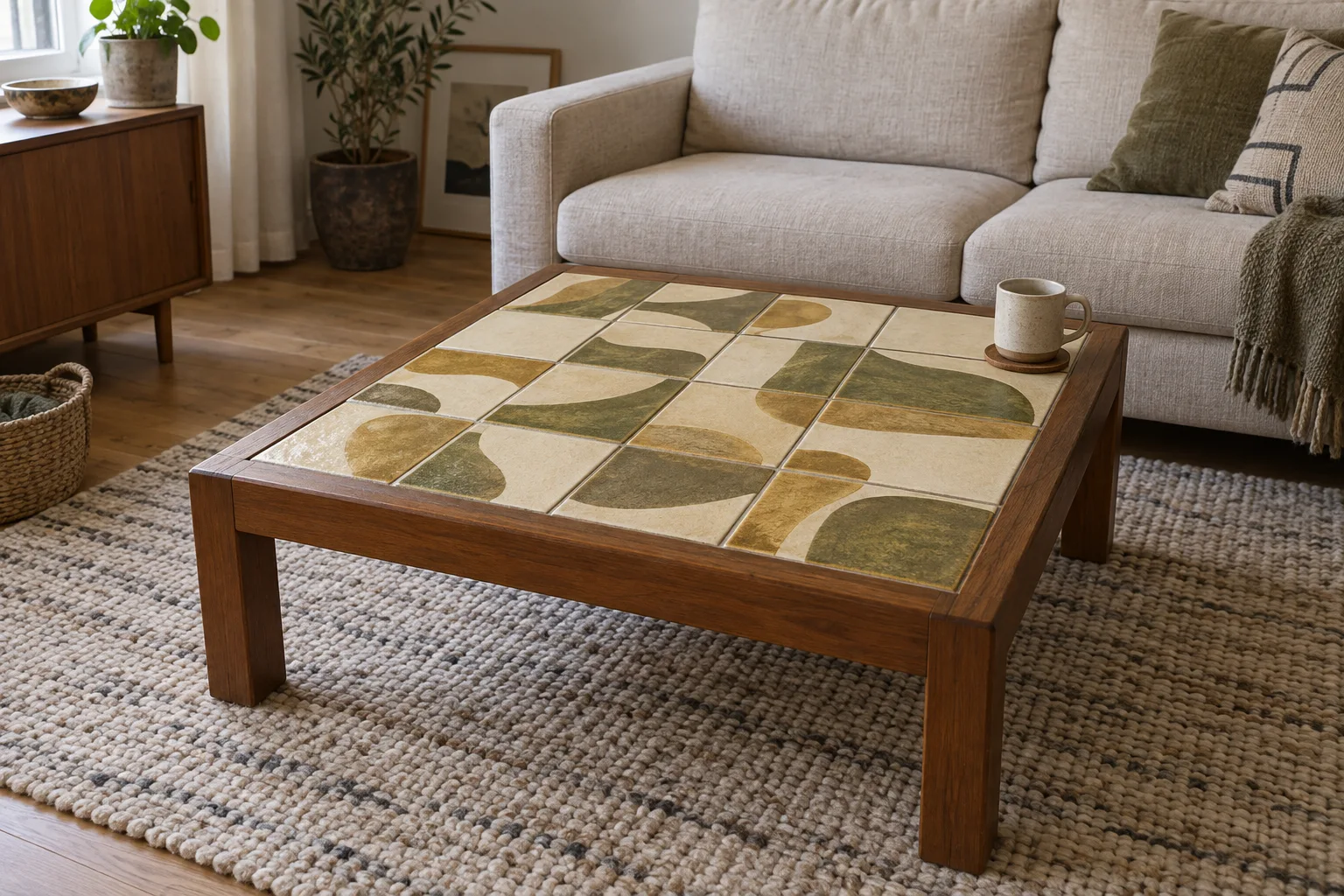
Trioh and Ox Art: two names can describe two contributions
The appeal is immediate: a useful low table carries colour and pattern without needing a tablecloth or another object on top. But “Danish tiled table” covers different shapes, tile arrangements and constructions. Begin by asking what the listing actually identifies: the furniture maker, the ceramic work, a model or simply an attributed style.
Lawrences’ archived Auctionet lot 2861203 is a helpful example. The auction house describes a square table, a tile signed “Ox Art, 73” and an underside marked Trioh, Made in Denmark. It records an 84.5 cm square top and a height of 41.5 cm. The signature and maker mark are separate observations in that record; they are not a shortcut for identifying another table.[1]
Gildings lot 75 records a different format: a rectangular teak-framed table with eighteen tiles, a signature and a Trioh stencil underneath, measuring 126 × 66 × 43 cm. These two records show why the same names do not specify one size or pattern. Treat the measurements as properties of the catalogued lots.[2]
For a table you are considering, request the complete top and base as well as readable photographs of any marks in their actual positions. A signature on one replacement tile would not establish the history of the whole table. If the seller names an artist or date, ask for the supporting record rather than extending a partly legible inscription into a biography.
Read the pattern before reading a chip
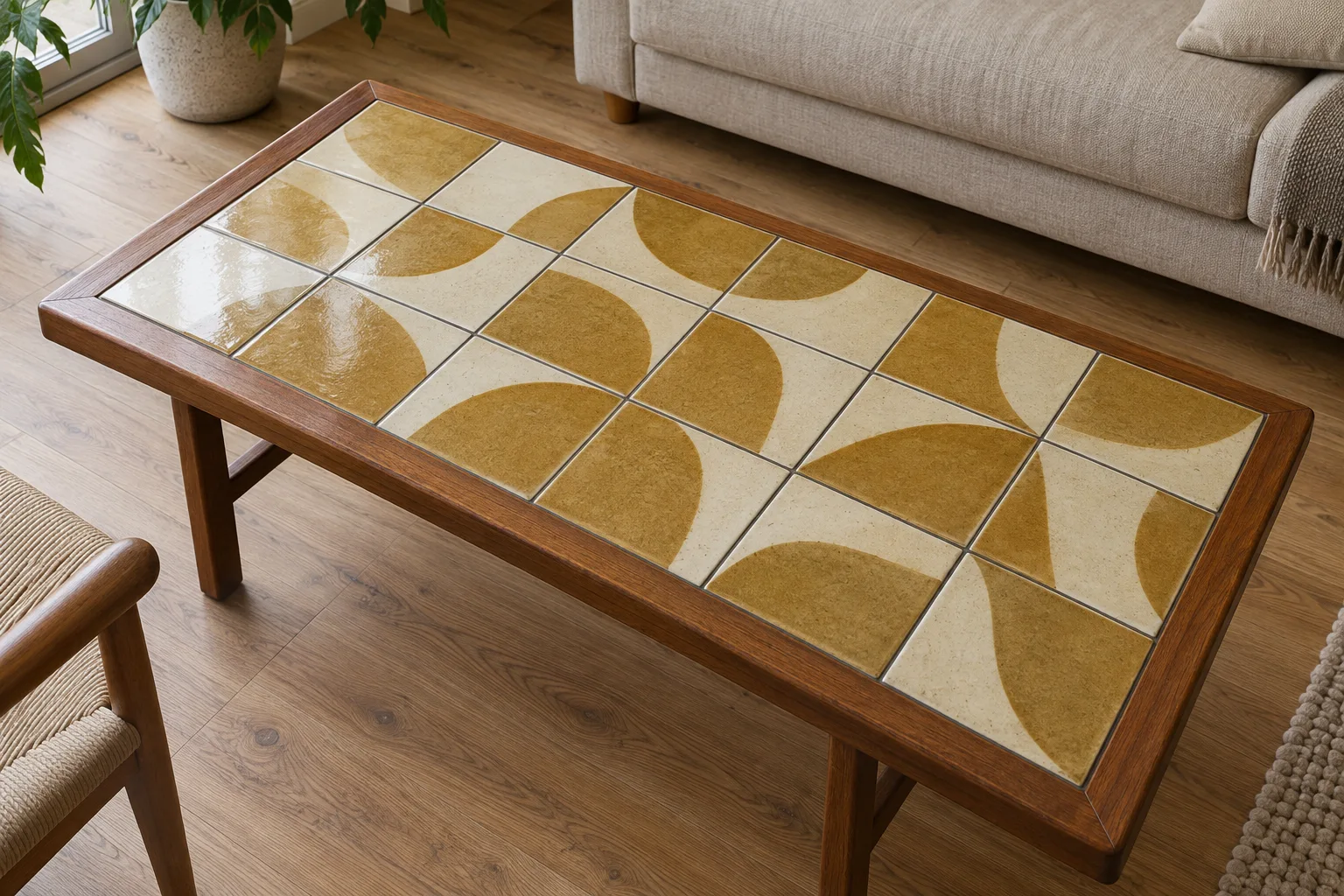
Start with an overhead or elevated view showing every tile and the entire border. Count the rows and columns, then follow the pattern across their joins. You are looking for the overall arrangement: an unexpected interruption, a different glaze sheen or an uneven gap is something to ask about. It is not automatically proof of a replacement; handmade surfaces can vary.
Next request daylight views with light falling across the surface. Separate a fine line in the glaze, a crack through a tile, a missing corner, loose grout and movement of the whole panel in your notes. A photograph may not settle which one you are seeing. Ask for another angle or a professional assessment instead of reducing every line to harmless “crazing”.
The Canadian Conservation Institute distinguishes wear and cracks in glaze from other losses and repairs, and explains that dirt can lodge in cracks and repaired areas. This supports a careful condition description, not an age test: staining or a crack network cannot authenticate a table or prove that a tile is sound.[3]
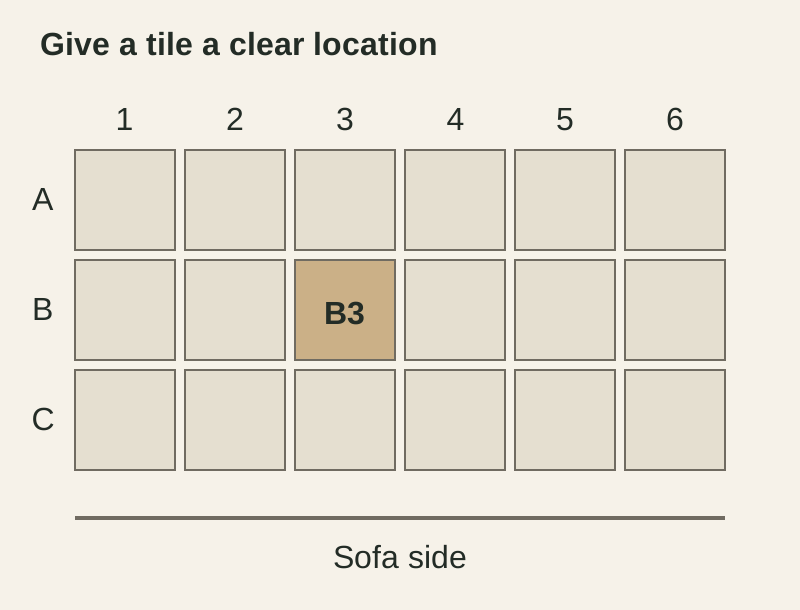
Give each area a location. Agree which edge faces the sofa, then label rows from the far edge and columns from the left. In a three-row, six-column example, B3 is the second row and third tile from the left. That is much easier to discuss than “the dark one”. Keep an overall photograph with those locations noted separately, followed by close-ups. Do not mark the ceramic or press on a suspect tile.
Ask explicitly whether any tiles have been replaced, lifted, reset, filled or overpainted, and whether work records exist. A well-explained repair may be acceptable to you. Its position matters too: a small edge loss and a conspicuous change in the centre of a continuous design can have very different effects on how much you enjoy the top.
The wooden border can change the whole decision
Do not spend the entire viewing bent over the ceramic. Inspect the timber surround, its corners, the underside and the way the top is supported by the base. Ask about loose joints, lifted veneer, previous water damage and any later screws or brackets. Keep the cabinetmaking and ceramic work separate in a repair enquiry.
John Moran’s August 2023 lot 153 describes a Trioh table with sixteen tiles inside a rosewood-veneer frame. Its condition report records fading around the border and water damage with veneer losses on two legs. That is a concrete reason to inspect below an attractive top; it does not mean those problems occur on every Trioh table.[4]
| Part | Useful evidence | Decision it helps you make |
|---|---|---|
| Ceramic tiles | Complete pattern, local damage and previous repair or replacement. | Whether you like the surviving surface and can accept or price its work. |
| Border and panel | Corners, joints, support and any movement or alteration. | Whether the top needs furniture work as well as ceramic attention. |
| Base and legs | Whole base, attachments, floor contact and repair history. | Whether the table can be used and transported as intended. |
For online purchases, request safe underside photographs without asking someone to balance a heavy table on one edge. If the top is said to lift out, find out whether that is part of the construction or a later change, and who will handle it. Do not assume the tiles or panel can be removed merely because that would make transport easier.
Do not buy it on the promise of an easy clean
An old mark can be less troublesome than the wrong attempt to remove it. CCI advises inspecting ceramics and applied decoration before cleaning, leaving soft or unsuitable ceramic surfaces to a conservator, and avoiding bleach or acid as a response to persistent stains. Keep those limits in mind when a seller suggests that every dark patch will disappear with a stronger product.[5]
A tiled table also contains wood, joints and whatever secures the ceramic panel. Instructions for washing a robust loose plate are not instructions for soaking this assembly. Ask a suitable restorer about the whole object, including the glaze, previous repairs and wooden finish, before using cleaners, polishing compounds or sealers.
A missing tile raises more than a size question. Its thickness, surface, colour and pattern may need to work with the surrounding tiles. An exact surviving spare, a deliberately distinguishable replacement and a repair to an existing tile are different options. Ask which is feasible, what the result will look like and what the work will cost before calling it a bargain.
Use coasters and appropriate protection for the surface you have, and ask for care advice after any repair. Ceramic does not make the wooden border immune to water, nor does a glossy finish establish that the table can accept a hot pan. Choose it for coffee and conversation, not as an experiment in heat resistance.
Choose the shape, then agree the collection
Revisit the two recorded shapes: the 84.5 cm square occupies space quite differently from the 126 × 66 cm rectangle. Mark the offered table’s actual footprint beside your sofa, including the wooden edge. Sit down, reach towards the far part of the top and walk around it. A square table you admire from above may reach too far into a narrow route.
Decide how much of the patterned surface you want to keep visible. If a large tray will permanently cover a repair you dislike, compare that compromise with a simpler table whose surface you enjoy. Equally, a modest worn example can be a satisfying everyday purchase if the frame is sound and the remaining work is understood.
Before paying
Please send the whole tiled surface, close-ups of the areas noted, the complete base and readable marks. Which tiles, grout, timber or fittings have been repaired or replaced? Can you confirm the exact dimensions and how the top and base will be protected during collection?
Agree who will pack and carry the table and which parts, if any, should be separated by someone familiar with its construction. Save the condition photographs before packing. Then choose the example whose pattern you like, whose repairs you understand and whose entire shape works beside the seat where you will use it.