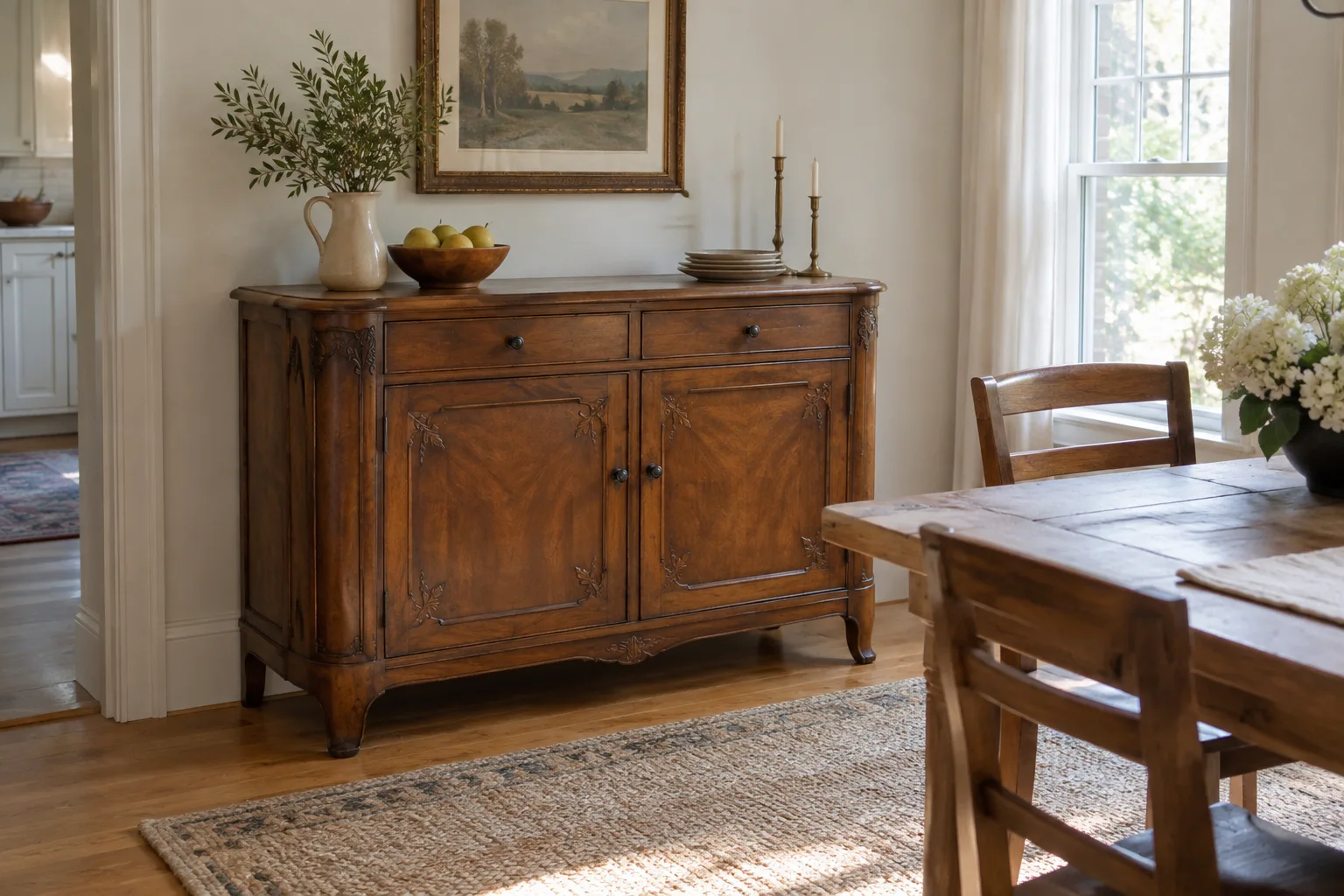
Start with the piece, not a favourite motif
Save a straight-on view, a side view and a closer photograph of the ornament. Is a curve shaping the leg or merely decorating a flat door? Does a repeated line organise the whole cabinet, or appear only on a handle that may have been replaced? Those are more useful observations than “it has flowers”.
Art Nouveau developed internationally from the late nineteenth century into the period before the First World War. The Met’s account includes natural forms and sinuous lines, but also different regional approaches. A geometric example does not fall outside the movement simply because it lacks a sweeping stem.[1]
French Art Deco is associated with the 1925 Paris exhibition that later supplied its familiar name, yet its development began earlier. The Met’s account also describes expensive materials and ornament; Deco is not a synonym for plain, cheap or machine-made.[2]
Look at Gallé’s Ombellifères cabinet
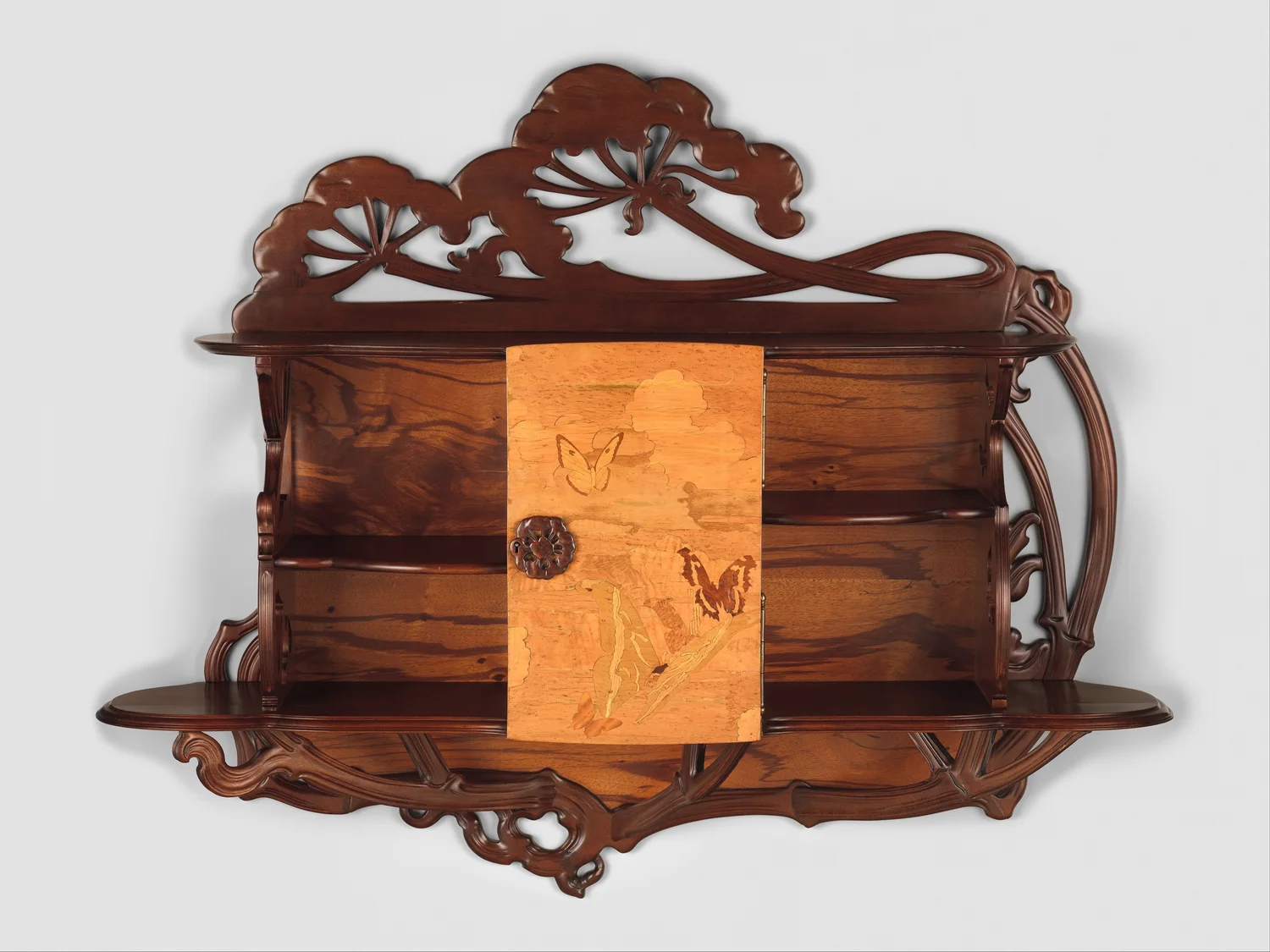
The Met dates Émile Gallé’s Ombellifères, or cow parsley, cabinet to about 1900. The institution’s accession number is 1982.246. In this documented example, the plant theme is carried through the shaped upper framework and the decorated central panel, rather than appearing as one detachable floral handle.[3]
Look at the relationship between the upper silhouette, the curved side supports and the marquetry panel. The cabinet remains a place to keep and display things, but its plant imagery helps organise what you see. That relationship is the useful comparison to take back to an ordinary listing.
In a listing, compare a similarly complete view before zooming into the decoration. If the photograph crops out the crest, feet or side supports, ask for those parts before deciding that the comparison is strong.[5]
Ruhlmann’s cabinet is curved too
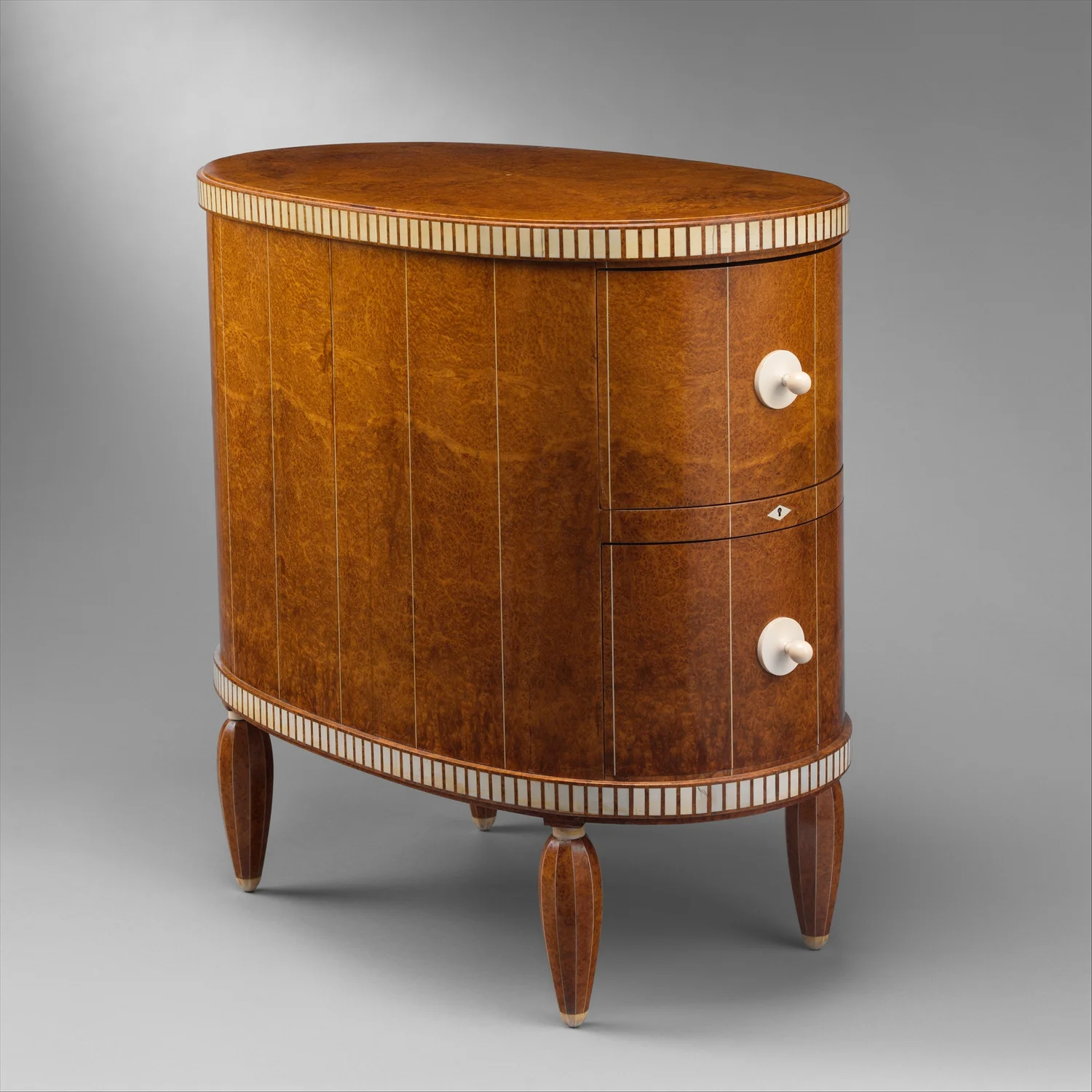
The Met dates this cabinet by Émile-Jacques Ruhlmann to about 1918–19, accession 1973.154.3. Its rounded body and bowed front immediately complicate the shortcut “curves equal Nouveau”. The figured wood, pale repeated border and controlled overall arrangement offer a different visual argument from Gallé’s branching upper structure.[4]
The detail below helps you follow that argument across the drawer front. Its inlay is arranged as a clear geometric border around a curved surface. You do not have to ignore the curve to see the difference; you have to ask what the curve is doing within the whole design.
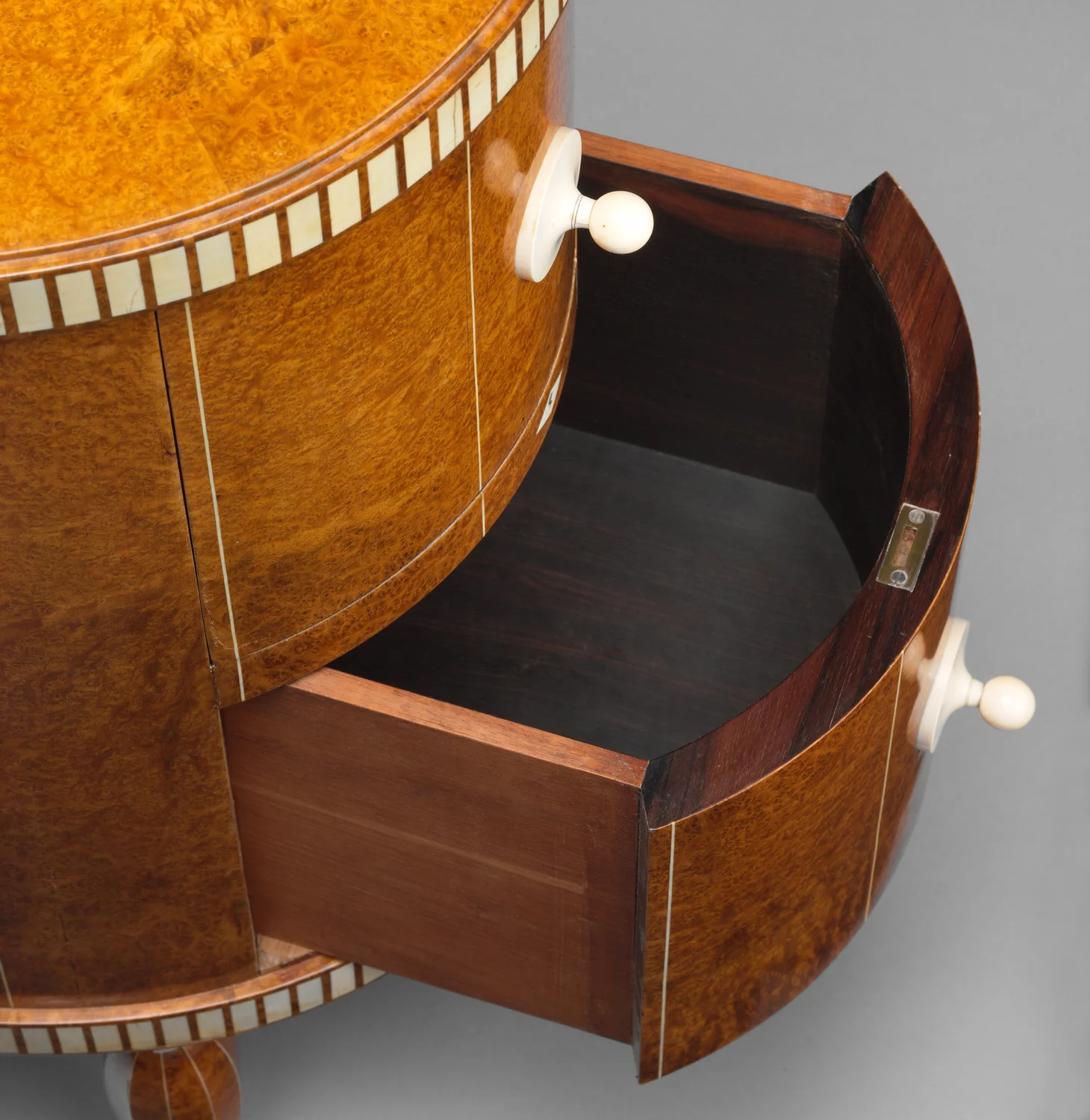
Together, the whole view and drawer detail show why two kinds of photograph help: one records the overall design, the other lets you examine how an important detail belongs to it. Ask for both when a cropped listing image seems persuasive.[6][7]
Compare relationships, not a bag of symbols
| Look at | Ask yourself | Avoid concluding |
|---|---|---|
| Whole outline | Do the supports, body and top form a coherent design? | One curved leg dates the entire object. |
| Ornament | Does it shape the structure, organise a surface or sit on a replaceable part? | A leaf, fan or sunburst proves one style. |
| Materials and construction | Do they agree with the proposed comparison, and what may have changed? | A shiny veneer proves a particular decade. |
| Dated reference | Which complete features match, and which conflict? | A similar museum photograph names the maker of the listing. |
These museum cabinets are reference points, not a shopping shortlist or a price guide. Your useful find might be an unmarked sideboard, dining chair or occasional table. Give it a careful description before deciding how much historical certainty you need to buy it.
For example: “rounded veneered cabinet with geometric inlay; maker and manufacturing date unconfirmed” tells you more than an unsupported famous-name attribution. If a seller proposes a particular model, use the relevant catalogue or archive to check that stronger claim.
Separate the style you enjoy from the age you are paying for
A later cabinet can borrow an earlier vocabulary. It may be attractive, well made and entirely suitable for your room. What changes is the description and the evidence needed to justify a period or maker premium.
Ask whether the offered piece has been altered. Handles, feet, doors or a finish can change the impression of the whole object. A replacement is useful information; it should not disappear inside a confident style label. Keep the seller’s account alongside photographs of the actual work.
When the date matters, look beyond the front elevation: a maker record, dated catalogue, provenance connected to the piece and examination of its construction may help. No single decorative motif can do all those jobs.
Turn the style label into a useful conversation
Message to the seller
Are you describing this piece as Art Nouveau/Art Deco in style, or claiming a particular manufacturing period, maker or model? Please share the complete front and side, safely visible construction and marks, known alterations, and the dated reference or provenance supporting the stronger claim. I would also like its full dimensions and condition details.
Use the style name to sharpen your search, then choose the actual piece. The comparison has done its job when you can explain what you like, what the evidence supports and what remains unknown.