Design story

Steltman: a chair that makes sense beside its opposite

One Steltman chair invites you to look around it. Put its opposite beside it and another idea appears: two unequal forms can make a deliberate pair. Rietveld designed that encounter for a particular shop, where the relationship between the customers mattered as much as the individual seat.

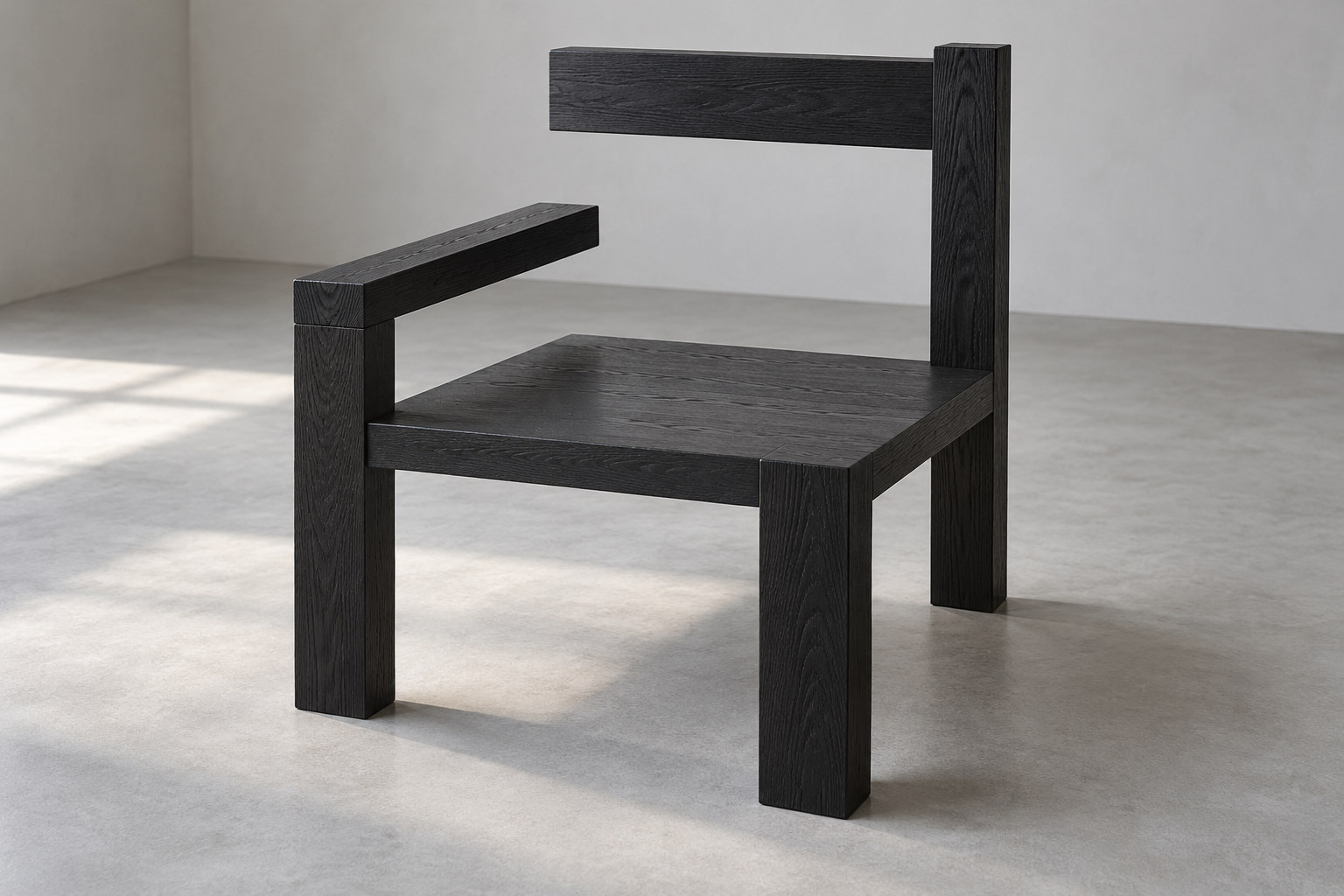
Editorial reconstruction of an asymmetric black timber chair with three floor supports, a cantilevered back plank and one arm.
PatinaHall editorial reconstruction. It is not a documentary photograph. An imagined rectilinear chair introduces asymmetry and open space. It is not a record of the original upholstered shop pair or a measured reproduction of a later wooden edition.
On this page
Key facts & takeaways

At a glance

Subject
Steltman Chair
Entry
Design story
Last reviewed
23 October 2026
Designed
1963documented

Three things to remember

  1. The chair was designed for a jeweller's interior in 1963.
  2. The shop used a mirrored pair, with the arm on opposite sides.
  3. The original upholstery and the later exposed-wood version are distinct.

Two seats at a display

The Steltman Chair's asymmetry begins to make sense when there are two of them. Rietveld designed a mirrored pair for the interior of Steltman's jewellery shop in The Hague in 1963. Customers could sit beside a display while considering the objects in front of them. The chair was part of that particular arrangement.1

An arm on one side leaves another side open. Reverse the arrangement and the second chair answers the first. The pair establishes a relationship between people, furniture and the display. Mirrored arm placement gives the pair a shared order while each seat remains asymmetric.

Space between the pieces

The exposed-wood version is built from a small vocabulary of upright and horizontal members. Some surfaces support the sitter; others describe a back or an edge. Rectangular gaps are as noticeable as the solid parts. Changing viewpoint changes which of those gaps can be seen through.

Saint Louis Art Museum interprets this balance through Rietveld's return to De Stijl ideas. Its record also preserves an essential practical distinction: Rietveld is the designer, while Gerard van de Groenekan is the maker of the museum's chair.3

The object rewards a slow circuit. From one direction it can look almost closed, from another conspicuously open. The same straight members produce different readings because they occupy different positions in space.
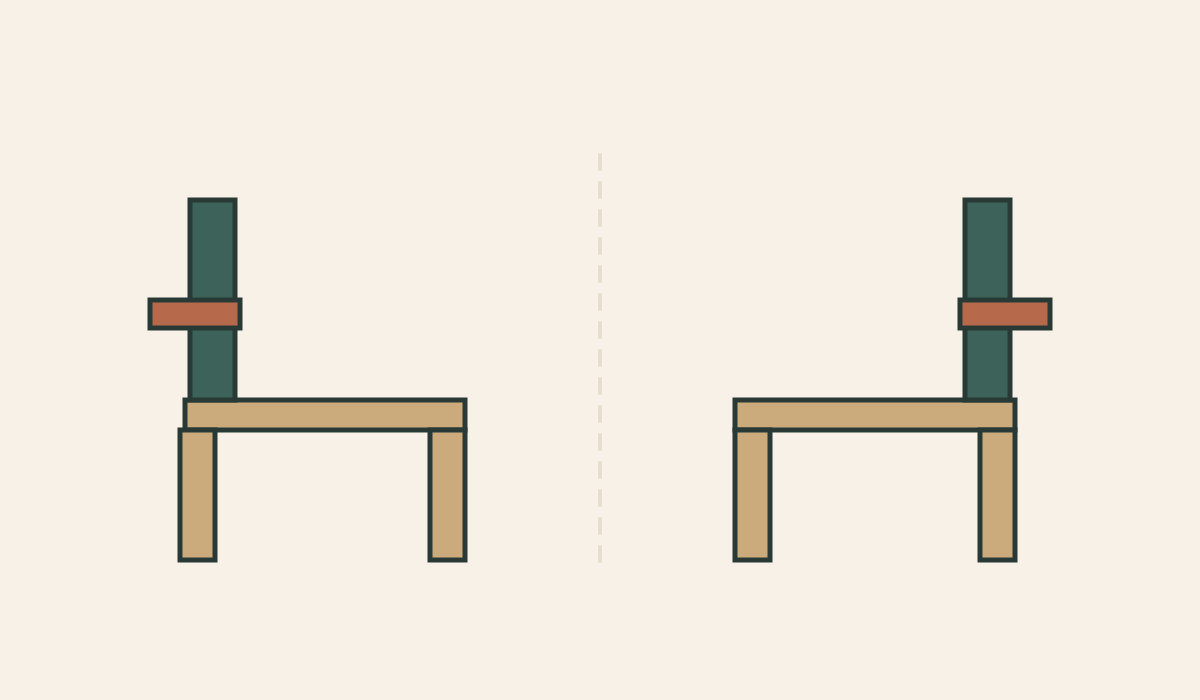
Two abstract mirrored seat-and-arm arrangements have their arms on opposite sides.
Original PatinaHall schematic, not to scale. Mirrored arrangements can place the arm on opposite sides. These abstract seat-and-arm diagrams explain handedness rather than reproduce the chair’s construction.

The familiar wood came later

The chairs made for the shop were white-upholstered. Spectrum distinguishes those originals from the exposed-wood version produced after Rietveld's death. The outline that is now often encountered as bare oak therefore has a history involving a different surface.2

That matters to the story because upholstery alters more than colour. It changes the edge, the feel of a surface and the way separate pieces meet the eye. Removing it from the historical account would make today's familiar version appear to be the whole original intention.

A design date is one kind of date

Centraal Museum explicitly labels 1963 as the design date and leaves the execution of its physical example unknown. It can confidently identify the design without pretending that every part of the object's history is settled.1

The same precision makes the story more interesting. There was a commission, an original pair, makers, and later versions. Return to the two seats at the display and the asymmetry stops being merely a striking shape. It becomes a way of arranging an encounter.
Research notesEvidence, connections and limits

The original shop pair and the better-known wooden versions must remain distinct. A museum's 1963 design date does not prove that its physical chair was made that year; Centraal Museum explicitly leaves execution undated.

Evidence map

Connected subjects and evidence

Reviewed facts

  • Designed 1963documented

    The original shop pair and the better-known wooden versions must remain distinct. A museum's 1963 design date does not prove that its physical chair was made that year; Centraal Museum explicitly leaves execution undated.

    Reviewed 23 October 2026 by PatinaHall editorial.

Reviewed connections

  • Steltman Chairdesigned byGerrit Rietvelddocumented

    The cited record identifies the designer of this design or coherent project family.

    Reviewed 23 October 2026 by PatinaHall editorial.
  • Steltman Chairmanufactured byGerard van de Groenekandocumented

    The source records this production relationship; it does not identify the maker or date of an unreviewed example. Later studio production is not used to date the original design.

    Reviewed 23 October 2026 by PatinaHall editorial.
    • Source 1Object 26103: Maker; ontwerp 1963, uitvoering onbekend

Research trail

Sources and further reading

  1. Steltmanstoel, object 26103Centraal Museum UtrechtAccessed 23 October 2026
  2. Steltman chairSpectrum DesignAccessed 23 October 2026
  3. Steltman Chair, object 85:2000Saint Louis Art MuseumAccessed 23 October 2026

Last reviewed 23 October 2026. Found an error or a stronger primary source? Contact PatinaHall.