Design story

Schröder Table: a small room made of planes

A table usually gives the eye a top and four supports. The Schröder Table gives it a small arrangement to walk around: flat parts cross, overlap and change their apparent balance as the viewer moves.

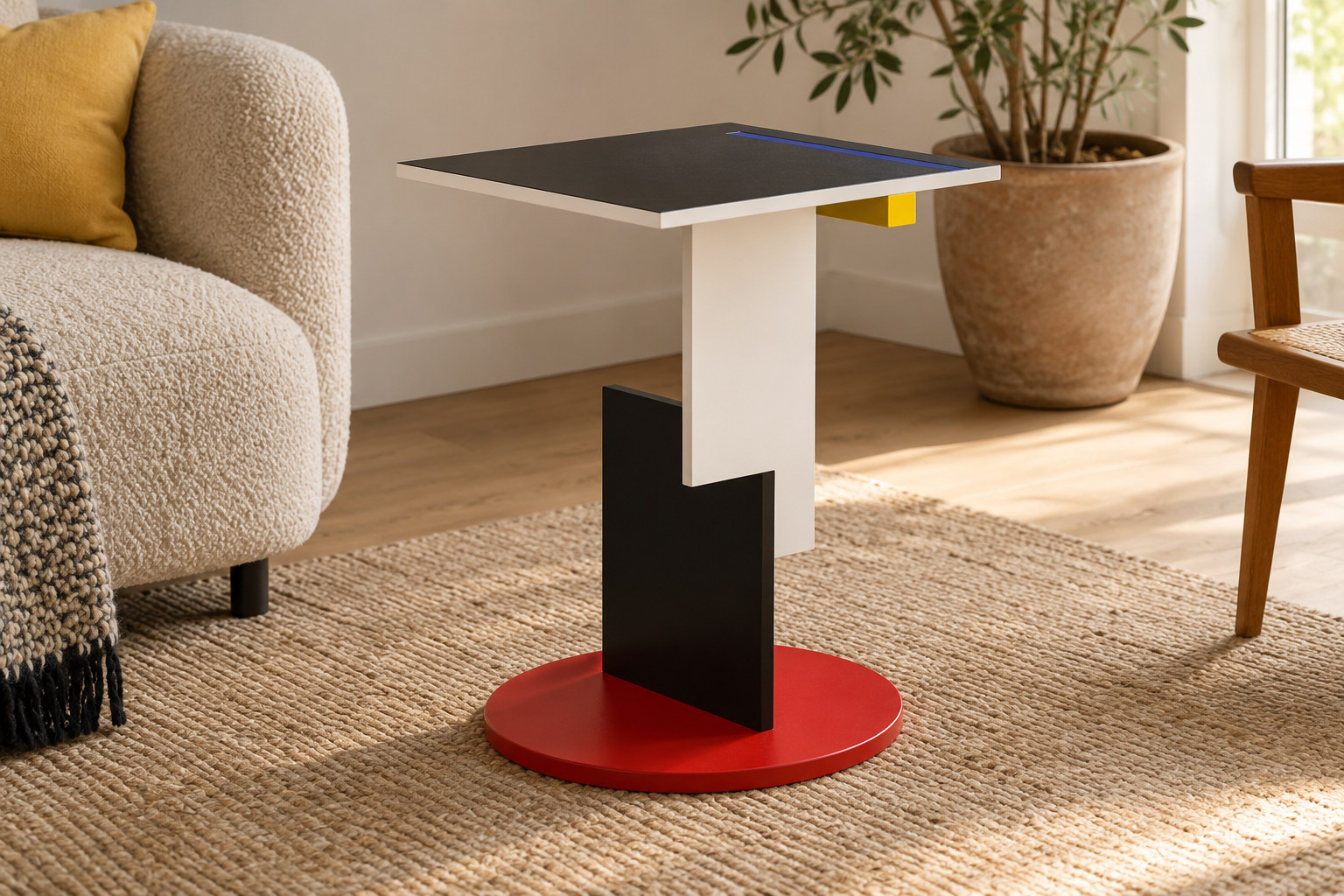
Small table with a black square top, intersecting pale and dark vertical planes and a red circular foot, seen from one side.
PatinaHall editorial reconstruction. It is not a documentary photograph. An interpretation of the table’s intersecting planes. The contrast between the square top and circular foot helps reveal its changing outline; this is not the Met’s individual table.
On this page
Key facts & takeaways

At a glance

Subject
Schröder Small Table
Entry
Design story
Last reviewed
23 October 2026
Designed
1923documented

Three things to remember

  1. The Met separates the 1923 design from its 1981 example.
  2. Asymmetry gives the table different readings from each side.
  3. Painted planes help the eye distinguish the intersecting parts.

Walk around the tabletop

The square top is only the beginning. Below it, upright planes interrupt one another rather than repeating the same arrangement at every corner. A circle at floor level introduces another geometry. The table seems composed in space as well as drawn in outline.

The Rietveld Stichting describes the small table as asymmetric. That word becomes useful when you change position: a broad plane from one direction becomes a narrow edge from another, and an apparent gap closes or opens. The furniture gives the room several different faces.2

Colour makes the parts readable

The Met records painted beech and beech-veneered plywood in its example. Paint lets a plane register as a distinct element before the eye starts following timber grain. Strong differences between surfaces make the intersections easier to read.1

This is a rewarding way to look at a small object. Instead of asking only whether the top is spacious enough, notice the changing relationship between its footprint, its upright parts and the air around them. A side table can do quite a lot with that small amount of room.
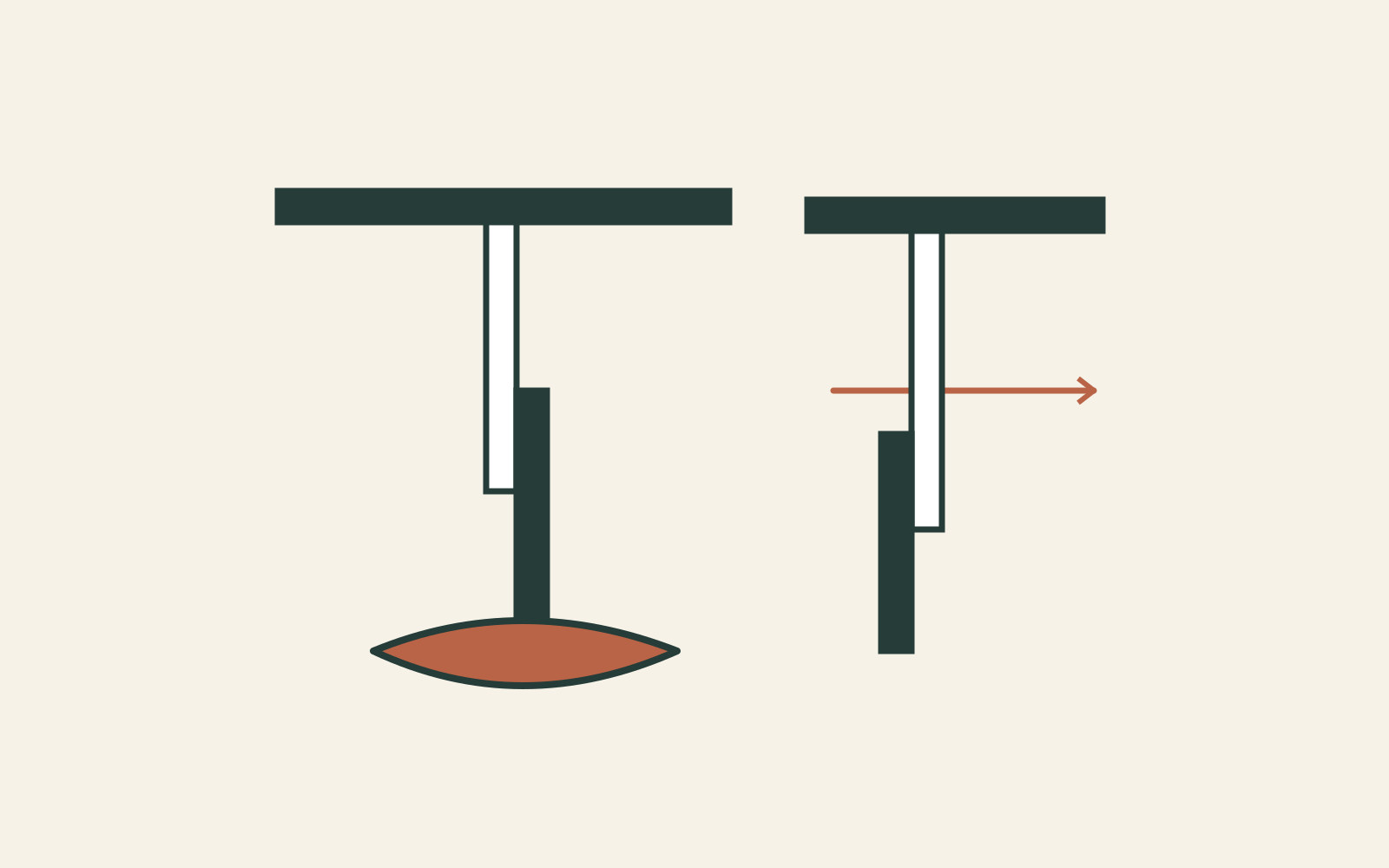
Two simplified table views emphasise a broad upright plane on one side and narrow edges on the other, linked by an arrow.
Original PatinaHall schematic, not to scale. One view shows broad planes while another turns them into edges. The simplified silhouettes explain why changing viewpoint changes an asymmetric composition; the two views are conceptual, not matched elevations.

One design, a later making

The Met distinguishes the design of 1923 from its table’s manufacture in 1981 and names Gerard van de Groenekan as maker. The later object carries an earlier spatial idea; it does not erase the years between them.1

That distinction also keeps the central pleasure in view. What travels through the design is a composition, ready to change again whenever someone walks past it.
Research notesEvidence, connections and limits

The Met dates its table’s design to 1923 and manufacture to 1981, crediting Van de Groenekan. These are distinct dates; that example does not establish the maker or manufacture date of every Schröder table.

Evidence map

Connected subjects and evidence

Reviewed facts

  • Designed 1923documented

    The Met dates its table’s design to 1923 and manufacture to 1981, crediting Van de Groenekan. These are distinct dates; that example does not establish the maker or manufacture date of every Schröder table.

    Reviewed 23 October 2026 by PatinaHall editorial.
    • Source 1Details; Curatorial discussion; image restrictions

Reviewed connections

  • Schröder Small Tabledesigned byGerrit Rietvelddocumented

    The cited primary or institutional record identifies this designer for the repeatable model or coherent project family. A design credit does not identify the manufacture of every example.

    Reviewed 23 October 2026 by PatinaHall editorial.
    • Source 1Details; Curatorial discussion; image restrictions
  • Schröder Small Tablemanufactured byGerard van de Groenekandocumented

    The source establishes this maker relationship in its stated scope. A historical example, current production and the original design date are separate facts.

    Reviewed 23 October 2026 by PatinaHall editorial.
    • Source 1Details; Curatorial discussion; image restrictions

Research trail

Sources and further reading

  1. Table: designed 1923, made 1981, object 852413The Metropolitan Museum of ArtAccessed 23 October 2026
  2. Furniture: Schröder Small Table and Birza ChairRietveld StichtingAccessed 23 October 2026

Last reviewed 23 October 2026. Found an error or a stronger primary source? Contact PatinaHall.