The missing legs are the starting point
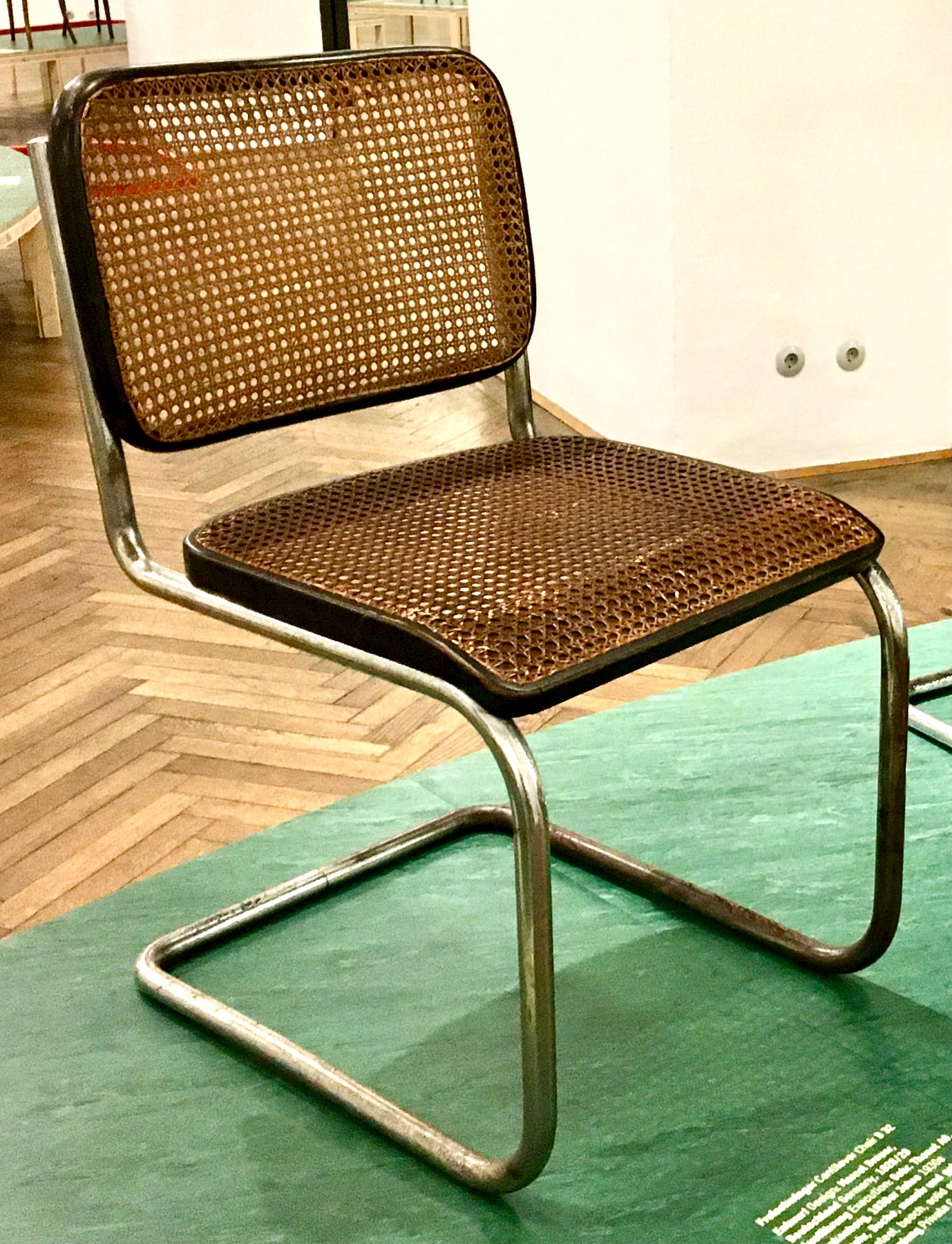
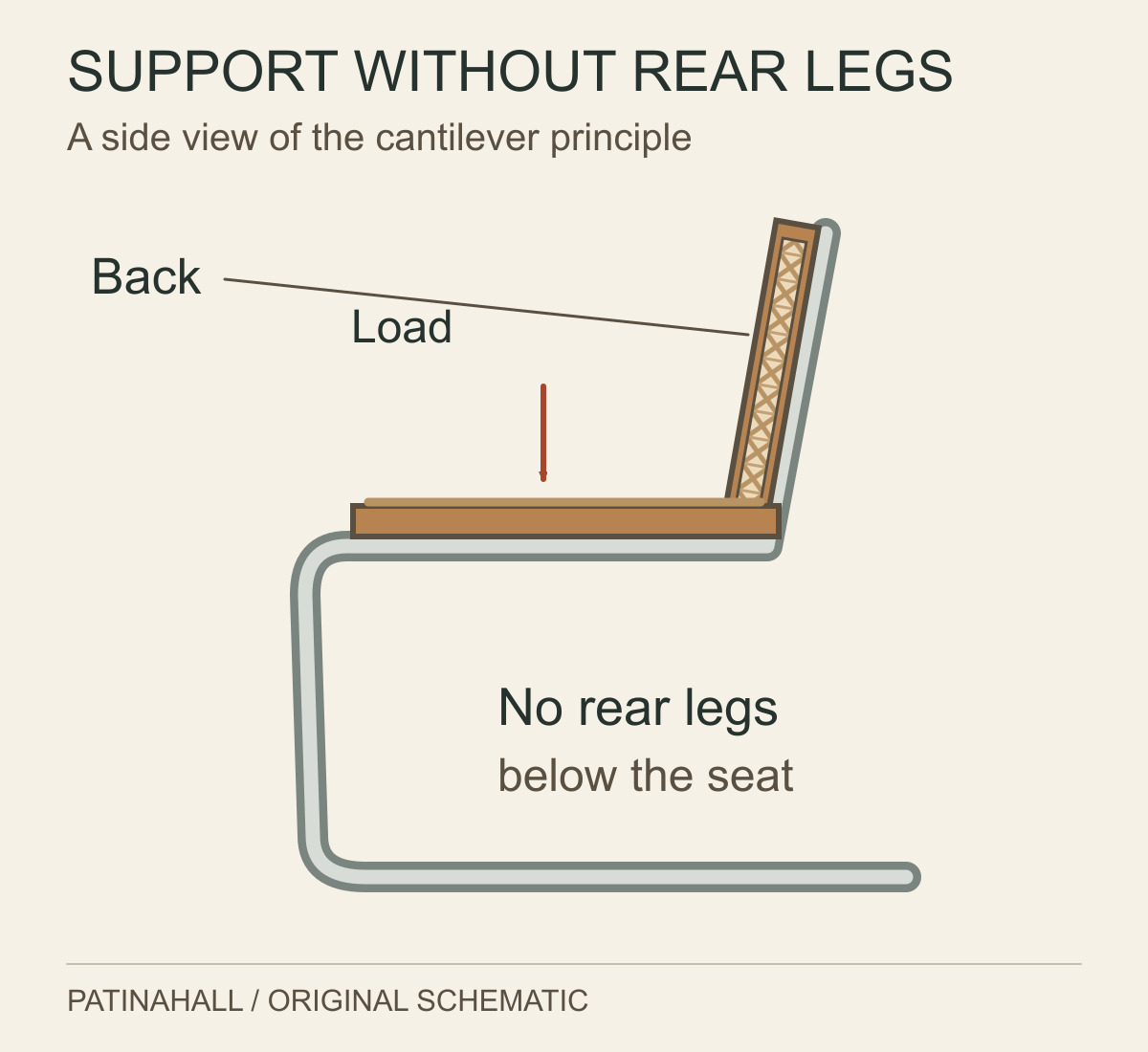
From the side, Cesca asks you to notice something absent. There is no ordinary pair of rear legs beneath the sitter. Support returns to the floor through a bent tubular frame, leaving the back of the seat apparently suspended.
That is a cantilever: a part projects from a support rather than standing on supports at both ends. In Cesca, the arrangement also gives the frame a degree of spring. Knoll describes that flexibility as part of the chair's comfort.5
The Museum of Modern Art records Marcel Breuer's Cesca Side Chair, model B32, as a 1928 design in chrome-plated tubular steel, wood and cane, made by Gebrüder Thonet.1
The remarkable thing is how quickly the unfamiliar support becomes an ordinary-looking dining chair. The absence of rear legs is easy to overlook once the seat and back come into view.
Three materials, three different jobs
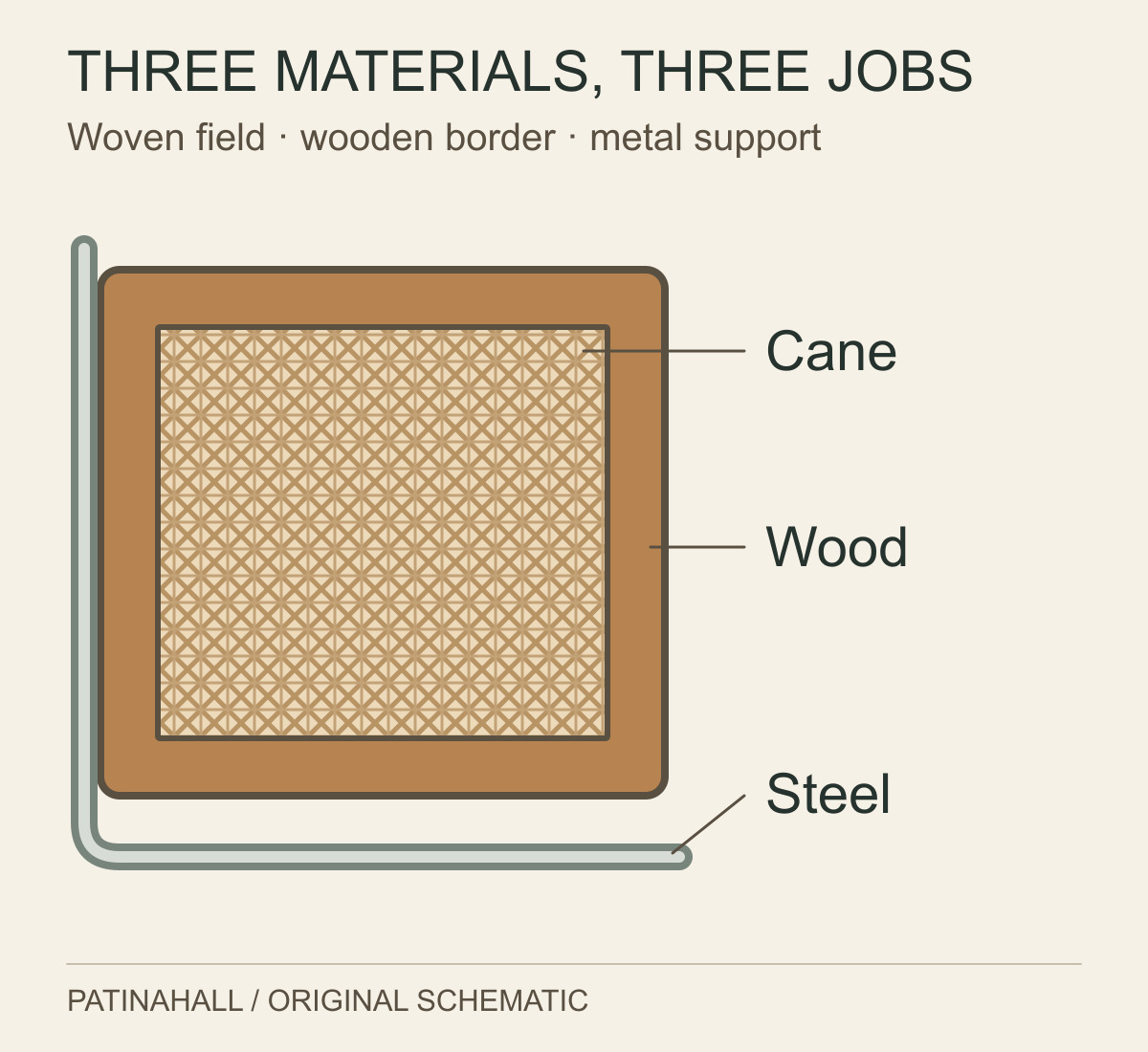
Steel supplies the narrow structural outline. Wood provides a firmer border around the seat and back. The woven cane fills those borders with a surface you can still see through. The museum's material record is short, but the combination explains much of the design.1
Think about the contrast between the shining tube and the small repeated openings in the weave. One reads as a continuous line; the other as a textured field. The wooden perimeter gives that field an edge, helping a porous surface remain visually distinct from the metal around it.
There is an armchair version too. MoMA records Breuer's B64, also dated 1928, alongside the armless B32.2 Adding arms changes the upper silhouette and the way the chair occupies space, while retaining the central relationship between a cantilevered support and framed sitting surfaces.
Breuer joined an argument already under way
It would be misleading to turn this story into the invention of every chair without back legs. Thonet's history places Mart Stam's cantilever experiments and Mies van der Rohe's flexible tubular chair within the discussion around the 1927 Weissenhof development. It then places Breuer's S32 in the following year.4
That sequence makes Cesca more interesting, not less. Designers were exploring what metal tube could let a chair do. Breuer's version joined that structural experiment to materials with a familiar domestic presence.
It is easy to read an unfamiliar frame as a technical demonstration. Wood and cane give this one another register: a chair that can join a dining table without making the whole room feel like an exhibition of engineering.
A 1928 design can have a much later life
The familiar name arrived within a longer production history. Knoll's account describes Dino Gavina renaming the chair after Breuer's daughter Francesca. It also dates Cesca's introduction into Knoll's collection to 1968, following its acquisition of Gavina.3
Those dates answer different questions. One belongs to the design; another to a later producer's catalogue. A chair made decades after 1928 does not become an early physical example merely because a listing repeats the design date.
The family continues to accommodate different surfaces: Knoll's current range includes cane and upholstered options, with and without arms.5 For this story, the cane version makes the material contrast especially clear.
Cesca remains easy to recognise because the experiment is visible without taking over. A steel line carries the sitter; a wooden border contains the weave. The chair leaves out two expected legs and keeps enough familiar detail to feel at home.
