Design story

Berlin Chair: a chair with more than one front

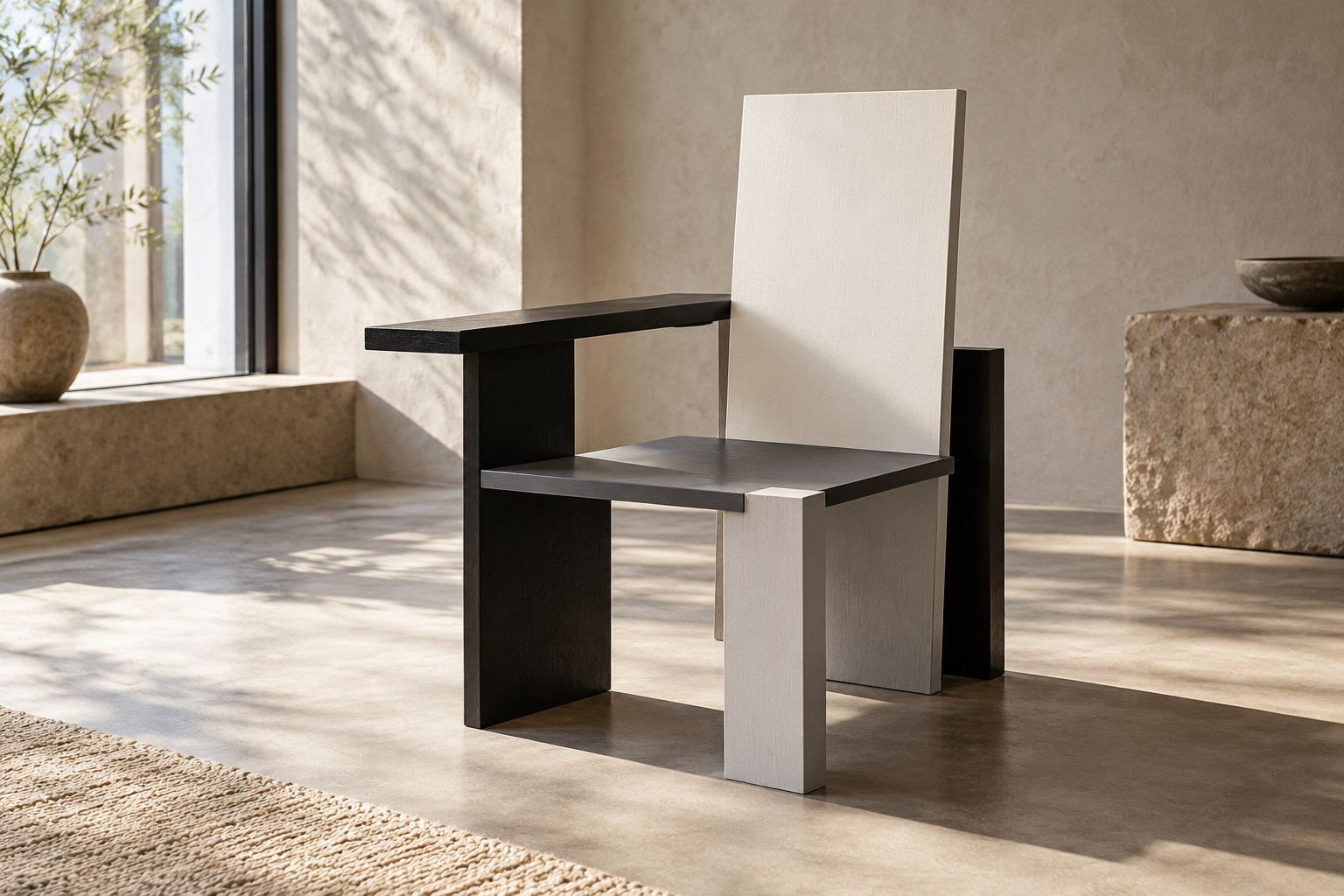
A chair usually invites one quick reading: back, seat, arms, legs. Berlin Chair makes that reading move around the object. Its unequal planes suggest a piece of architecture small enough for one person.

An asymmetric chair made from black, white and grey rectangular planes, with one broad raised arm plane.
PatinaHall editorial reconstruction. It is not a documentary photograph. An interpretation of intersecting planes and unequal sides, showing how the design changes with the viewpoint. This is not MoMA’s particular 1979 example.
On this page
Key facts & takeaways

At a glance

Subject
Berlin Chair
Entry
Design story
Last reviewed
25 October 2026
Designed
1923documented

Three things to remember

  1. Rietveld conceived the design in 1923.
  2. The two handed arrangements are distinct versions.
  3. MoMA’s Cassina-made example dates from 1979.

Walk around the planes

Berlin Chair rewards a second viewpoint. An upright plane can read as a back from one direction and as a divider from another. The broad projecting arm gives one side a different visual weight, while the spaces beneath and beside the seat let the room pass through the composition.

Black and white sharpen these relationships. Rather than relying on carved ornament, the chair makes the edges and meetings of flat parts do the visual work. The Foundation places its conception in 1923, in connection with a room and colour scheme developed with Vilmos Huszár.2

Asymmetry gives the room a role

The unequal sides make placement unusually interesting. Turning the chair changes which plane first meets the eye and where the open side seems to lead. A corner, wall or neighbouring object becomes part of that reading.

The Foundation records left- and right-handed arrangements.2 These are mirrored compositions, not evidence that an owner can swing one arm from side to side. Each arrangement gives the chair a particular relationship with the space around it.
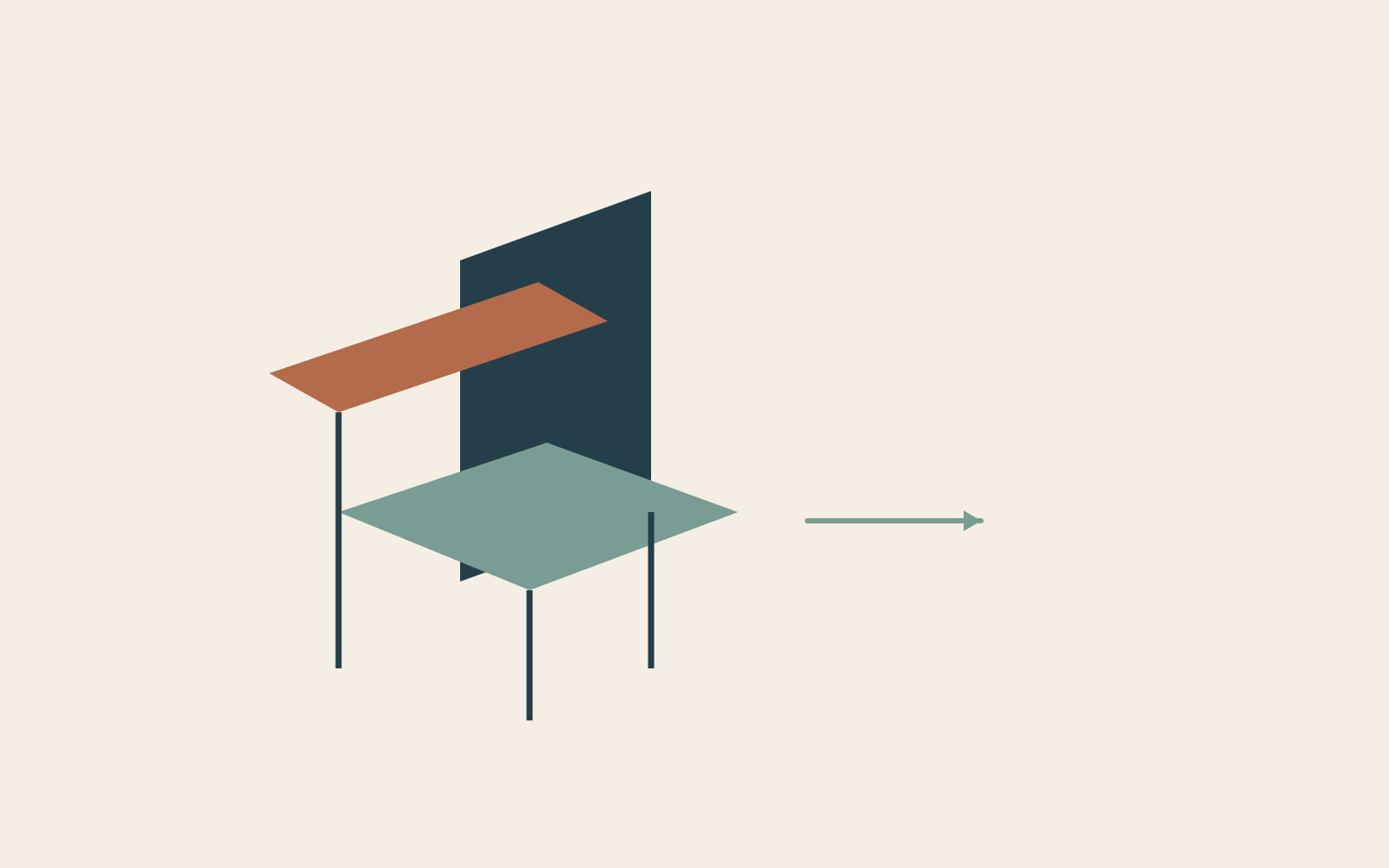
Three unequal planes meet at right angles while an arrow suggests a change of viewpoint.
Original PatinaHall schematic, not to scale. Intersecting planes and open intervals change their visual relationship as the viewer moves. The drawing does not fix a measured Berlin Chair version.

One idea, several moments

The 1923 idea and a later physical chair need separate dates. The Foundation suggests the early design probably existed first as a model. MoMA’s record describes its own painted-beechwood example as designed in 1923 and made in 1979, with Cassina named as manufacturer.12

That interval is part of the appeal. A compact experiment in planes could be revisited decades later as full-size furniture. Looking at Berlin Chair becomes a way to notice how much of a room a single seat can quietly reorganise.
Research notesEvidence, connections and limits

The Foundation distinguishes the 1923 conception, probably initially a model, from later versions. MoMA catalogues a 1979 Cassina example. Huszár’s collaboration concerns the room and colour scheme; it does not establish joint authorship of the chair.

Evidence map

Connected subjects and evidence

Reviewed facts

  • Designed 1923documented

    The Foundation dates the conception to 1923, probably first as a model. MoMA’s Cassina-made example dates to 1979, object 13.1980.

    Reviewed 25 October 2026 by PatinaHall editorial.

Reviewed connections

  • Berlin Chairdesigned byGerrit Rietvelddocumented

    Gerrit Rietveld designed the chair. Vilmos Huszár collaborated on the room and colour scheme, not automatically on the chair design. Cassina is the manufacturer named for MoMA’s 1979 example, not every Berlin Chair.

    Reviewed 25 October 2026 by PatinaHall editorial.
  • Berlin Chairmanufactured byCassinadocumented

    Gerrit Rietveld designed the chair. Vilmos Huszár collaborated on the room and colour scheme, not automatically on the chair design. Cassina is the manufacturer named for MoMA’s 1979 example, not every Berlin Chair.

    Reviewed 25 October 2026 by PatinaHall editorial.

Research trail

Sources and further reading

  1. Berlin Chair: Title/date; Manufacturer; Object numbermoma.orgAccessed 25 October 2026
  2. Furniture: Utrecht armchair, 1935Rietveld FoundationAccessed 23 October 2026

Last reviewed 25 October 2026. Found an error or a stronger primary source? Contact PatinaHall.