Two ways of arriving at a curve
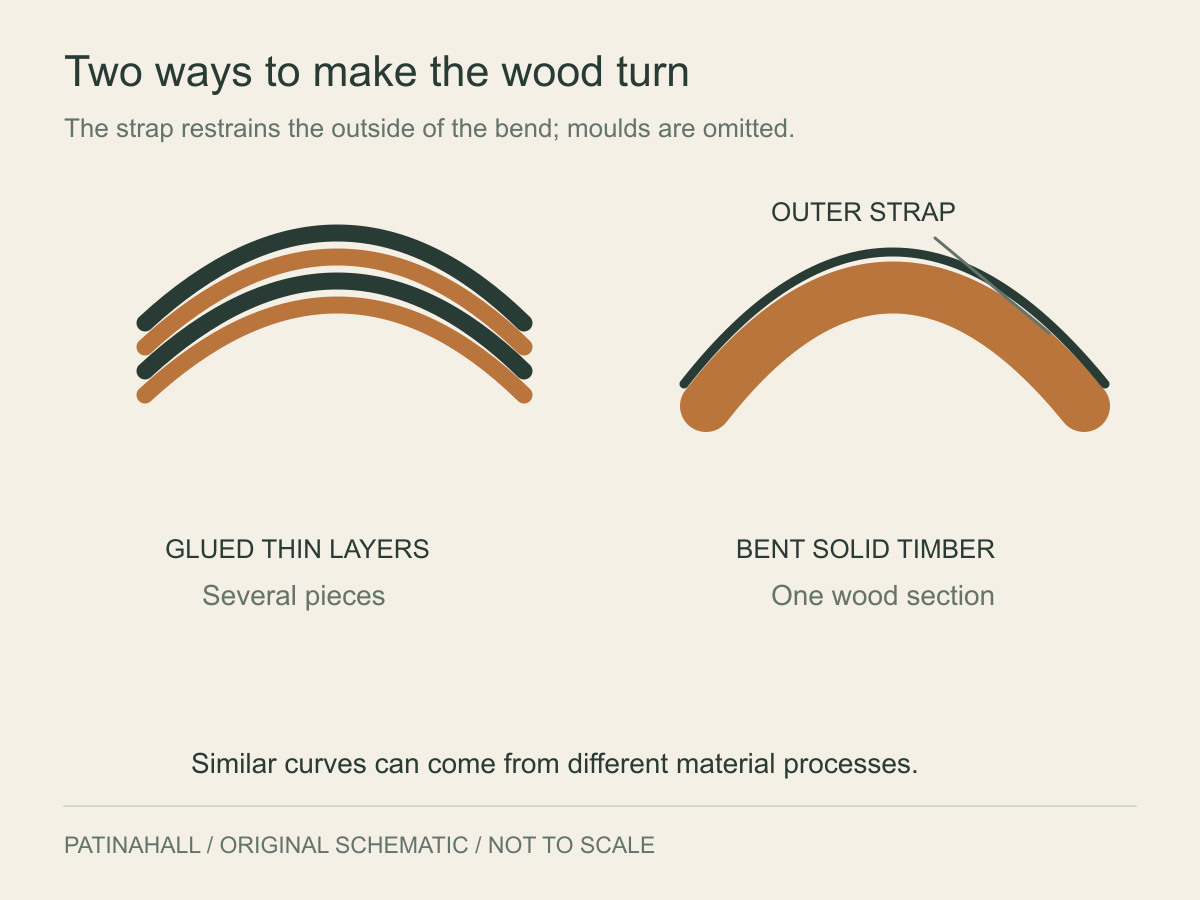
A curved chair part can be cut from a thick board, assembled from thinner layers or formed by bending the timber itself. The finished outlines may look similar, but the material and the work have taken different journeys.
Thonet’s early experiments in Boppard used veneers softened in hot glue and pressed together. The company’s historical account recalls a shipment to South America whose glued components failed in the heat and humidity. It presents this setback as part of the search for a more dependable process.2
That story is useful even without turning it into a single miraculous turning point. A method that works in the workshop still has to survive transport and use. The furniture’s destination can expose a weakness that the maker’s immediate surroundings never revealed.
The strap on the outside
The later process bent steamed solid wood with the help of a metal strap around the outside of the curve. As the timber is forced into shape, the outer side wants to stretch. The strap helps restrain that movement, reducing the tendency for the fibres there to tear apart.1
This makes the tooling part of the form. The smooth wooden loop looks self-contained when removed from the mould, but achieving it required another object to hold and guide the wood.
It is a useful distinction when looking at bent furniture. A continuous grain does not mean the curve happened easily. The apparent simplicity of the finished component can conceal a demanding sequence of preparation, forming and drying.
Moving the workshop towards the forest
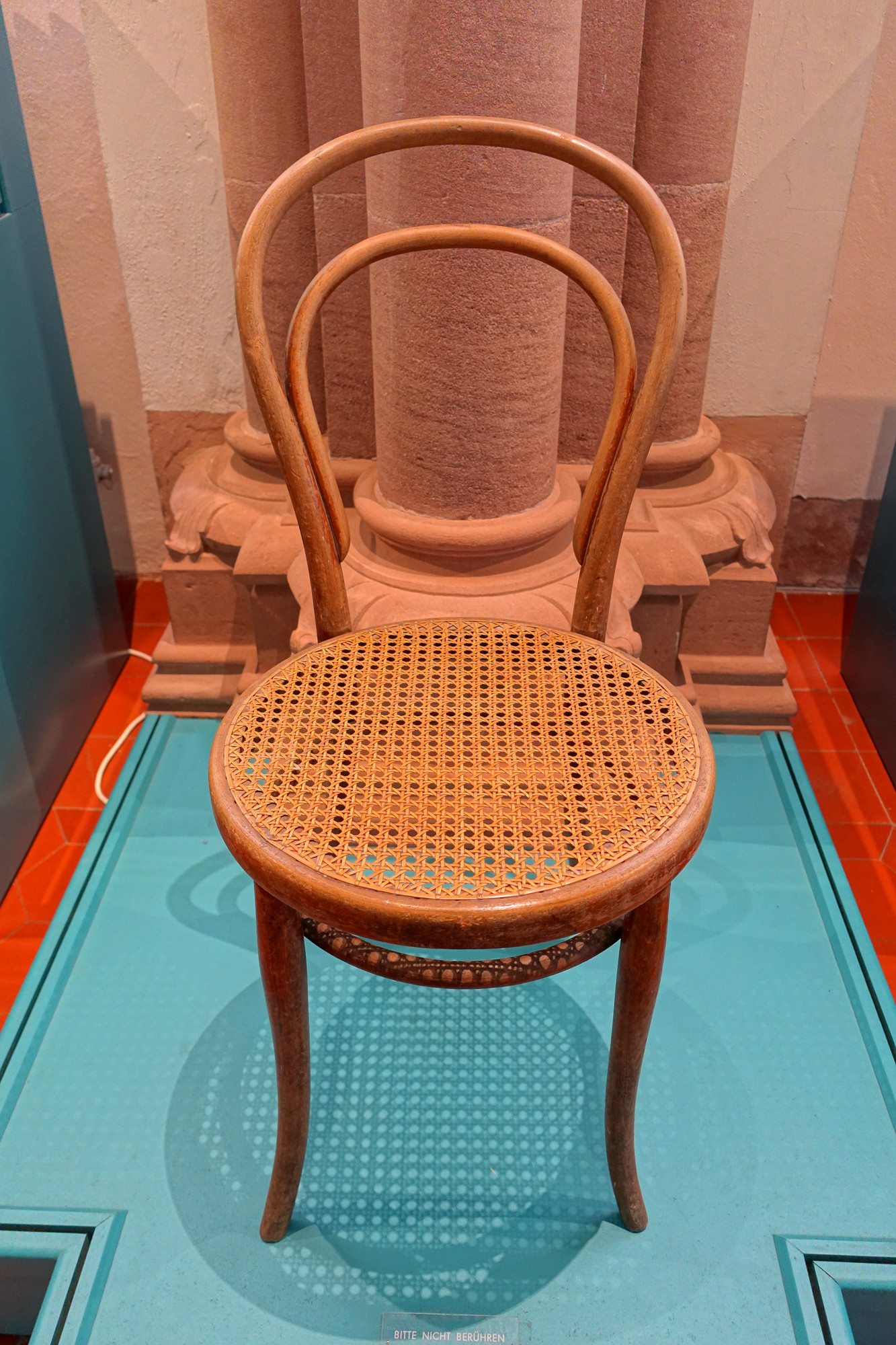
Thonet established his workshop in 1819. After moving to Vienna, he developed the enterprise with his sons; Gebrüder Thonet dates from 1853. The company records its solid-bending patent in 1856, followed by the No. 14 chair in 1859.3
The V&A places a factory at Koryčany in 1857, where timber, labour and transport connections could support expansion. Tasks were divided so that workers repeated particular operations. Making a chair became an organised flow of material through specialised stages.1
Those arrangements are less immediately attractive than a curved backrest, but they explain why the form could become familiar. A successful prototype demonstrates a possibility. A factory must make that possibility repeatable while supplying the next chair, and the next.
The crowd behind the solitary chair
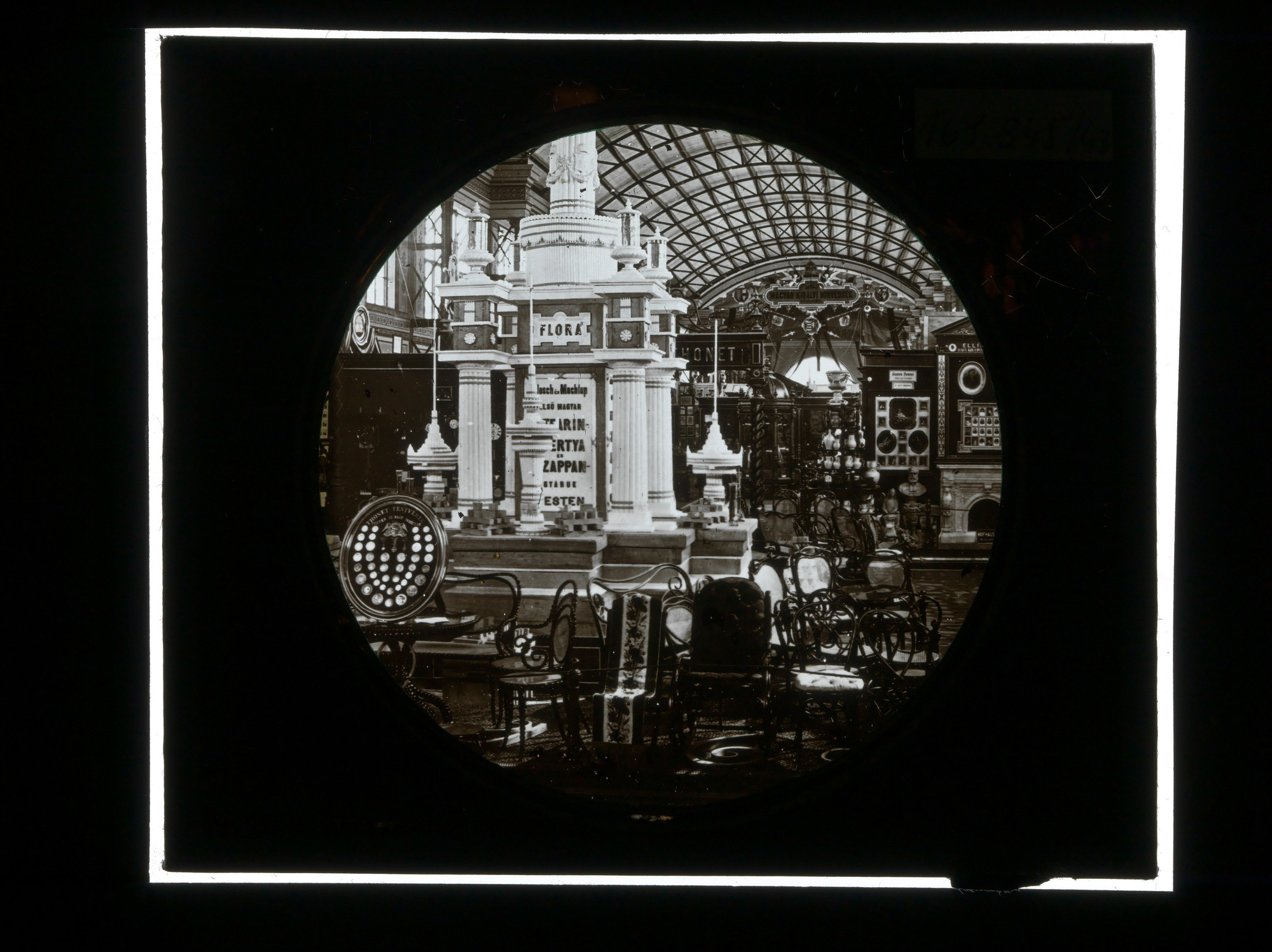
The 1873 exhibition photograph brings some of that collective scale back into view. It shows the company’s output after Michael Thonet’s death, when the business had become much larger than a cabinetmaker’s bench.
Look again at a bentwood chair on its own. Follow the curve, then imagine the strap, the mould, the timber arriving and the repeated operations. The chair still looks light. Its history has acquired the weight of a whole production system.