A chair designed beyond its outline
How did one café chair become a global manufacturing system? Chair No. 14 worked because the curve, the parts, the hardware and the packing crate solved one another's problems. It was not a handsome chair followed by a clever distribution plan. The distribution plan was already inside the chair.
The Philadelphia Museum of Art and the Germanisches Nationalmuseum both place Michael Thonet's design in 1859. Taken together, their records put that date beside the facts that made industrial manufacture possible: few components, repeatable work and assembly that could happen after shipment. 1 2
That is why the familiar outline matters, but cannot tell the whole story. A curved back is visible. A reduced parts inventory, divided factory labour and a smaller freight volume are not. No. 14 brought all of them into the same object, then let the object travel before it became a chair.
Teaching beech to turn a corner
A carved curve begins with a block thick enough to contain the final shape; everything outside that shape becomes waste. A bent curve begins with a long, comparatively slender piece of wood. If it can be made pliable, formed and dried consistently, the curve can be repeated without carving it out afresh.
Thonet's account of solid bentwood starts with beech rods softened by steam. A metal tension band lies along the outside of the intended bend, where the wood would otherwise stretch and split. Held against that band, the outer fibres keep their length while the inner side compresses. The prepared rod is drawn into a mould and remains there until its new geometry has set. 5
The mould does not remove skill; it changes where skill is spent. Material selection, moisture, heat, pressure and timing still matter, but a successful curve can now become a controlled production step shared among workers. The result is both structural and visual. Long bent members carry the sitter while drawing the chair's recognisable loops and arcs, so the method does not hide behind the form. It creates it.
Beech was well suited to that method. The same Thonet material history describes solid beech as the basis of the company's serial bentwood process. MoMA's documented 1881 Chair No. 14 is correspondingly catalogued in beechwood with a cane seat.5 3
Bentwood is a family, not a model number
Once a workshop can repeat a reliable curve, one chair does not exhaust the idea. Bentwood is a technique; Chair No. 14 is one particular design made with it. Shared material and process can create a resemblance without making every result the same model.
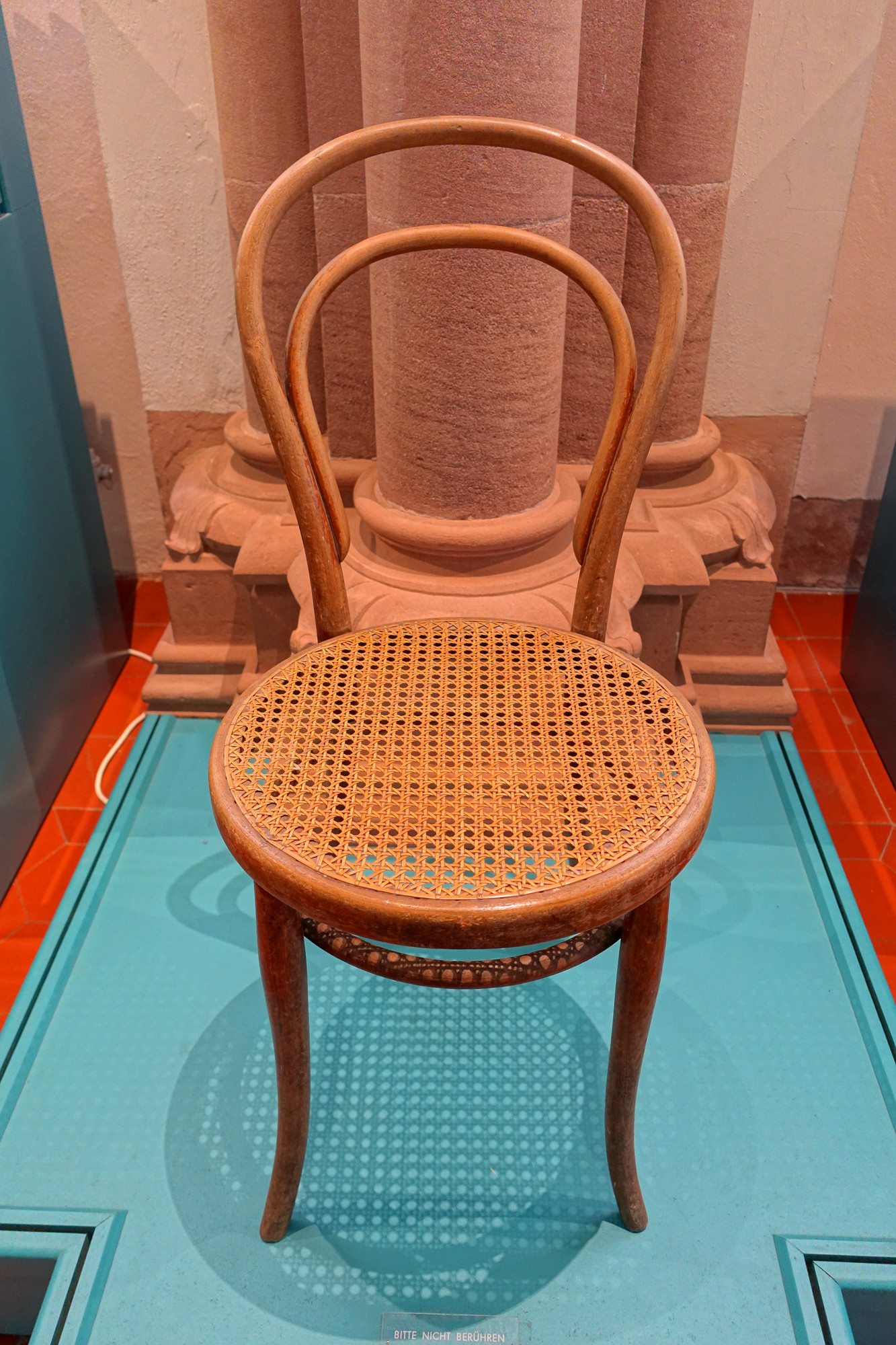
The later museum chair in the primary photograph helps fix that distinction. Its seat ring, slender legs, curved rear supports and open back make a specific arrangement. Other Thonet chairs can share beech, cane, screws and looping members while changing the back, seat, proportions or number of parts. A production method can create a family resemblance without erasing individual design identities.
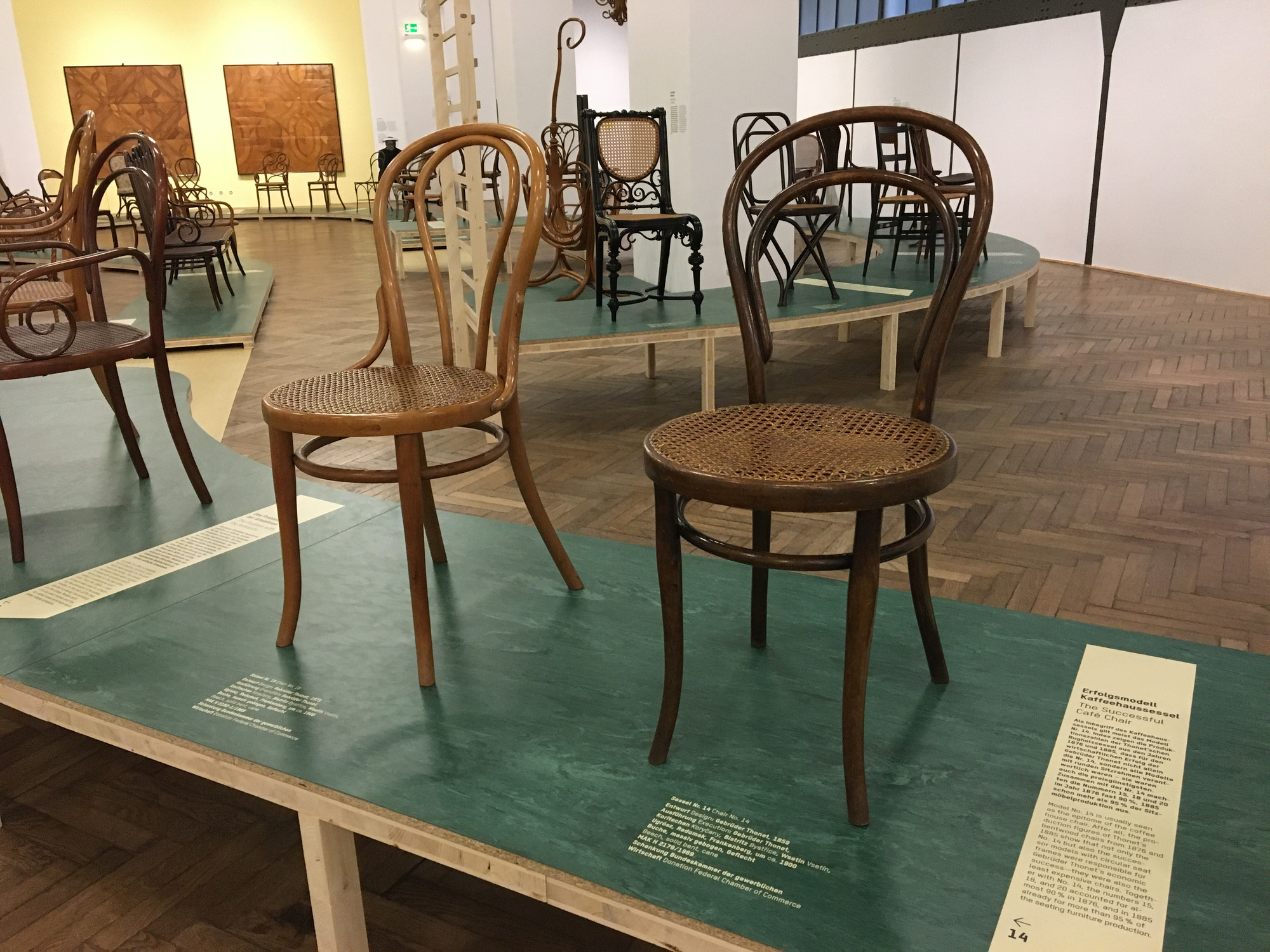
The modern MAK exhibition photograph beside this chapter is useful for that reason. It gathers different Thonet bentwood forms into one contemporary museum display, making comparison easier. It is a modern curatorial view, not a period factory scene; its value is visual evidence that one method could support a much larger furniture vocabulary.
That wider vocabulary also clarifies why No. 14 became so influential. It was not important simply because wood had been persuaded to curve. Its particular curves were organised into an unusually economical product whose manufacture, assembly and movement reinforced each other.
Six wooden parts, ten screws, two nuts
The manufacturer's account reduces Chair No. 14 to six wooden components, ten screws and two nuts. The Philadelphia Museum of Art repeats the same construction and explains that the parts could be assembled after shipment. 41
The small number matters in several ways. Each wooden member can have a clear job and a repeatable shape. Factories need fewer different components to make, sort and keep together. Hardware joins those components without requiring the whole chair to leave the bending operation already complete.
Look at the chair as a sequence rather than a silhouette. The seat ring establishes the horizontal frame. Legs lift it from the floor. Curved rear members continue upwards to support the back. Cane spans the seat without turning it into a heavy wooden platform. Screws bring the separate pieces into one load-bearing assembly.
The point is the production logic. A joint can be structurally ordinary and historically consequential when it allows work to happen in a different place or order.
The crate completed the chair
A finished chair occupies a great deal of air. That is harmless in a café and expensive in a freight crate.
Thonet says 36 disassembled No. 14 chairs, including their hardware, could fit into one cubic metre and be assembled after transport. The Philadelphia Museum of Art gives the same packing account. Whether viewed from a factory, railway wagon, ship or destination workshop, the consequence is the same: shipping space no longer had to be measured around 36 finished backrests. 41
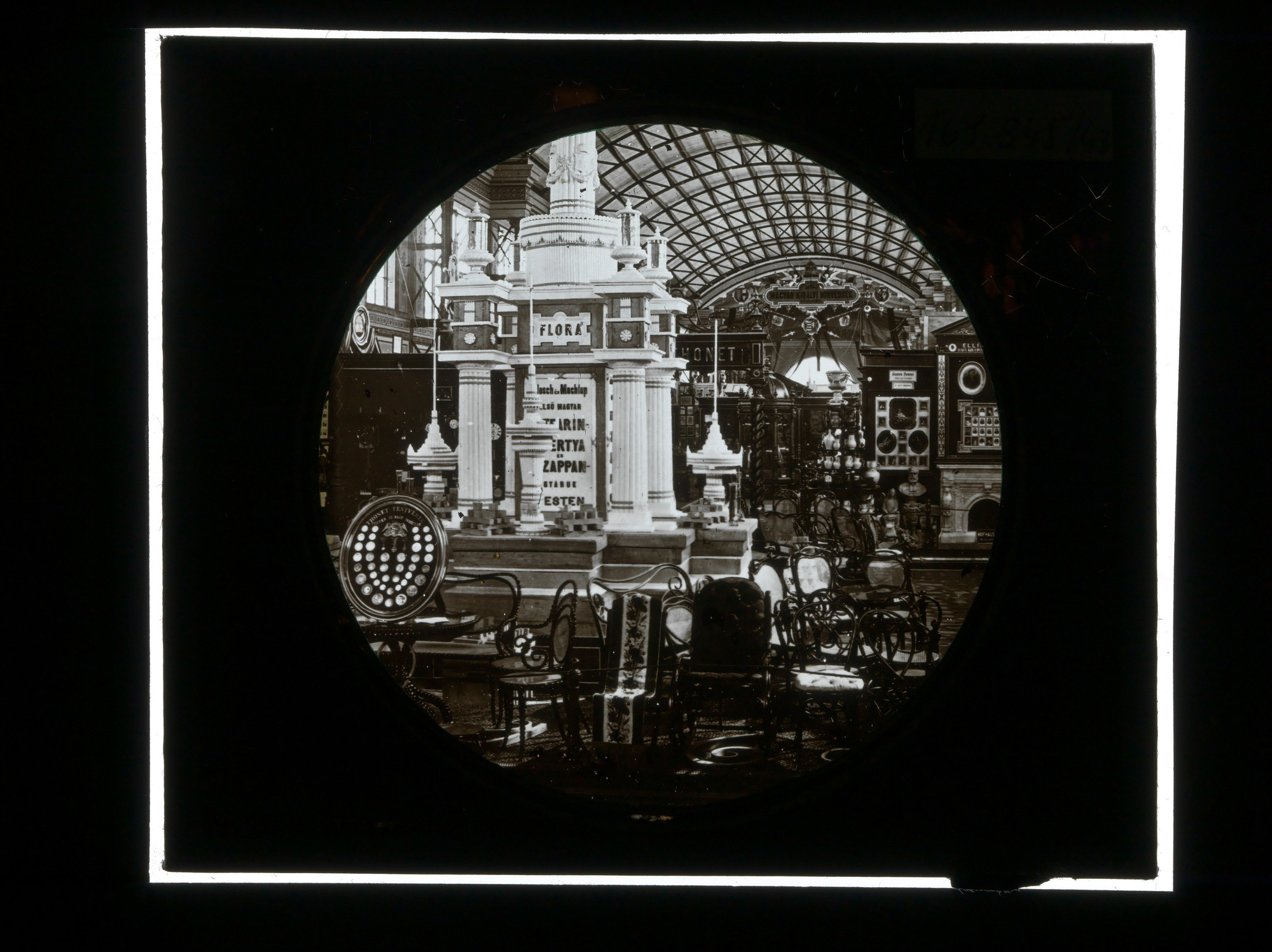
The 1873 Wien Museum photograph beside this chapter shows a display of Thonet furniture at the Vienna World's Fair. The museum catalogues the view broadly as Thonet furniture rather than itemising the visible models. It records how the company presented a furniture range and makes tangible the international setting into which these production and packing decisions travelled. 6
The Germanisches Nationalmuseum reports that roughly 50 million No. 14 chairs had been produced by 1930.2 The figure describes importance through multiplication, not scarcity. A chair that could be bent repeatedly, packed tightly and assembled elsewhere could reach rooms far from the moulds that made its curves.
The crate therefore belongs in the design history. It did not determine what the chair looked like on its own, but it rewarded fewer components, compact parts and deferred assembly. The form made the logistics possible, and the logistics gave the form its extraordinary range.
1859 is not the date of every No. 14
A design can remain permanent while individual chairs enter the world years or decades later. The date 1859 names the accepted design moment for No. 14. It is not a date stamp that history applies to every example with the same outline.
MoMA catalogues one physical Chair No. 14 as an 1881 object made by Gebrüder Thonet from beechwood and cane.3 The primary photograph on this page shows another museum example catalogued around 1920 at the Germanisches Nationalmuseum. Both chairs help us see the design. Each still keeps its own manufacture date and institutional identity.
That separation is more than tidy cataloguing. It lets the story survive when no example is for sale, while preventing the famous history of the model from becoming borrowed provenance for an unknown chair. No. 14's achievement is already substantial: it joined material behaviour, repeatable parts, assembly and transport so completely that an economical café chair became a global design system.

