Designer profile

Cees Braakman: bringing factory knowledge home

Furniture history often remembers a cabinet’s outline more readily than the factory knowledge behind it. Cees Braakman’s career at Pastoe invites a wider view. Travel, materials, repeatable parts and the work of colleagues helped shape what the manufacturer could offer a household.

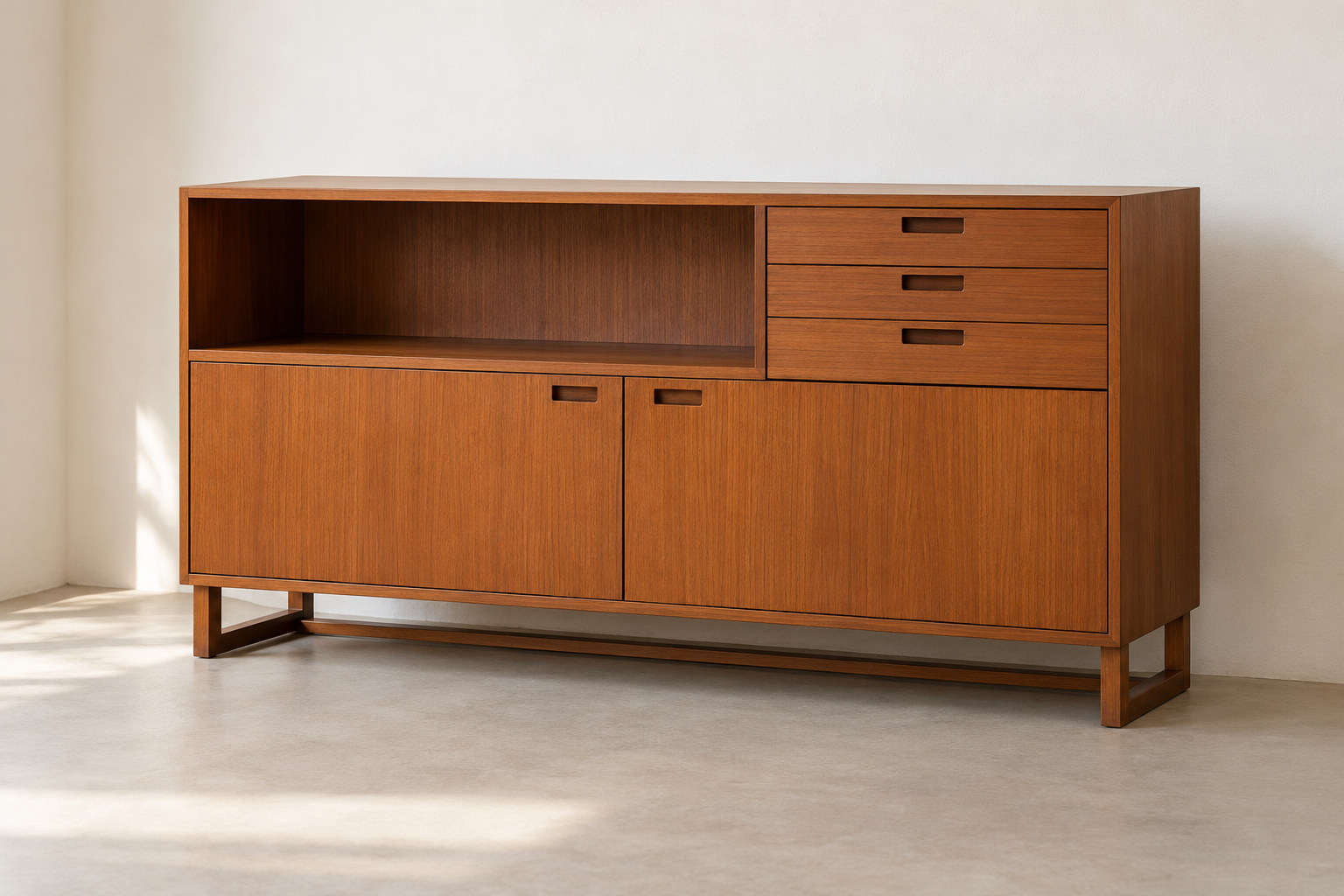
Editorial reconstruction of a low timber storage unit composed of repeated open and closed rectangular bays on slender supports.
PatinaHall editorial reconstruction. It is not a documentary photograph. Repeated bays introduce the idea of compatible cabinet parts. This imagined arrangement does not reproduce an original Made-to-Measure set, Bus’s fitting or a verified timber specification.
On this page
Key facts & takeaways

At a glance

Subject
Cees Braakman
Entry
Designer profile
Last reviewed
23 October 2026

Three things to remember

  1. His American study journey examined furniture production.
  2. His Pastoe work connects manufacturing knowledge and adaptable storage.
  3. A product system is a collaborative achievement, not just a silhouette.

A journey into production

Cees Braakman's American study journey concerned the inside of furniture making. A local history of UMS Pas-Toe records him visiting production businesses in 1947 and taking particular interest in Herman Miller. The useful subject is what a factory could learn, as well as what a designer could see.1

A finished chair can travel as an image. Production knowledge involves other questions: how material is prepared, how a curve is formed, what equipment is needed and which operations can be repeated. Those questions help explain why travel could change the offer of a furniture company.

The product and the process belonged together

Pastoe's account connects Braakman's interest in American design with Charles and Ray Eames and with a growing emphasis on adaptable storage. It presents the factory's development through manufacturing and customer choice together.2

This provides a way to look beyond the surface of a period cabinet. A curved part or repeated component is also evidence of decisions about making. The visual result can be considered alongside the process that allowed a manufacturer to offer it again.

The histories differ about the exact year when Braakman succeeded his father at Pastoe. That uncertainty need not be hidden behind a confident date. The documented production journey and subsequent body of work support the central account without requiring that disagreement to be silently resolved.
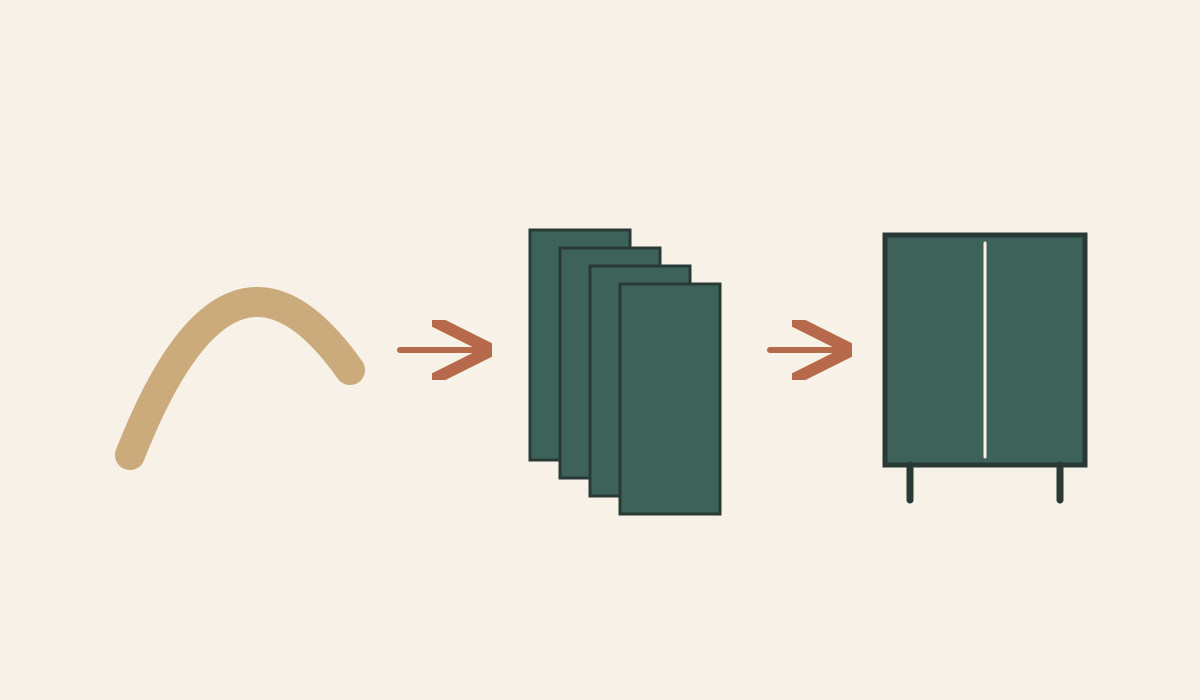
A curved component, repeated panels and a cabinet arrangement are joined in sequence.
Original PatinaHall schematic, not to scale. Production knowledge connects forming a component with making repeatable parts and offering a cabinet system. These are ideas, not a historical factory diagram.

Choice becomes part of the furniture

Made-to-Measure brought a further question into the relationship: what should the customer be able to decide? Pastoe's heritage account describes a cabinet system that could be configured and later expanded. The company was offering a vocabulary of possible arrangements. 2

The significance for Braakman's career lies in the connection between those choices and the factory behind them. Adaptability has to be made possible through compatible parts and repeatable work. A system is therefore a collaborative achievement, as well as a design idea.

A manufacturer leaves an archive

Kunsthal's centenary presentation brought sketches, advertising, photographs and exhibition displays into Pastoe's history. Those materials extend the story beyond a row of finished products. 3

They are also a useful reminder of what can be brought home from a production journey. The result may appear in a cabinet, but it can continue in the way a factory thinks, presents its work and gives a household something to choose.
Research notesEvidence, connections and limits

The local history and current manufacturer history give different dates for his succession at Pastoe. The article keeps that disagreement visible and uses the published local history for the production journey rather than claiming access to unseen catalogue contents.

Evidence map

Connected subjects and evidence

Reviewed connections

  • Pastoe Made-to-Measuredesigned byCees Braakmandocumented

    The cited record identifies the designer of this design or coherent project family.

    Reviewed 23 October 2026 by PatinaHall editorial.
  • Cees Braakmancollaborated withPastoedocumented

    The source documents the designer working with this organisation; it is not a national-origin or employment-date inference.

    Reviewed 23 October 2026 by PatinaHall editorial.
    • Source 1Eerste vijftig jaar UMS Pas-Toe: the 1947 study journey

Research trail

Sources and further reading

  1. Eerste vijftig jaar UMS Pas-Toe: the 1947 study journeyOud-UtrechtAccessed 23 October 2026
  2. The Story of PastoePastoeAccessed 23 October 2026
  3. Like Pastoe: 100 jaar vernieuwing in vormgevingKunsthal RotterdamAccessed 23 October 2026

Last reviewed 23 October 2026. Found an error or a stronger primary source? Contact PatinaHall.