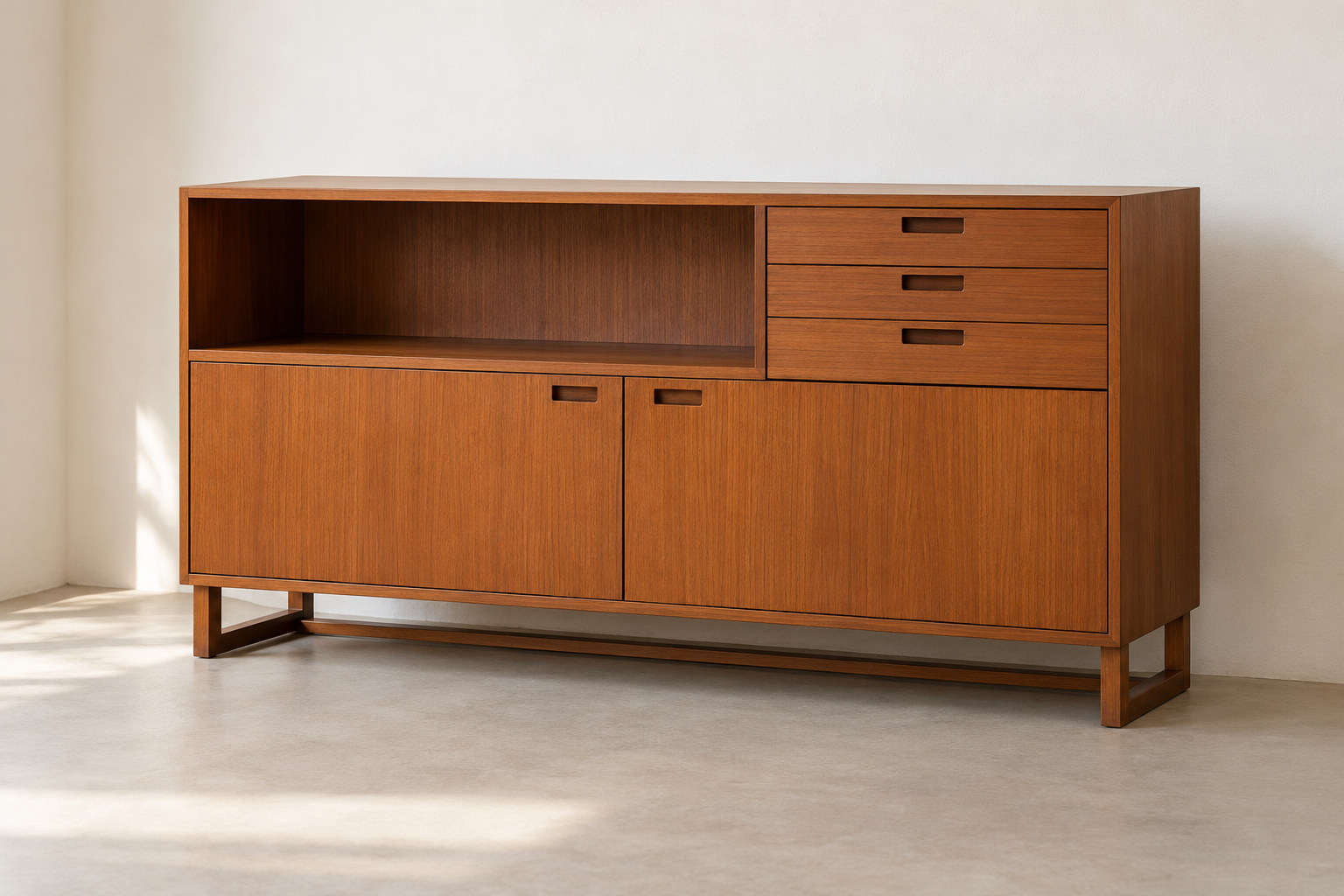
The useful invention can be a junction
A cabinet usually arrives as a finished volume. Pastoe's Made-to-Measure system asked what would happen if its arrangement could begin with standard parts. Panels and storage components could be combined, assembled and later changed. The corner was a place where a product could become a system.
Pastoe dates the introduction of Pastoe naar Maat to 1955. Its present heritage account describes customers choosing their own cabinets and having the possibility of later expansion.1
A choice within a vocabulary
Made-to-Measure did not mean that every dimension was freely invented. The historical account describes Cees Braakman working with standard measurements. The possibility of different combinations came from a defined vocabulary of compatible parts.2
That is a productive kind of constraint. Repeatable dimensions allow pieces to meet; a choice of pieces lets the whole change. A low run and a taller arrangement can share a logic without being the same piece of furniture.
Look at the meeting of a horizontal panel and an upright. It is a small event with consequences for everything attached to it. If that connection can be repeated, the designer has given the customer more than one silhouette.
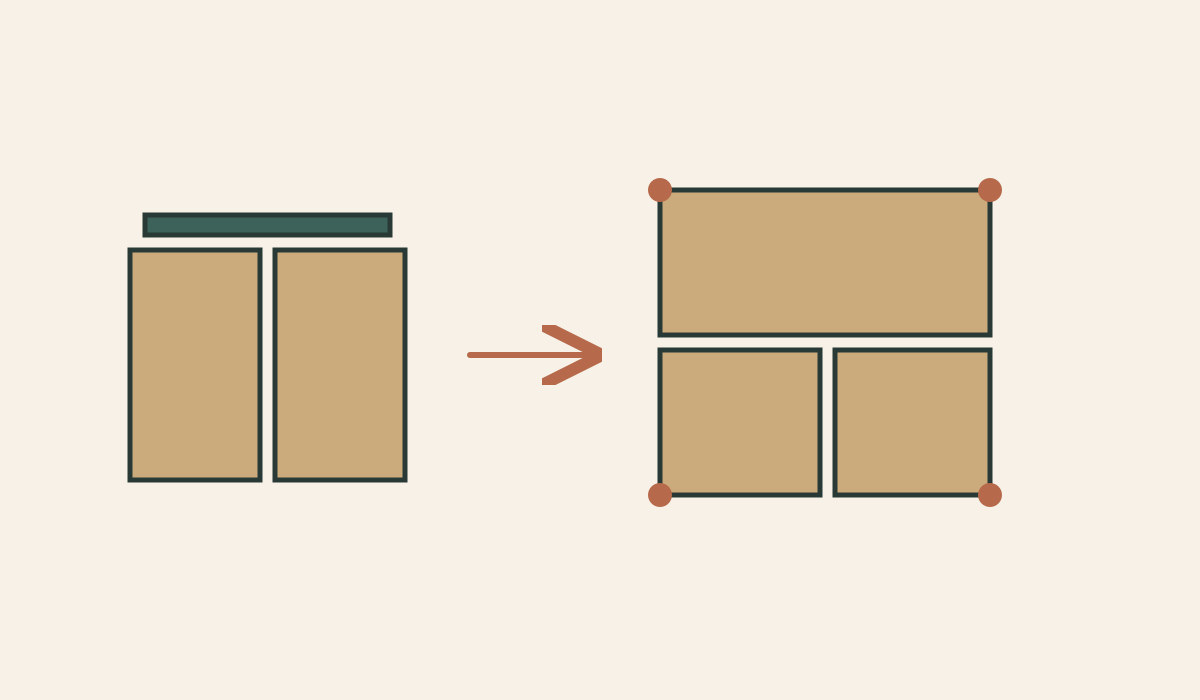
The joint has its own author
The published history and Domus's account identify Johannes Antonius Bus's contribution to the corner-joint development. Braakman's modules and that connecting technology are related achievements, rather than one person's interchangeable credits.23
This matters because furniture history is often told through the face of the finished object. The less photogenic fitting can determine what forms are possible, how parts travel and who can put them together. A system makes the contribution of that fitting unusually consequential.
Flexibility also changes the transaction
The history records that delivering the furniture as components could remove an assembly stage at the factory. It also notes that the system was not necessarily cheap: development itself carried a cost. A kit and an inexpensive product are different claims.2
The interesting promise was room for change. The cabinet could be understood as an arrangement made for a moment, with compatible parts still available to the imagination. Return to the corner and it begins to look less like the end of a panel and more like the beginning of another possible cabinet.