An architect at the factory
The connection with architecture was literal. Kartell’s headquarters at Noviglio, occupied from 1967, was designed by Castelli Ferrieri with Ignazio Gardella. Her involvement in the company extended across the place where objects were made and the objects that emerged from it.1
A factory encourages a particular kind of attention. A curve must become a mould; a part must come out of it; several parts must meet reliably. The attractive surface is only one stage of the problem.
That makes the 4870 a useful introduction to her work. It looks straightforward from a distance, yet small decisions govern what it can do when somebody sits down, when it is assembled and when a roomful of chairs needs to be put away.
A second design underneath
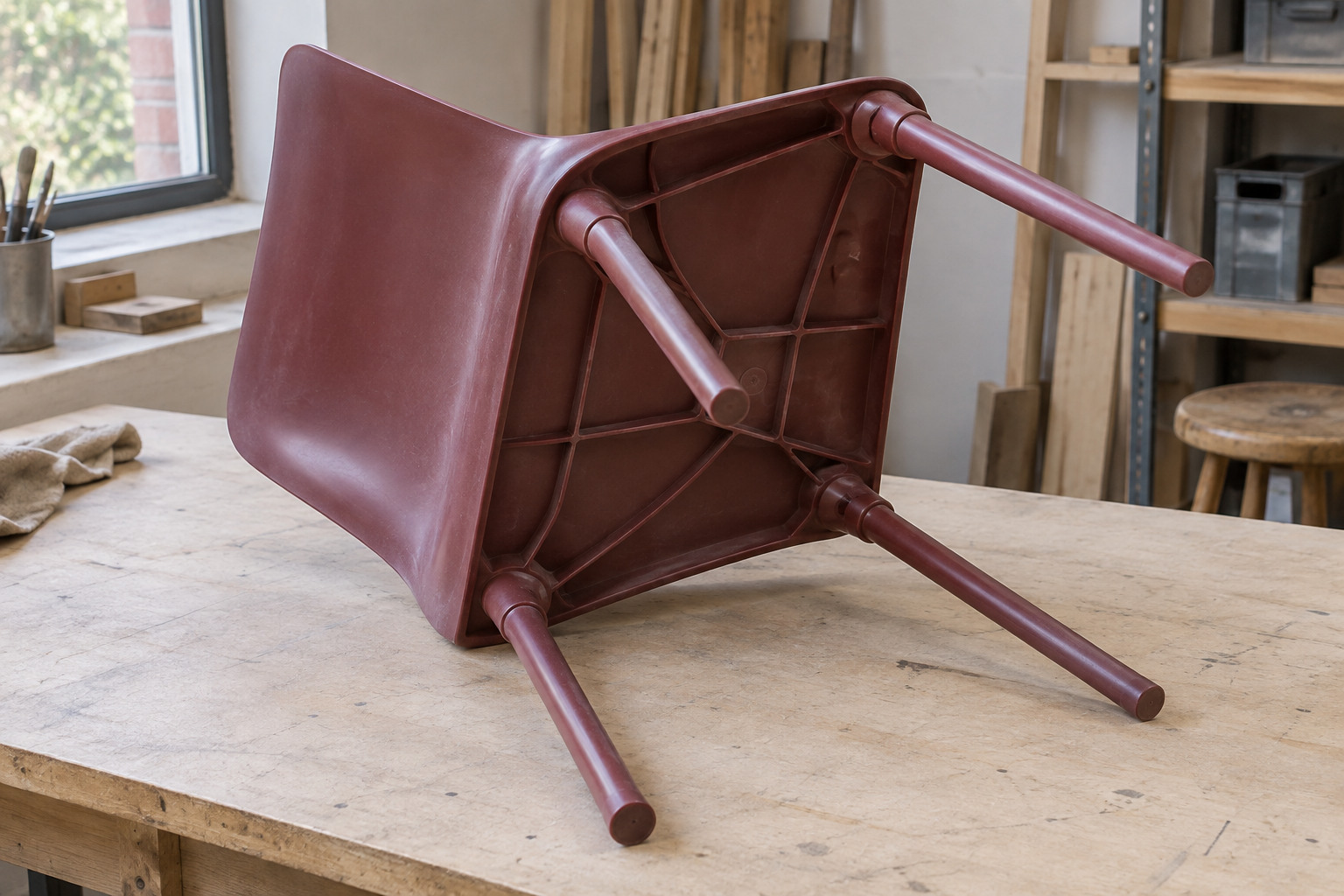
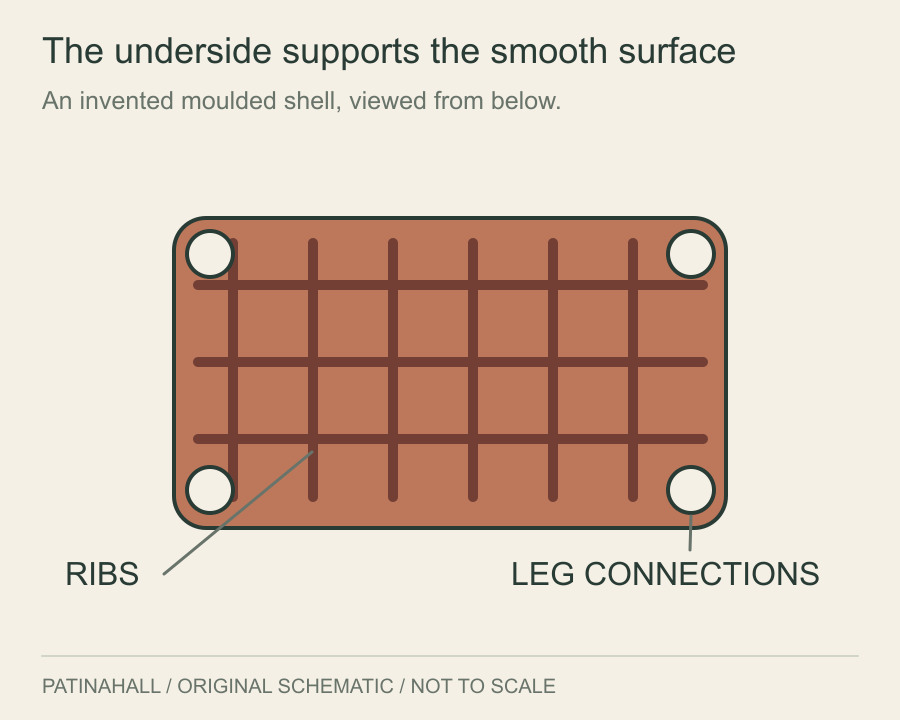
The RMIT study of Castelli Ferrieri’s work examines the seat’s ribbed underside. Ribs give a moulded surface additional structure without simply turning the entire seat into a thick slab. Above, the chair can remain visually calm; below, its supporting geometry becomes explicit.
The shell combines seat and back. The four legs are separate components, fitted to cylindrical connections under it. This arrangement also affects assembly and the space the parts occupy before the chair is put together.2
Turn the chair over in your mind and the design has changed character. What looked like a continuous skin becomes a set of relationships between surfaces, stiffening elements and points of support. That is the architectural analogy at its most useful: not a chair pretending to be a building, but an object whose parts have clearly assigned jobs.
Where do the next chair’s legs go?
Stacking is easy to request and surprisingly difficult to resolve. Each chair must find space inside or around the one below it without its projecting parts getting in the way.
In the 4870, slots in the seat receive the rear legs of another chair. The relationship is planned into the shell rather than left to chance. The same study connects the leg arrangement with the ability to place chairs close beside one another.2
The ADI Design Museum’s record of the 1987 Compasso d’Oro recognises the chair as a synthesis of use, technology and economy. These are visible in the object’s less glamorous moments: being assembled, lined up or stacked after everyone has left.3
Simplicity has an underside
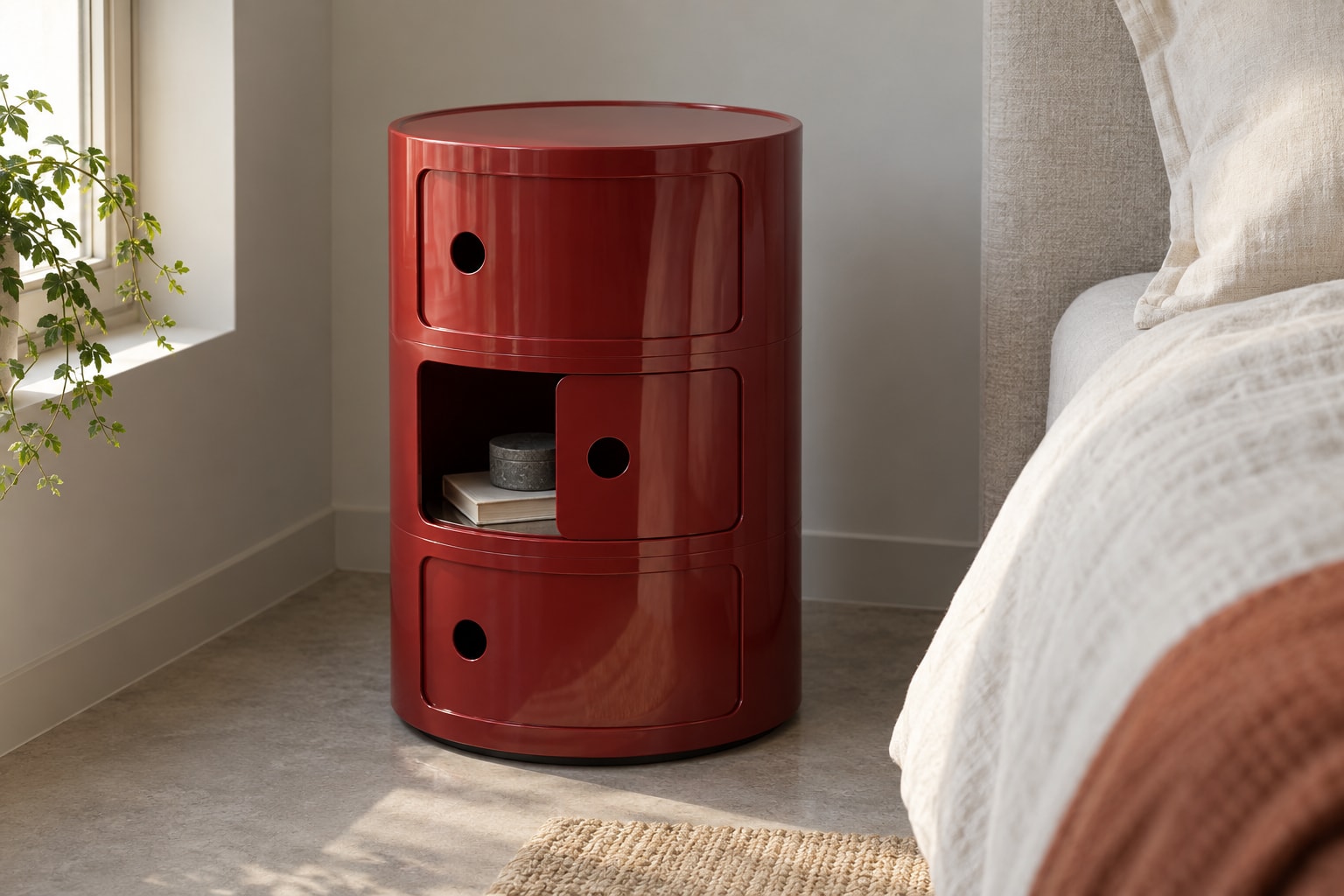
Castelli Ferrieri’s familiar storage designs make a related point. Repetition and manageable components can be a way of working with the possibilities of industrial plastic, rather than an afterthought added to a finished shape.
The lesson of the chair is wonderfully accessible. You do not have to know the machinery’s settings to become a better observer. Follow a rib, find the connection of a leg, imagine another chair settling over it. A plain plastic seat starts to reveal how much thinking its smooth upper surface has been keeping out of sight.