Design story

Componibili: the cupboard door that goes around the corner

Componibili keeps its door close. Instead of swinging into the room, the curved panel slides around the round unit, making a small cupboard useful in places where an open door would be awkward.

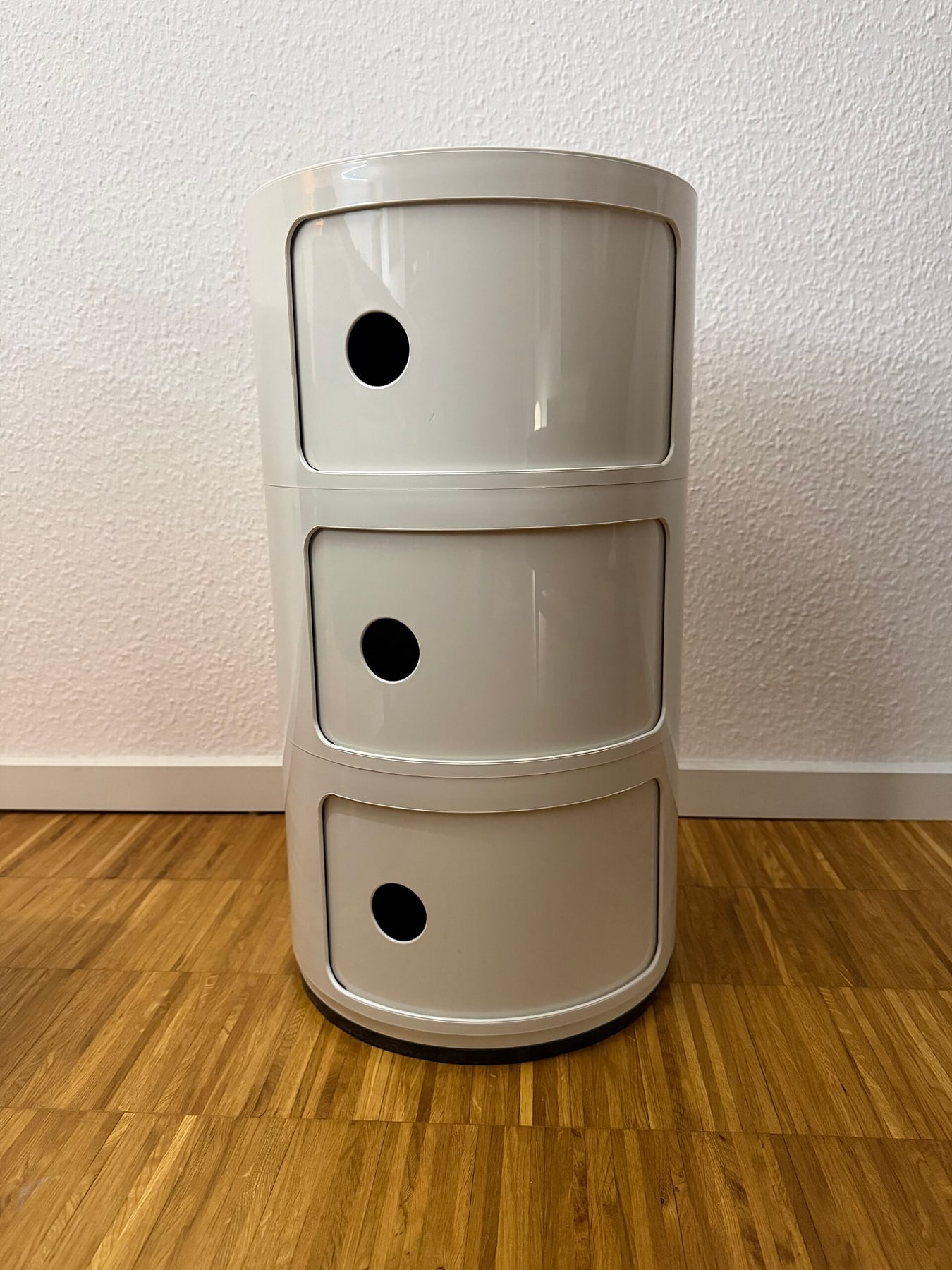
A white cylindrical Componibili cabinet with three sliding doors and round finger holes, standing on a parquet floor.
Three curved sliding fronts make a compact Componibili tower. Each opening stays within the cabinet’s circular footprint. Mediatrotter, CC BY 4.0. Resized; metadata removed. Source: Kartell Componibili (weiß).
On this page
Key facts & takeaways

At a glance

Subject
Kartell Componibili storage
Entry
Design story
Last reviewed
6 September 2026

Three things to remember

  1. The sliding door avoids the outward sweep of a conventional cupboard door.
  2. 1967 is the manufacturer’s date for the family, not every round object in it.
  3. Current fixed configurations should not be treated as freely separable or stackable modules.

The door borrows less room

A small cupboard occupies more space when its door is open. The door needs somewhere to swing, and the person opening it needs to stand around that movement. The round Componibili changes the arrangement: its curved panel slides around the unit instead of projecting a broad leaf into the room.

MoMA Design Store describes the three-tier version’s sliding doors, circular finger openings and recessed top. These are straightforward details, but they make the object unusually easy to understand. The hole tells the hand where to go; the curved surface suggests the direction of travel.2
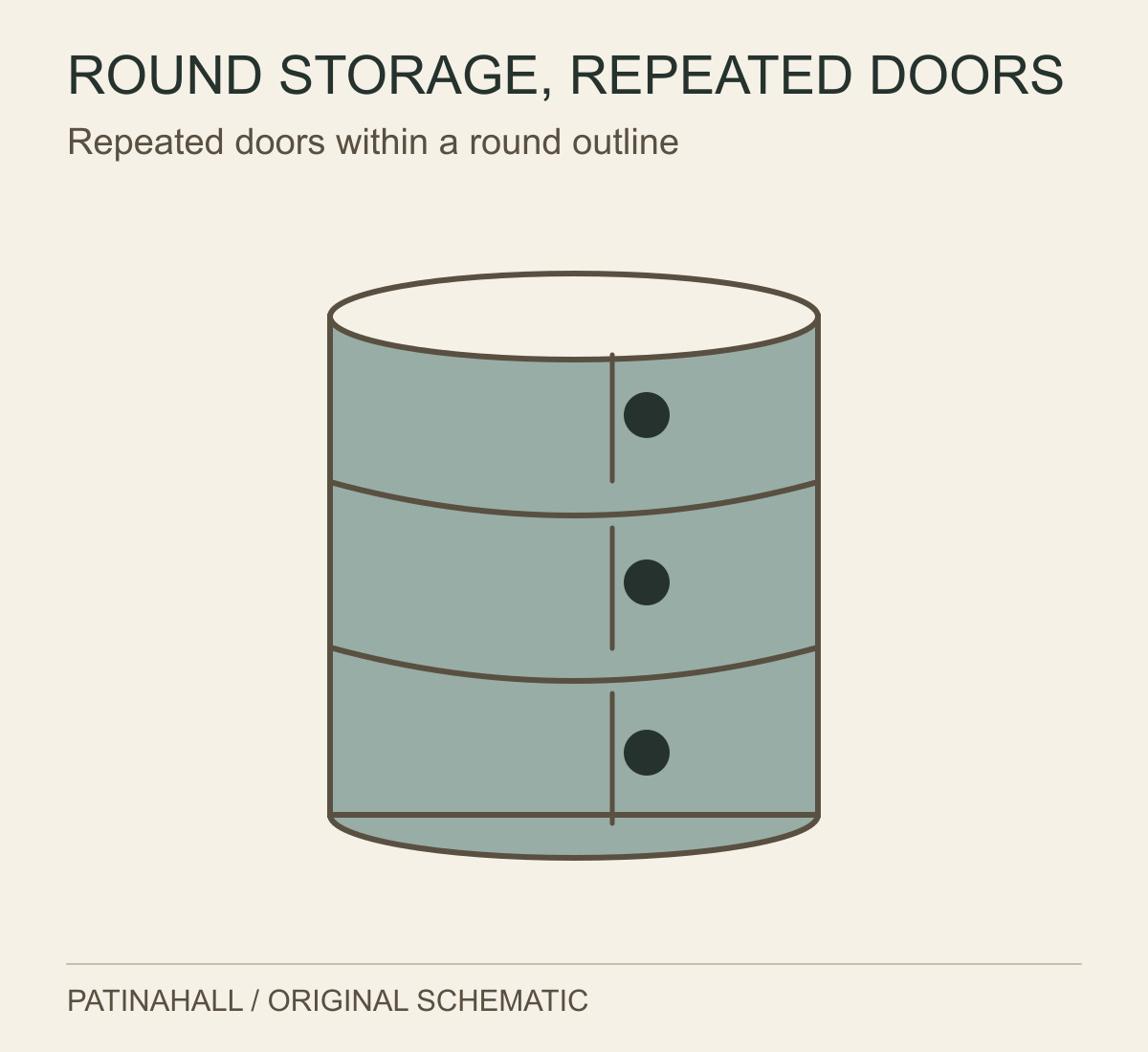
A round three-compartment storage unit has horizontal divisions and circular finger openings on its curved doors.
Repeated compartments and curved doors explain Componibili’s familiar appearance. The geometry is simplified and does not show separable modules or an authorised stacking configuration. Original PatinaHall schematic, not to scale.

A door that stays close to its cupboard

Seen from above, the important difference is clear. A hinged door sweeps out an arc beyond the cabinet. The sliding panel follows a path close to the cylinder. The contents still need access, but the movement is organised within a tighter area around the furniture.

That makes the round shape functional as well as distinctive. The curve is not simply a decorative alternative to a rectangular chest. It gives the door a route and removes sharp front corners from the outline of a small storage unit.

Place a small storage unit beside a bed and the advantage is easy to imagine. The cupboard can be opened without pushing a broad door across the neighbouring floor. Its usefulness includes an action as well as a footprint: what happens around it when somebody reaches inside.
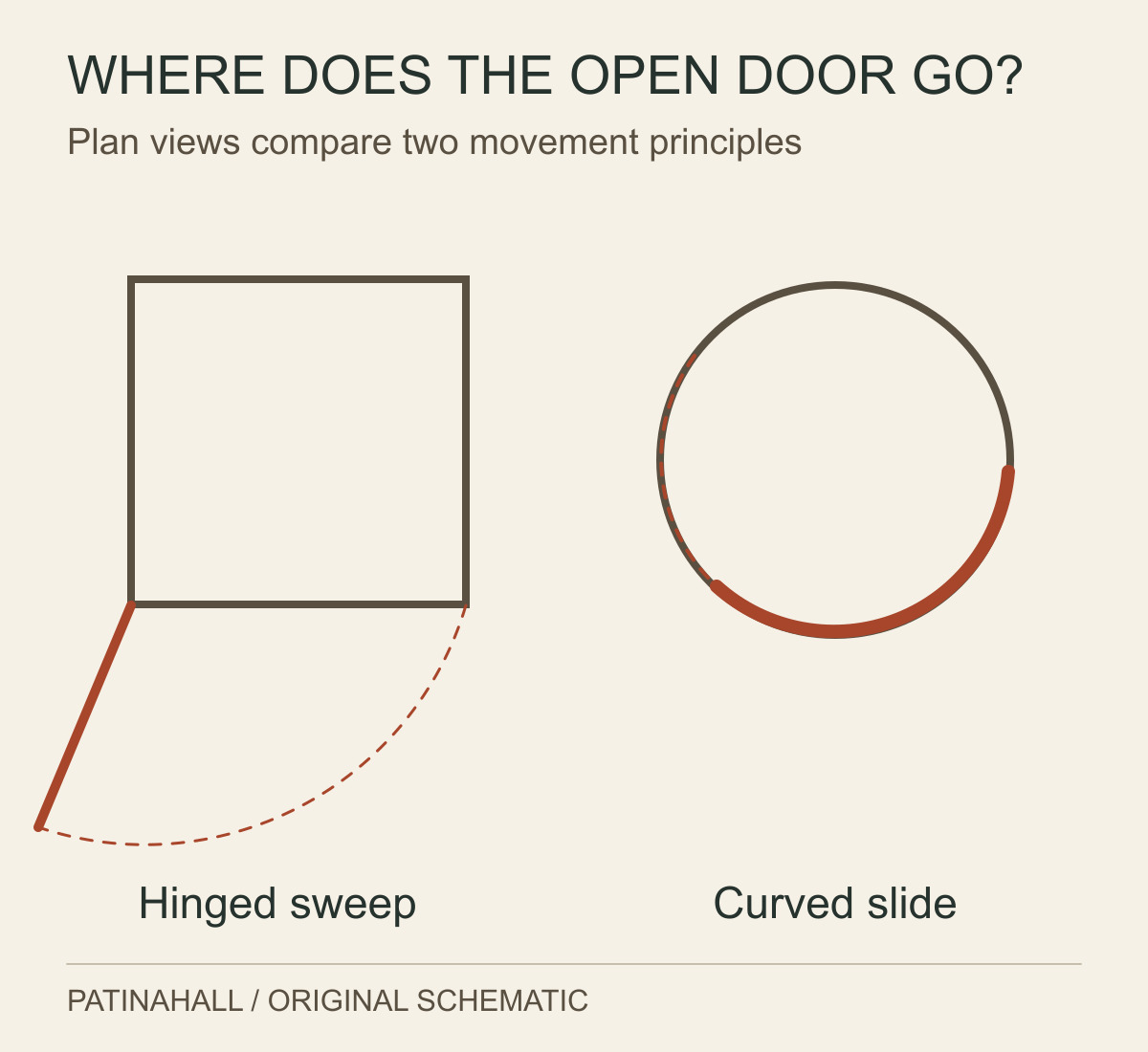
A rectangular cupboard door sweeps outward through a dashed arc, while a curved door follows a circular cupboard’s perimeter.
The plan contrasts an outward hinged sweep with a slide close to a cylinder. It explains Componibili’s spatial idea without depicting exact tracks, overlap or opening clearance. Original PatinaHall schematic, not to scale.

A 1960s family that kept changing

Kartell dates the Componibili family to 1967 and credits Anna Castelli Ferrieri. Its current description says the units were designed for different uses throughout the home and presents the familiar round form in several heights.1

That lack of one assigned room is part of the attraction. A small enclosed compartment can hold bedside objects, bathroom items or the loose things that gather beside a chair. The furniture provides storage without looking like a reduced version of a large wardrobe or traditional chest.

The MoMA store’s current three-tier example is made from ABS plastic. Its smooth surfaces and repeated horizontal divisions give colour a large role in how the object reads. The same round outline can become a conspicuous accent or recede into a quieter interior.2

A stack in appearance, a fixed unit in use

The horizontal divisions suggest separate modules, but current product instructions deserve attention. Kartell says its Classic and New Colors configurations are fixed structures whose individual sections cannot be separated. The New Colors description also excludes adding castors to that line.13

The distinction does not weaken the original idea. It simply changes what the owner can do with a particular version. The visual rhythm of repeated compartments remains, while the useful daily action is much smaller: slide a door, take something out, close it again. A little cylinder has made that ordinary movement unusually neat.

Research notesEvidence, connections and limits

Kartell supplies the family date and present construction limits. MoMA Design Store documents the sliding ABS three-tier unit but has conflicting date fields, which are not used to resolve the round version’s first year. The schematic explains door movement without specifying tracks, loads or interchangeability.

Evidence map

Connected subjects and evidence

Reviewed connections

  • Kartell Componibili storagedesigned byAnna Castelli Ferrieridocumented

    Kartell documents Anna Castelli Ferrieri in the designed by role for Kartell Componibili storage. This relation describes the design family, not the origin of an individual secondhand object.

    Reviewed 6 September 2026 by PatinaHall editorial.
    • Source 1Design, material or production account; scope described in the evidence note
  • Kartell Componibili storagemanufactured byKartelldocumented

    Kartell documents Kartell in the manufactured by role for Kartell Componibili storage. This relation describes the design family, not the origin of an individual secondhand object.

    Reviewed 6 September 2026 by PatinaHall editorial.
    • Source 1Design, material or production account; scope described in the evidence note

Research trail

Sources and further reading

  1. Componibili Classic: fixed configurationsKartellAccessed 6 September 2026
  2. Kartell Componibili 3-Tier Storage, WhiteMoMA Design StoreAccessed 6 September 2026
  3. Componibili New Colors: construction limitsKartellAccessed 6 September 2026
  4. Kartell Componibili (weiß).jpgWikimedia CommonsAccessed 6 September 2026

Last reviewed 6 September 2026. Found an error or a stronger primary source? Contact PatinaHall.