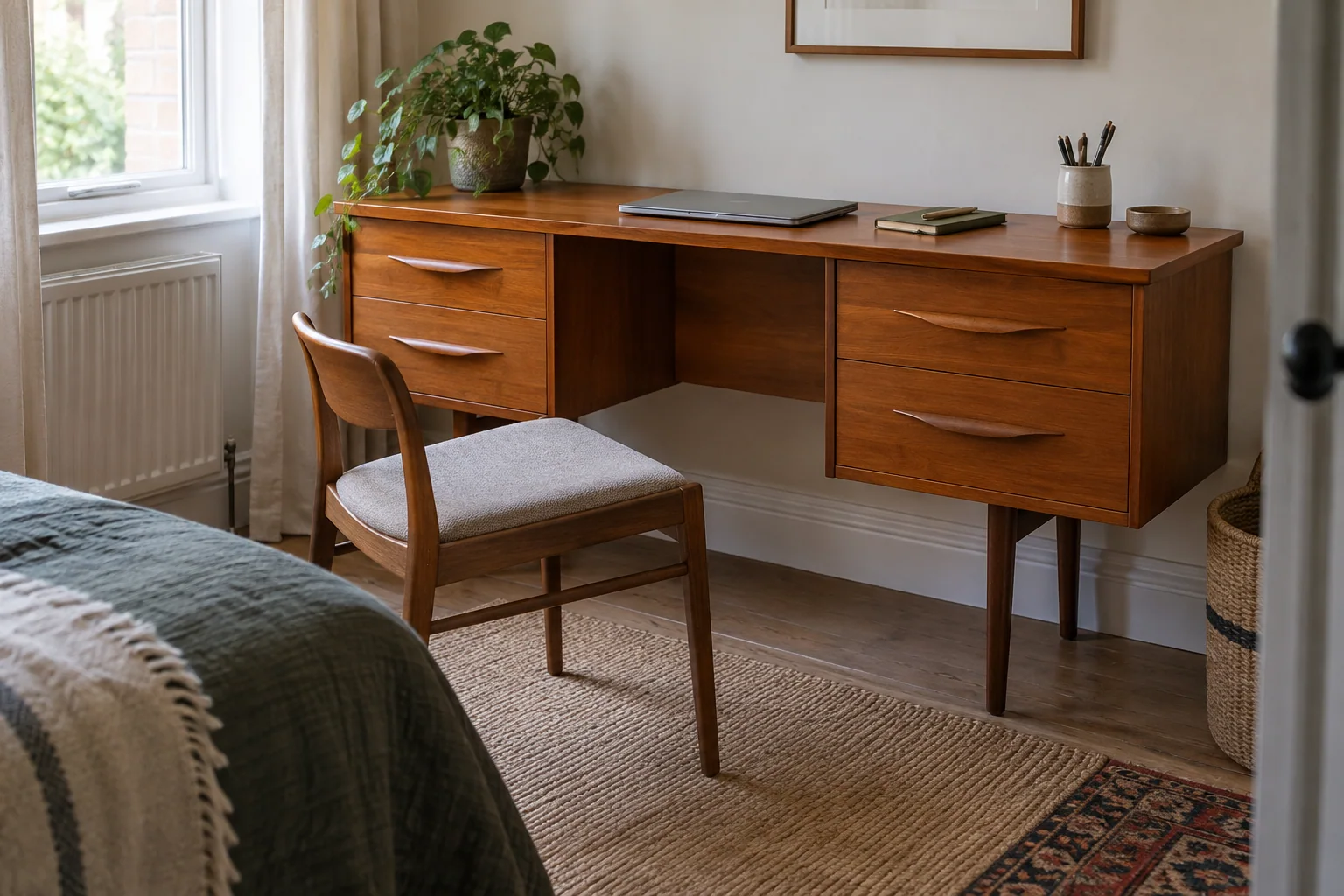
Two Frescos, two different places to sit
Consider two sold listings. Mustard Vintage records a Fresco measuring 152.5 cm wide, 46 cm deep and 70 cm high, with a 51 cm-wide seating opening and 65 cm clearance beneath the top. It also describes a concealed central drawer. These are the dealer’s measurements of one example.[1]
Lucian Linnell Vintage lists another at 144 × 46 cm, with a 73 cm top, a 48 cm-wide knee opening and 67 cm underneath. The seller specifically notes the absence of a central drawer. Neither set of numbers is a universal Fresco specification; together they show why measuring only the outside is insufficient.[2]
| Measurement | Mustard example | Linnell example |
|---|---|---|
| Overall width | 152.5 | 144 |
| Top depth | 46 | 46 |
| Top height | 70 | 73 |
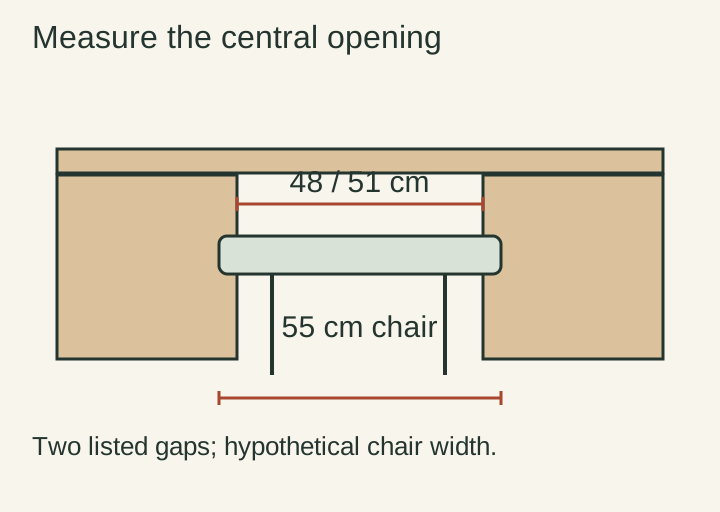
| Clear knee width | 51 | 48 |
| Clear height underneath | 65 | 67 |
If your chair is 55 cm wide at the point that enters the opening, it will not tuck into either of those recorded gaps. That illustrative check is easy to do before travelling. Also compare your thighs, normal sitting height and the route your knees take when you turn to get up.
A wide desk can still run out of depth
Draw the measured top on paper or mark it on your current table. Place your equipment inside that outline with the laptop open to its normal angle. Include the screen projecting behind its base, a mouse area and somewhere to rest your forearms. Keep the central sitting position fixed while you try the arrangement.
The drawers give storage at either side, but they do not move your body along the whole width. A monitor placed over one drawer bank may leave you working with your head turned. Try the equipment directly ahead of the actual knee opening, then decide what the spare width is useful for.
For occasional correspondence or a compact laptop setup, the shallow top can be a real advantage in a bedroom. For a full working day with several devices, compare it with a deeper desk before buying extra stands to rescue a layout you have not tried.
Keep the mirror, brackets and identity together
The Linnell listing describes upright mirror supports that unscrew without leaving marks on the top of that piece. Ask your seller to show how their mirror is attached and whether anything has been cut, filled or glued. Do not assume every Fresco uses that arrangement.[2]
Have the seller or a suitable furniture professional handle removal if the attachment is uncertain. Keep the mirror, supports and labelled fittings together in protected storage. This preserves an easy route back to dressing-table use and avoids handing a future owner a desk with an unexplained box of metal parts.
A High Wycombe Furniture Archive record distinguishes the later Fresco dressing-table model 2300 from the very similar model 1982, launched in 1967. That is a useful warning against identifying an exact version from sculpted handles alone. Compare the whole layout and any surviving documentation; avoid borrowing a Quadrille description for a Fresco.[3]
Try one ordinary working session
Sit with the intended chair and open the drawers you would use most. Check whether an armrest catches the top, whether reaching into the centre drawer requires moving your legs, and where cables can pass without being trapped. A freestanding light and a reversible cable arrangement are worth trying before drilling an old surface.
Send this with your chair measurements
Please measure the narrowest clear knee opening and its height, show the underside and central drawer, and photograph the mirror attachments. My chair is ___ cm wide at entry height. Has the top, mirror mounting or drawer arrangement been altered?
Choose the Fresco when the simple arrangement works as it stands. The pleasure is getting a useful desk and a good piece of bedroom furniture in one object, without spending every morning negotiating with it.