Two names worth keeping distinct
LK Hjelle identifies Siesta as Ingmar Relling’s 1965 design and describes a family with different back heights and arm arrangements. Its current specification separates the wooden frame, canvas and cord from the cushions. That is a useful starting point for understanding the construction, while the edition of an older chair still needs establishing.[1]
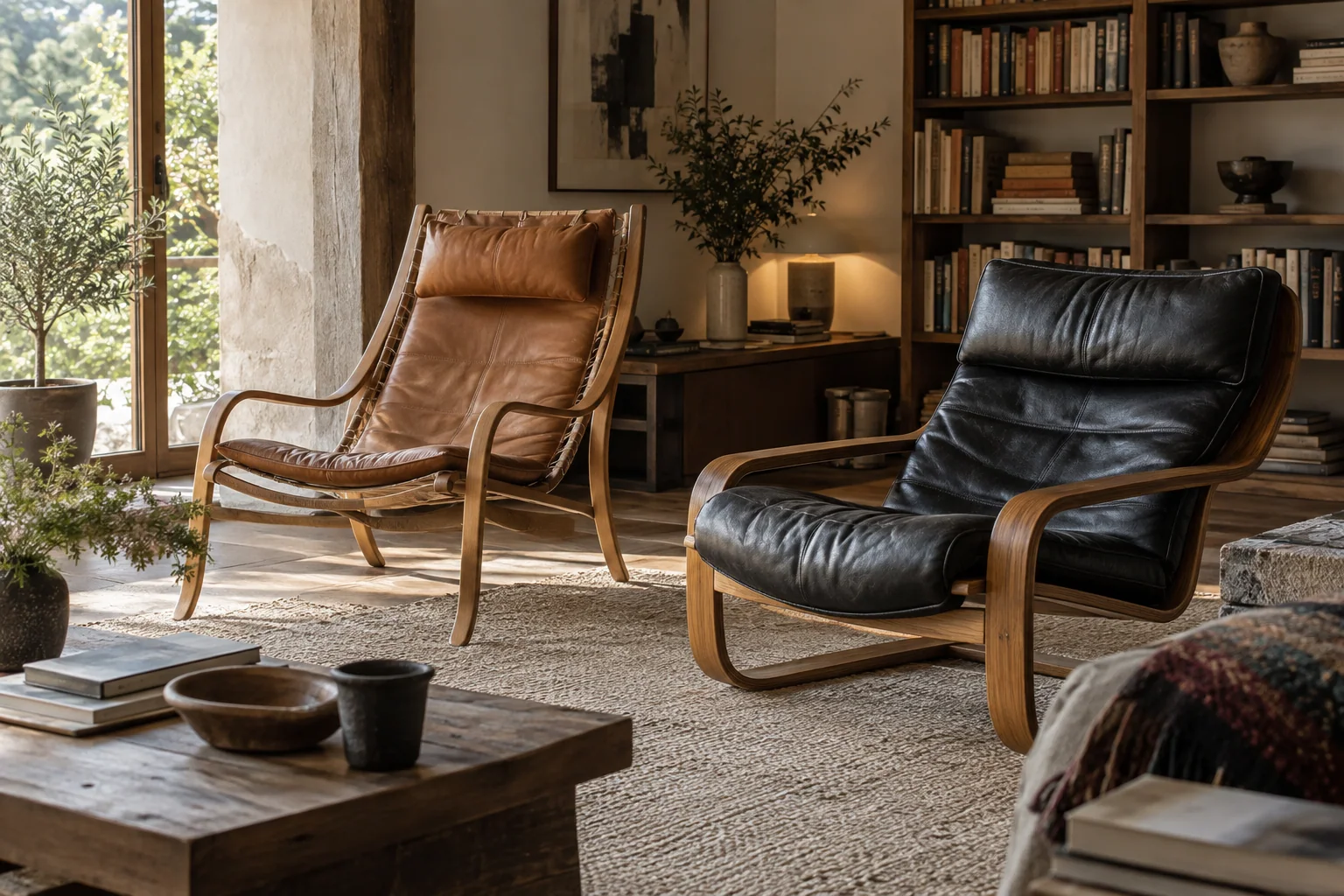
For Kroken, a Kalmar Auktionsverk catalogue records a pair attributed to Åke Fribyter for Nelo, with leather and bentwood. That is an auction description of those chairs, not a factory specification for every listing using the name. Ask a seller what supports the attribution and compare the whole object rather than accepting any broad sling chair as Kroken.[2]
Choose a particular example from each family to compare. Mixing the dimensions of one dealer’s low-back chair with photographs of another high-back version creates a comparison that no real chair can satisfy.
Try the posture you want to keep for an evening
If the chair is sound, settle into it with your feet supported as you normally prefer. Read for several minutes, then stand up. Notice whether your head meets the cushion where you want it, whether your hips slide forward and whether the arms provide useful support.
| Question | What to record for each actual chair |
|---|---|
| Where does my back settle? | The contact point and whether I keep adjusting my position. |
| Where do my feet go? | Floor contact or the footstool position that makes the seat usable. |
| Can I rise comfortably? | The occupied height, available hand support and effort for me. |
| Will it work beside my table? | Reach to a book or drink from the relaxed position. |
Do not assume that a thicker replacement cushion is an upgrade. It can change the relationship between seat, arms and head support. Try a chair with the cushions included in the sale, and identify any missing pieces before comparing comfort.
Look beneath the leather
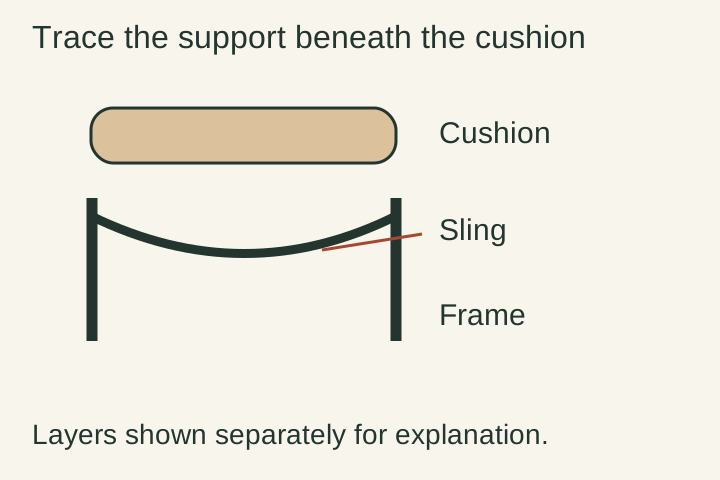
With the seller’s agreement, have removable cushions lifted so the support can be seen. Look for tears, worn edges, uneven sagging and old patches in the sling. Examine visible attachments and lacing without pulling them tighter or deliberately flexing the frame. A split or loose structural part calls for assessment before sitting.
Describe the fault by location: a seam in the cushion cover, a tear in the supporting canvas, an attachment pulling away, or separation in a frame member. Those are different repair briefs. “The leather needs doing” can overlook the part actually carrying the sitter.
Ask about previous work and retain any invoices. Replacement canvas or cord can be entirely reasonable, but the question is what was fitted, how it relates to this version and whether the frame was checked at the same time.
Current spares are a lead, not a promise
Hjelle’s current Siesta information describes replaceable parts. Its spare-parts page also distinguishes a specific pair of rear legs for a high-back chair without arms and notes that a crossbar is not included. That is a useful reminder to request the complete part description, not simply “Siesta legs”.[3]
Send photographs, dimensions and identifying evidence before buying replacements for an older chair. For a Kroken listing, ask the repairer separately about support fabric, cover and frame work; do not assume a Siesta component is a substitute because the chairs share a sling principle.
Compare complete seats
Add purchase, collection, support repairs, cushions and return delivery. If the support work remains unpriced, compare the chair as a project with an unresolved cost, not as an almost-ready bargain.
Both kinds of chair can make a room feel relaxed without a huge upholstered mass. The successful choice is the particular seat whose posture you enjoy and whose supporting layers make sense.