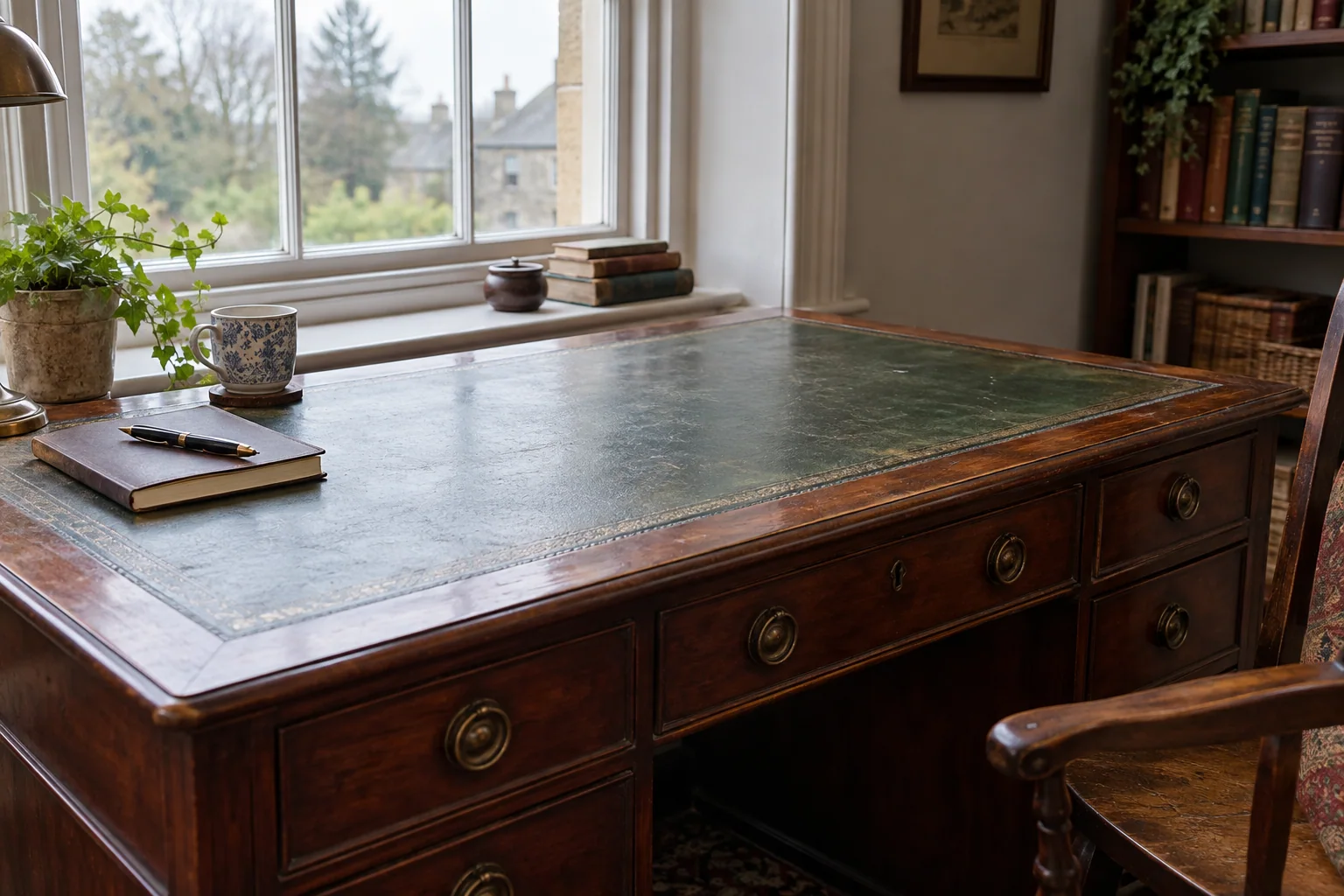
A marked writing surface may still be a good one
Sit at the desk and try the activity you bought it for. A few old marks may not affect a notebook or laptop, while a lifting edge, missing area or uneven substrate can make writing awkward. Describe the functional problem before commissioning removal of the whole inset.
If the old surface is stable and you only need a small smoother area, discuss a removable writing pad with the restorer. Check that its underside is suitable for the existing finish and does not trap grit or moisture. A loose pad is an option to assess, not permission to cover an active problem indefinitely.
For a desk with historical significance or unusually well-preserved decoration, seek conservation advice before replacing original material. The choice is easier to make before the old inset has been stripped away.
Writing leather is a material choice, not just a colour
Specialist suppliers distinguish desk leathers from general upholstery material. Collectors Workshop describes both cattle-hide desk leather and sheep skivers prepared for writing surfaces. Restoration Materials also notes that skiver thickness varies. Ask what material and thickness suit the actual recess and intended use.[1]
Request samples if colour, grain or pen feel is important. Test with the paper and writing tool you normally use, keeping that trial separate from the desk itself. A thick soft upholstery offcut may look attractive without producing the firm surface you want beneath a single sheet.
If cloth or another surface is proposed instead, ask the restorer to explain its effect on use, appearance and retained original material. Do not describe a material change as a like-for-like restoration.
Measure the recess rather than guessing from the old leather
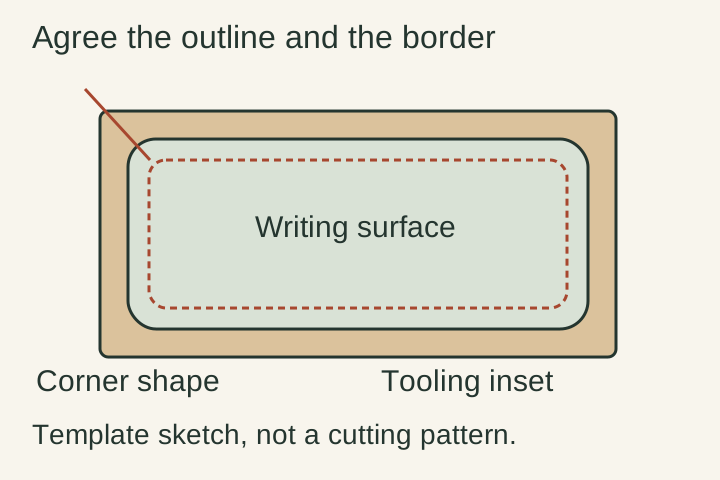
| Item | What to specify |
|---|---|
| Outline | Recess dimensions, squareness and a template where needed. |
| Corners | The actual curve or corner shape, not simply “rounded”. |
| Depth and substrate | Space for the proposed material and any preparation required. |
| Tooling | Border position, width, pattern and relation to corners. |
| Finished surface | Colour, grain, thickness and the writing feel agreed from samples. |
Restoration Materials asks for templates for curved outlines and for the upper face to be clearly marked. That matters because turning an asymmetric template over can produce the wrong shape. Follow the selected supplier’s ordering requirements rather than sending an unlabelled paper outline.[2]
Agree who is responsible for the final dimensions and trimming. An oversized leather supplied for fitting is different from an inset promised to arrive at its final size. Do not cut into the desk to make a wrongly ordered replacement fit.
Preparation and fitting can be the larger uncertainty
Ask the restorer what must happen beneath the leather. The old adhesive, substrate condition and surrounding wood finish can affect the method and scope. Have removal, preparation, material, tooling and fitting named separately so you can see what an estimate actually includes.
Avoid choosing an adhesive from a generic internet recipe. The restorer needs to identify the existing materials and an appropriate approach for this desk. Keep any work to the surrounding wooden border distinct from replacing the writing surface; one job does not automatically require a full refinish.
Before placing the order
Please confirm the condition of the old inset and substrate, whether replacement is necessary for my use, and the agreed template, leather thickness, tooling and fitting method. I would like the quote to state what happens if hidden substrate repairs are needed.
A well-chosen replacement should make the desk a pleasure to work at while leaving its age legible elsewhere. The aim is a useful writing surface with an understood repair, not making every part of an old desk look equally new.