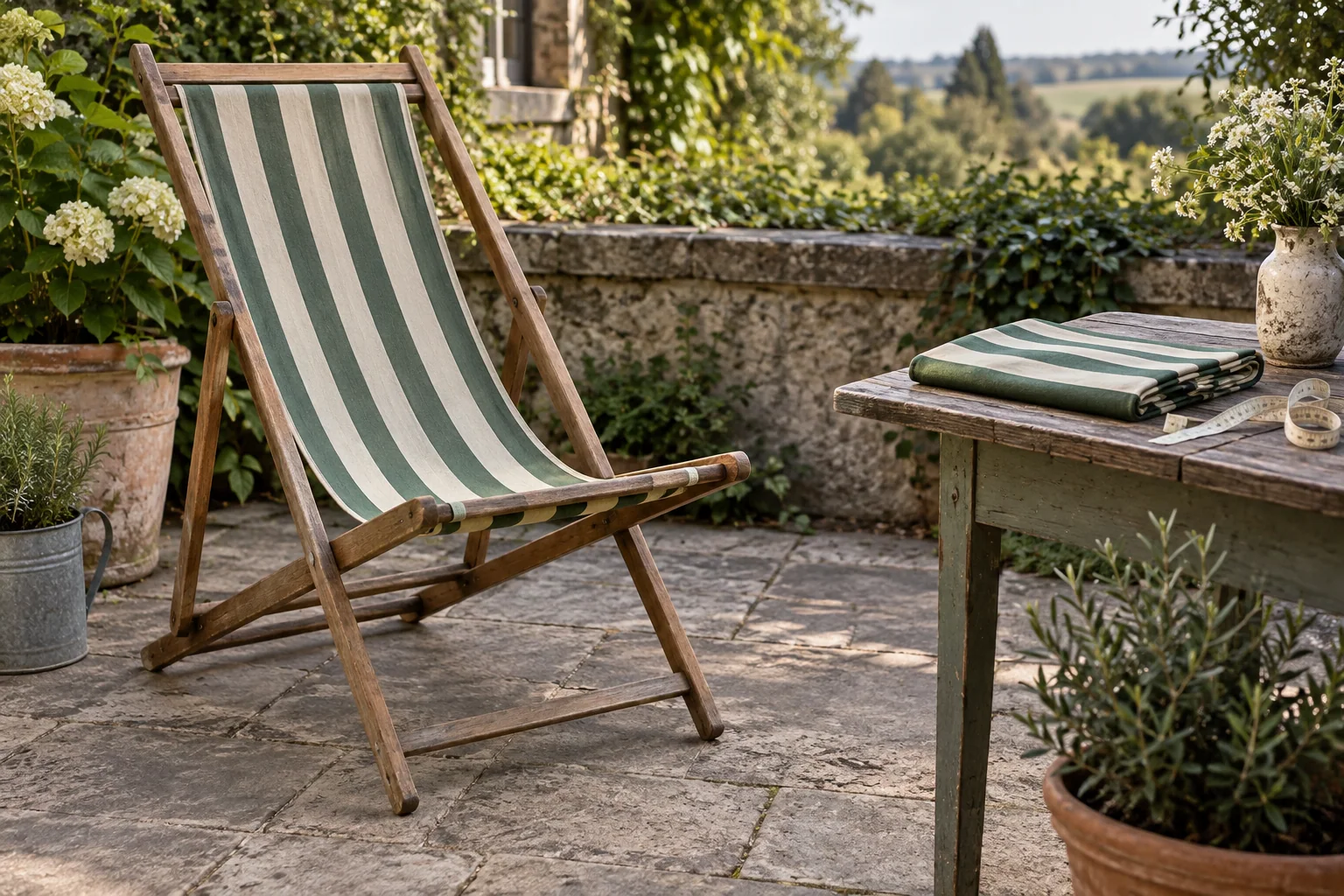
Canvas by the metre and a finished sling are different purchases
The Stripes Company distinguishes traditional attached canvas from removable covers with dowelling rods through sewn end channels. Its replacement-sling service asks for the old stitched cover as a pattern. Those are two different buying routes, even when the finished chairs look much alike.[1]
| What you find | What to establish with the supplier |
|---|---|
| Canvas wrapped and attached around rails | Suitable load-bearing deckchair canvas, rail dimensions and the required cut length. |
| A removable cover with rod channels | Finished sling measurements, channel dimensions and which rods or other fittings are included. |
| An unfamiliar fixing or missing original cover | Photographs and measurements reviewed before anyone promises a standard replacement. |
Do not start by stripping an uncertain frame. Photograph the top and bottom attachments, side edges and the chair in its normal supported positions. If removal is necessary, have someone familiar with the construction do it, and keep the old cloth as evidence rather than throwing away the pattern.
The old cloth can be a pattern and a misleading ruler
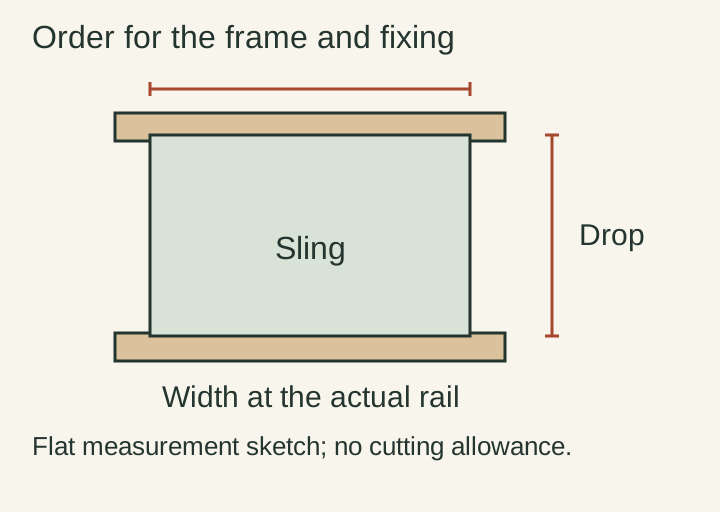
The supplier’s FAQ advises measuring the top rail for canvas width; it notes that the lower part of the frame is commonly narrower so the chair can fold. It also warns against assuming the old canvas has the right width. That makes sense of an apparent contradiction: retain the old cover, but check it against the frame.[2]
Send top and bottom widths separately, photographs of the attachments and any taper in the cover. For a sewn sling, ask the maker exactly where to measure the finished length: include a sketch showing their chosen points. Do not silently substitute the distance between rails for fabric length.
A strip of cloth must provide a seat shape, not simply join two pieces of wood. Too much or too little length changes the way it hangs and may affect normal operation. Have the maker specify the pattern and allowances for this frame instead of adding a guessed hem or shortening a stretched old sling by eye.
An order description to copy
This frame uses ___. The upper and lower attachment widths are ___ and ___. Here are photographs of both ends and the old cover, with its orientation marked. Please confirm the finished dimensions, end-channel or attachment requirements, and whether the order includes any rods or fittings.
A useful published example, with its limits
When checked on 11 September 2026, The Stripes Company listed its replacement deckchair sling at £38. The described service remakes a sewn-channel cover from the old sling. Treat that as one supplier’s published service price, not a quotation for an unknown frame, a full restoration or delivery to your address.[1]
Ask about postage in both directions, lead time, pattern suitability and what happens if the old cover is too distorted to copy. If you have two chairs, measure both. A matching pair may have different earlier repairs or covers, and one pattern should not automatically become two orders.
Choose cloth intended for this load-bearing use. A decorative striped furnishing fabric is not equivalent just because it looks similar. Ask the maker to specify suitable construction and fabric rather than shopping only by colour.
Give the renewed chair a life it can handle
Before fitting or using the new canvas, have joints, rails, folding hardware and position supports checked. Confirm that the fabric installation leaves normal folding and support engagement working properly. Keep fingers clear of moving joints, and do not use a person’s weight as a test of doubtful repairs.
The Stripes Company describes its woven cotton deckchair canvas as not weatherproof and advises bringing it in when not in use. Follow the instructions for the fabric you actually order. A sheltered summer afternoon and winter storage in a damp shed are very different conditions.[2]
A good restoration here can be wonderfully modest: a sound familiar frame, the right sling and a stripe you enjoy. Settle fit and structural work first, and choosing the stripe becomes the easy part.