Use the names to search, then look at the actual chair
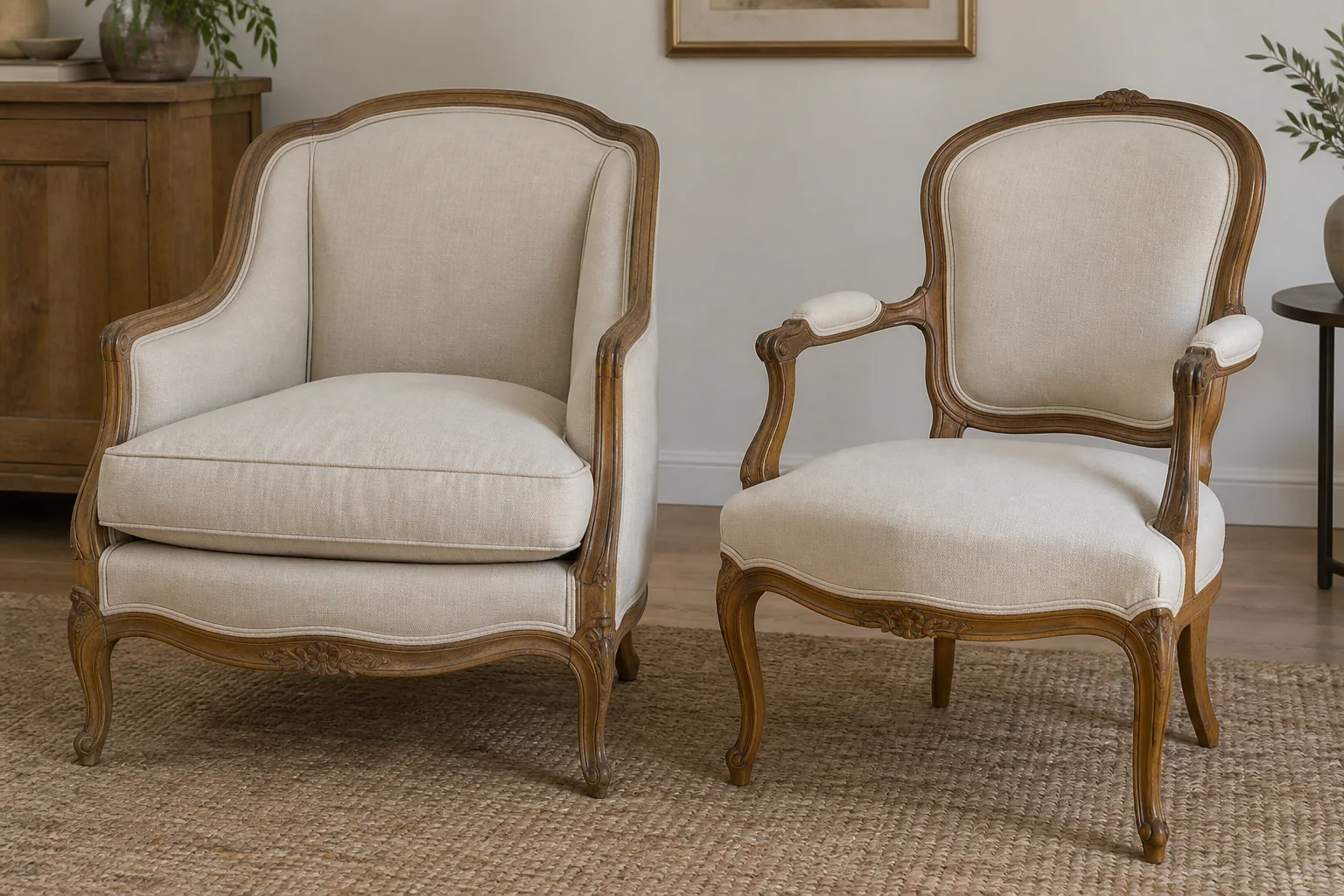
The Met explains a bergère as an armchair upholstered between the arms and seat. In English-language sales, “fauteuil” often helps locate open-arm French-style chairs, but it is also the broader French word for an armchair. The terms are not a perfectly exclusive two-box classification.[1]
Look at the gaps beneath the arms, the fixed side panels, the back angle and the cushion. A seller may also use “bergère” loosely for caned furniture. Ask what is actually enclosed, upholstered or woven rather than deciding the construction from the title.
For everyday buying, a later revival can be exactly what you want. “Louis XV-style” describes a style relationship; it does not place the manufacture in Louis XV’s reign. Keep the claimed age, place and maker in separate fields on the receipt.
Measure inside the arms and in front of the back cushion
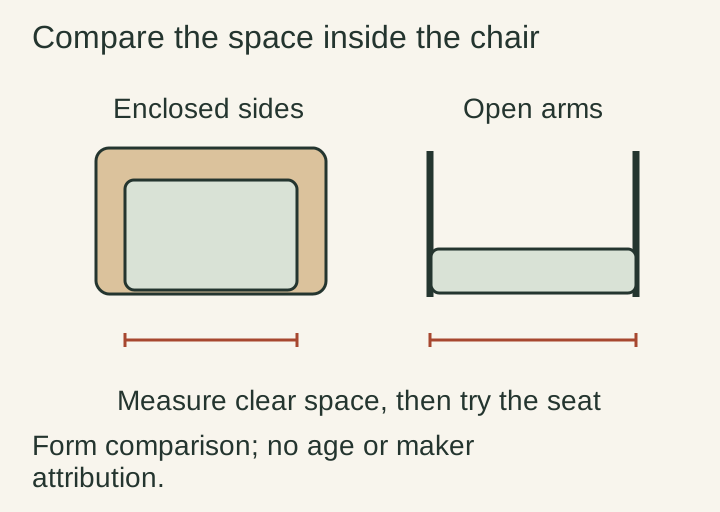
Record clear seat width, useful depth to the back support and occupied seat height. Compare those measurements with a chair you find comfortable. Broad carved arms can make a chair look generous while taking space away from the person sitting inside.
For a documented twentieth-century example, Fireside Antiques describes a Napoleon III-style chair approximately 30¼ inches wide and 32 inches deep, with current upholstery and disclosed fabric wear. Its roughly 76.8 × 81.3 cm outside footprint still does not tell you its usable seat depth or whether it suits you.[2]
Try the chair if sound: sit back, rest your arms, reach a nearby table and stand up. Do not assume enclosed sides mean a deep lounging position or open arms mean an upright dining chair. If a replacement cushion is planned, ask how its thickness will change your position against the wooden arms.
An upholstered side has more work hidden inside it
Inspect the front and rear legs, the arm-to-frame connections and the seat rails where visible. Ask for the back and underside, plus any known repairs. A decorative painted or gilded finish can conceal a changed connection; colour alone cannot settle the repair’s quality.
Enclosed upholstered sides add surfaces and edges to an upholstery job. Ask the workshop to count the seat, back, sides, arm pads and any loose cushion separately. A quote for a simple open-arm chair may not describe the work on a more enclosed bergère.
Keep a finish you like unless there is a concrete reason to change it. A worn paint layer and a loose joint call for different decisions. Do not strip an unknown surface in order to check whether a chair is old.
Let the modest description be enough when it is enough
The Met’s recorded bergère 1971.206.5 carries a qualified maker attribution despite a historical stamp: several members of the Cresson family shared relevant names. Even a mark can need interpretation. That museum example illustrates caution; it does not authenticate a similar chair in an advertisement.[1]
Ask the seller
Please give the clear seat width, depth to the back support and occupied seat height, and show the frame connections, back and underside. What is known about the age, maker and repairs, and which upholstery or finish is a later replacement?
Buy the chair for its comfortable position, useful size and character at the supported description. A charming twentieth-century French-style armchair need not become a royal-period attribution to earn a place in the room.