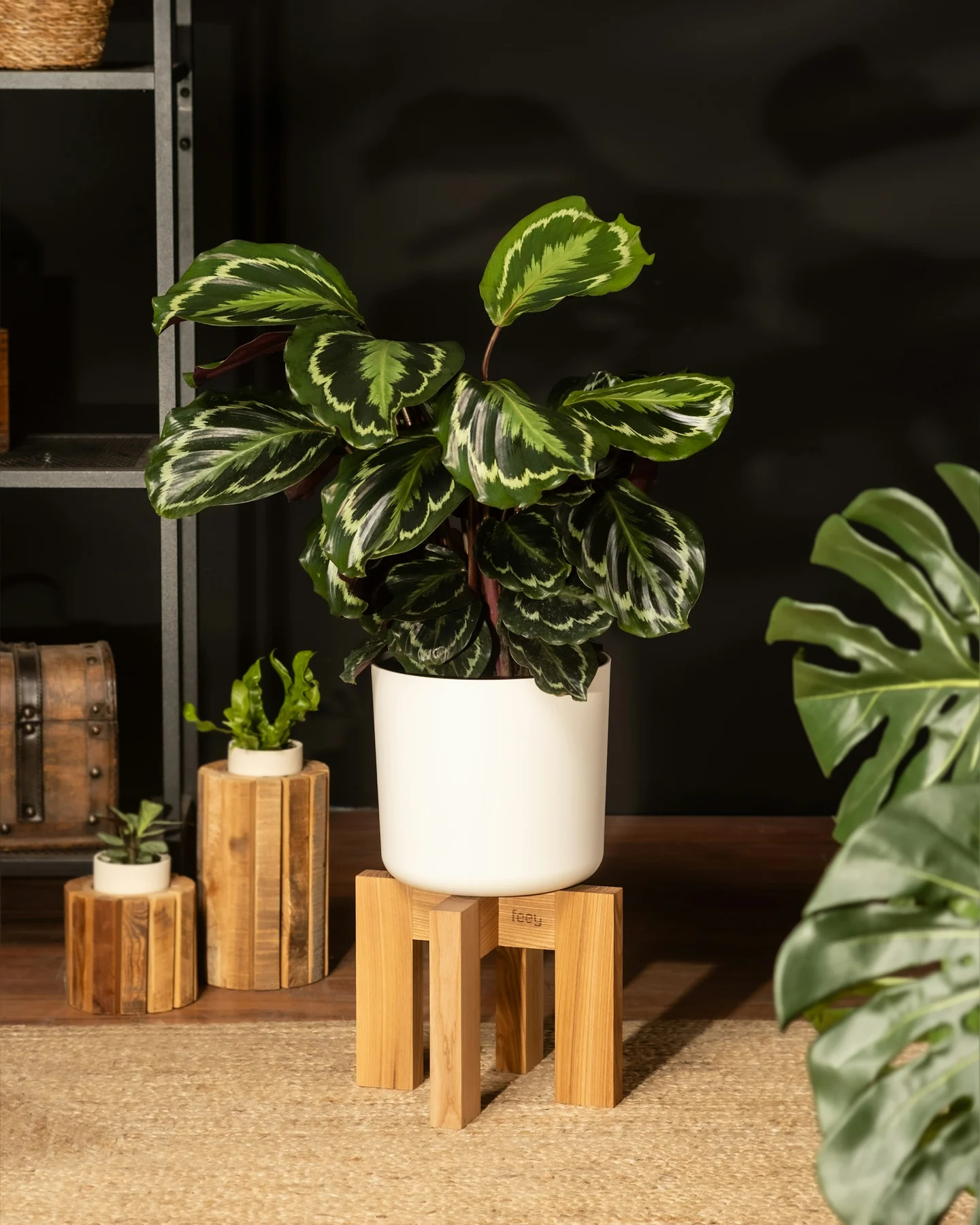
Measure underneath, not only across the rim
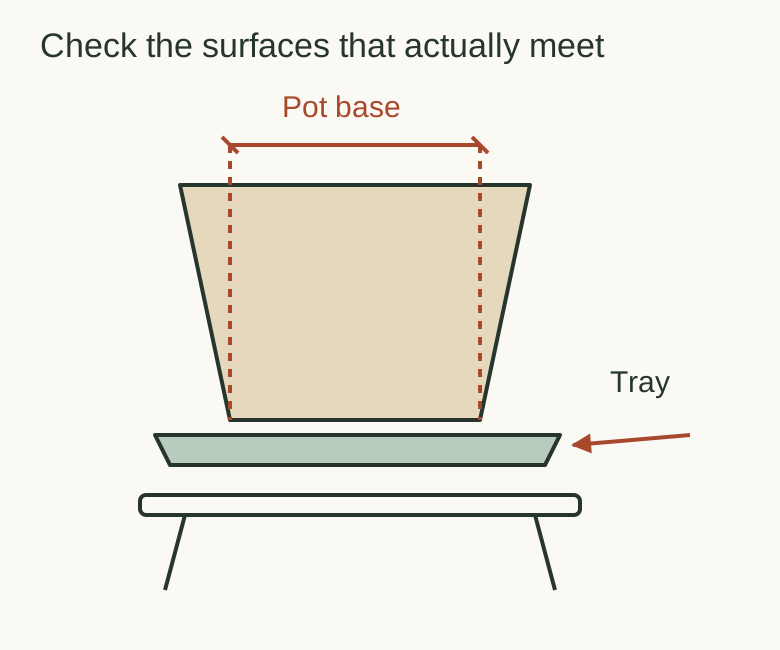
A pot may be wide at the top and narrow at the foot. A stand may offer a flat platform, an open ring, narrow bars or a woven surface. Those arrangements support a pot differently, so compare the points that will actually meet.
Measure the pot base, its widest diameter and the saucer or outer container. For a ring stand, establish where the pot is intended to sit and whether the ring suits that exact pot shape. Do not assume a pot balanced part-way through an opening is properly supported.
Include leaves and branches in the room layout. A small base can carry a plant that spreads across a passage or leans towards a window. Check space for curtains and access to the pot when you need to lift it.
The watered plant is the relevant weight
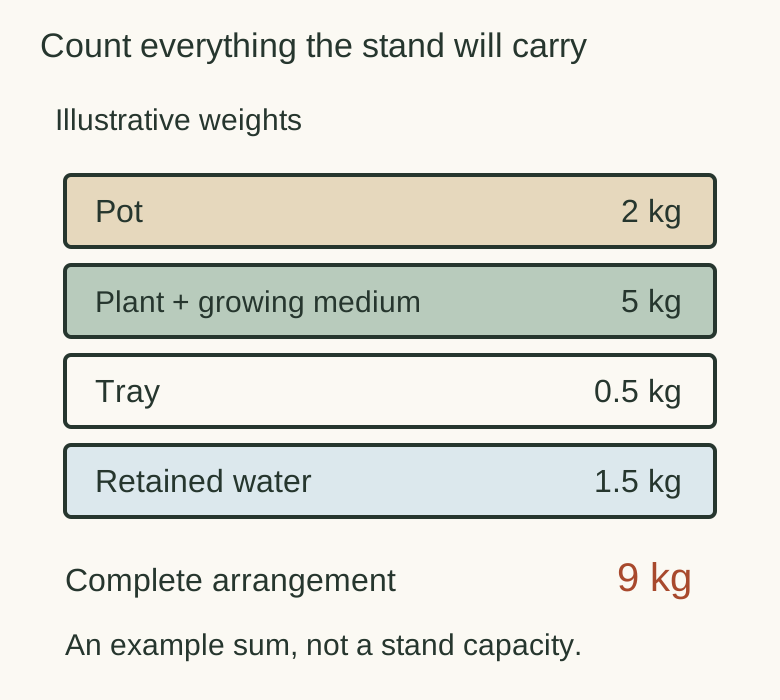
Weigh the complete arrangement you intend to use after watering and drainage, including the outer pot and tray. If it is too heavy to handle safely, use an appropriate weighing or handling arrangement rather than struggling onto domestic scales with it.
For an illustrative calculation, a pot of 2 kg, plant and growing medium of 5 kg, tray of 0.5 kg and retained water of 1.5 kg make 9 kg together. Those invented example weights explain the addition; they are not a recommended load or a capacity for any pictured stand.
Ask for the identified maker’s limit and intended support arrangement where available. Unknown capacity remains unknown, even when a stand feels solid in your hands. Do not test it by progressively loading it with household weights.
Look at what carries the pot
Inspect the platform, bars or ring, then the joints and feet below them. Ask about repairs, missing parts, distortion and previous use. For a tiered stand, examine each level and how it connects to the main frame.
A mark left by an old pot can be acceptable if you like the piece as it is. A loose platform, cracked joint, weakened woven support or corroded connection needs assessment. Do not hide an unresolved support problem with a larger decorative tray.
Place the empty stand in its intended orientation on a suitable floor and observe its contact points with the seller. A wobble may involve the floor, the feet or the structure. Do not assume that a pad answers all three possibilities.
Plan watering before choosing an old finish
The Canadian Conservation Institute advises keeping potted plants off wooden furniture to prevent water damage. Treat a fragile or important old wooden surface conservatively: if water separation cannot be dependable, choose another stand or use the piece for dry display.[1]
The RHS advises watering houseplants according to their needs and allowing excess water to drain. For a stand you want to preserve, the practical question is where that drainage happens and how you keep the support and floor dry.[2]
For a manageable plant, watering and draining it in a suitable separate place may be the simplest routine. Before returning it, check the outside and underside of the pot and tray. For a heavy plant that stays in place, use an arrangement designed for water containment and access rather than hoping a decorative saucer will never overflow.
A tray reduces some contact with water but does not certify protection: it can leak, overflow or hold moisture against a finish. Do not add a new coating to an old surface without understanding the existing finish and the consequences.
Let the plant and the room share the decision
Check the light your plant needs at the proposed position, not just whether its leaves look good beside a chair. Allow access for inspection, turning or moving the plant. A tall stand behind other furniture can make a simple watering job awkward.
Account for children, pets and ordinary bumps in the room. A narrow high stand with a large plant deserves particular attention to the complete arrangement; visual balance is not a stability assessment. Choose a different form if the intended use cannot be established.
For a group of plants, compare several separate supports with a tiered stand. Leave space to reach each pot without moving another plant across a fragile surface.
Ask with the pot measurements included
Message to the seller
My complete watered plant weighs [weight], with a pot base of [size] and a tray of [size]. Could you show the stand’s support surface, joints and feet, identify any repairs or corrosion, and provide its intended load/use information if known? Please confirm the clear support dimensions and whether any insert or water tray is included.
Buy when you can explain where the weight rests and where the water goes. If either answer depends on a guess, change the pot, the stand or the arrangement before bringing them together.