Act out the morning routine
List what needs to stay on the table: a brush, cosmetics, a jewellery tray or a small lamp. Measure those objects together. Then decide whether you normally sit or stand and where the stool goes afterwards. A tiny top can work well for a short routine, but not if every drawer opening requires you to clear it.
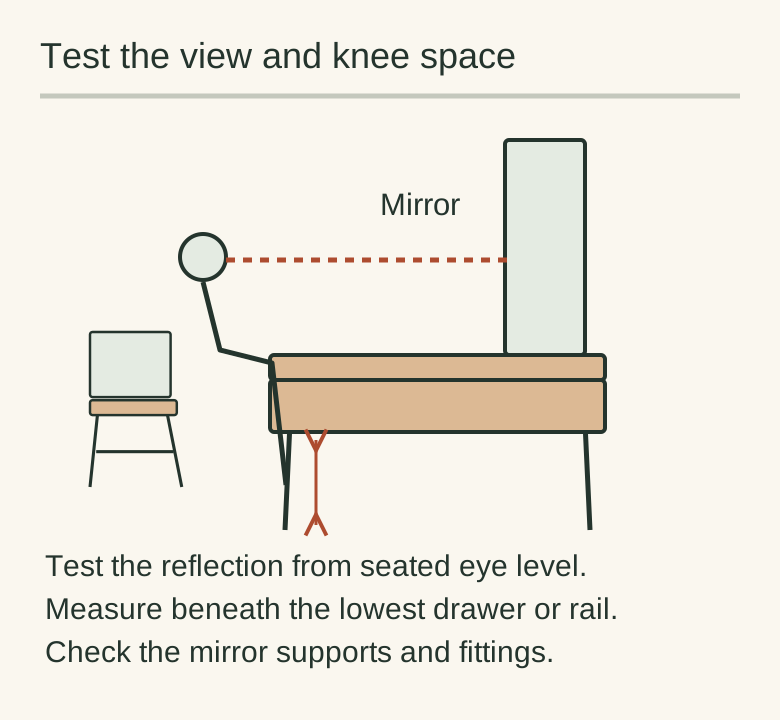
Use the chair or stool you intend to keep. Check that your knees fit beneath the lowest rail and that your feet can rest naturally without a stretcher occupying their place. If the stool is part of the sale, assess it separately rather than assuming the pair is comfortable because it matches.
Make the mirror useful at your eye level
From the intended seated position, check what the mirror actually shows. A large frame can contain a surprisingly narrow reflective area. For a tilting mirror, ask the seller to show the permitted movement and how the position is retained; do not force a stiff pivot.
Try the likely lighting at the time you will use it. A bright window behind you may reflect strongly, while a lamp placed behind a side cupboard may cast an awkward shadow. Plan cables so they do not cross the stool’s route or a moving mirror joint.
Read the whole construction
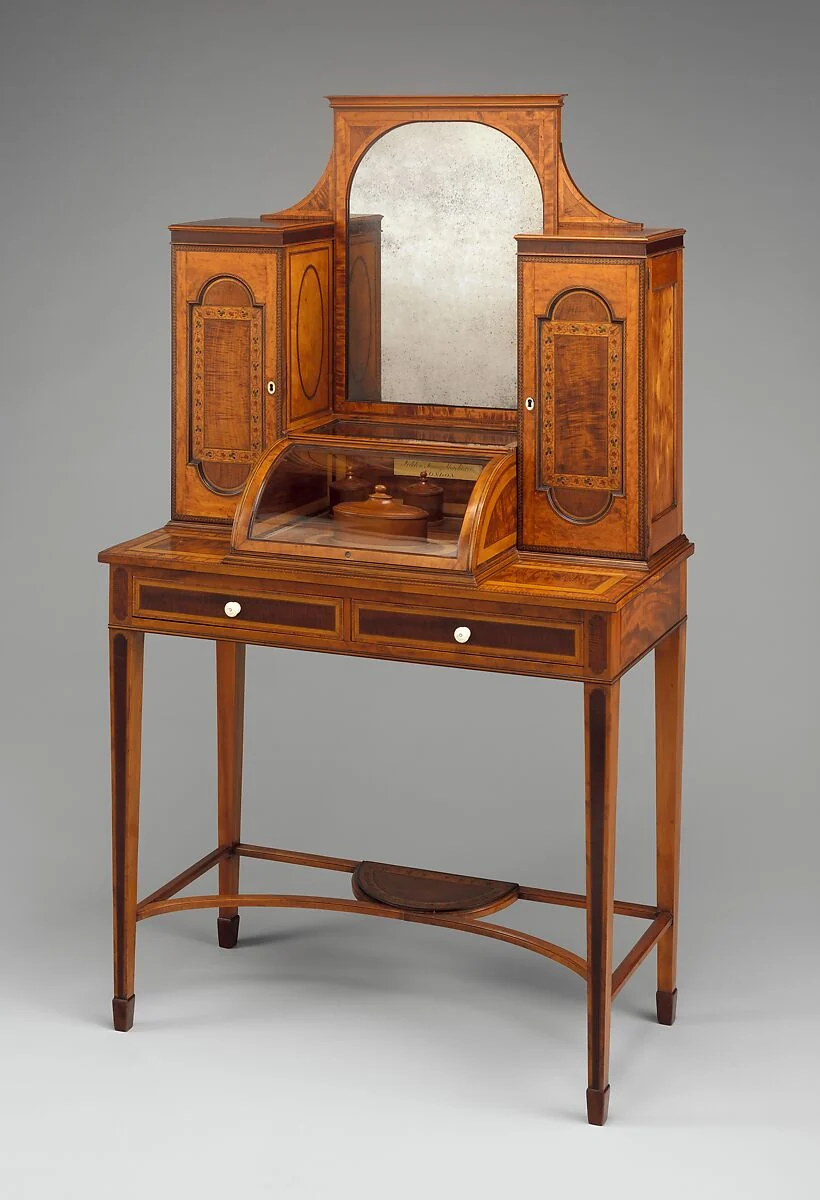
The Met records the illustrated dressing table as Seddon, Sons and Shackleton, about 1790–95, object 19.66. Its overall dimensions include the elaborate upper structure. They cannot establish the clear knee space or useful mirror view for a modern sitter.[1]
Inspect where the mirror supports join the base, whether an upper section is removable and how drawers are retained. Record cracks, loose fittings and any replacement mirror. Clouding or spotting may appeal visually, but judge whether the remaining reflection suits the task you need it for.
IKEA’s HEMNES dressing-table instructions require securing that specified furniture to the wall. Treat installation as an explicit question for a vintage piece too: the appropriate restraint and fixing depend on its construction and your wall, rather than on a photograph or an assumed equivalent.[2]
Check the working footprint
| Measure | Why it matters |
|---|---|
| Clear knee opening | Drawers and rails may sit well below the top. |
| Usable top depth | Upper cupboards or a mirror base can occupy much of it. |
| Stool with a person seated | The room needs the occupied position, not only storage underneath. |
| Open drawers and doors | Access may conflict with the sitter, bed or bedroom door. |
For a simple rehearsal, mark the furniture footprint and stool position on paper or with a floor-safe method. Open the nearby wardrobe and bedroom door. If the dressing table is also to serve as a desk, test that job independently; shallow knee space and a high mirror assembly may make long work sessions impractical.
Do not assume an old surface will tolerate spills, hot styling tools or an adhesive organiser. Establish the finish and choose protection suitable for it. Keep treatment and conversion ideas out of the purchase budget until someone has assessed the exact materials.
Ask for the views that settle the fit
Ask the seller
Please show the mirror supports and back, the open drawers, the knee opening and any detachable upper section. What are the usable top dimensions and mirror adjustment range? Are the glass, fittings or stool replacements, and what installation and transport arrangements are needed?
A successful choice is one you can approach, use and leave without rearranging the bedroom. If the daily routine works, the decorative details can be enjoyed rather than worked around.