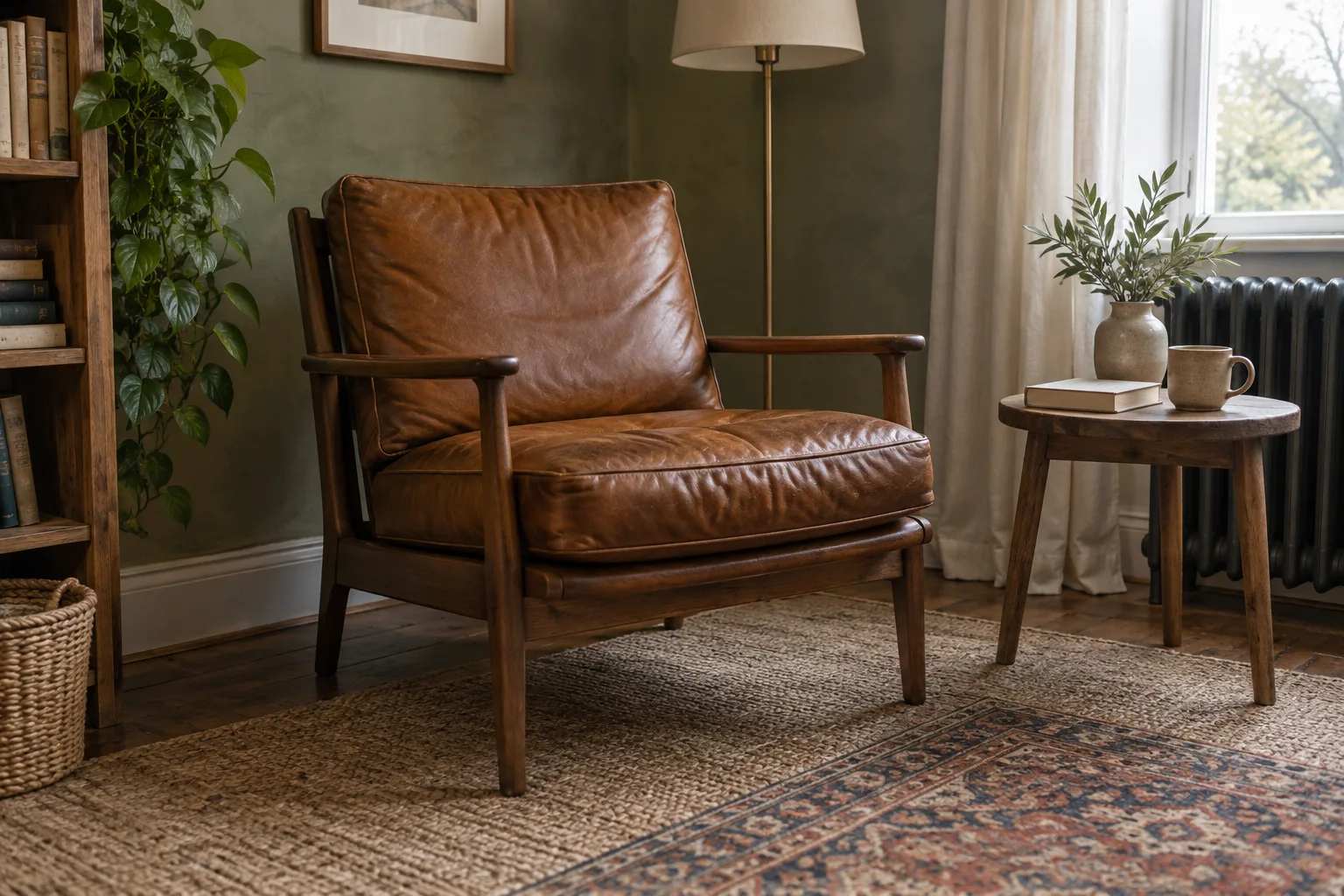
Start with what is on the chair now
The attraction of an old leather chair is often the surface it already has: softened colour, small creases and a cushion that no longer looks factory fresh. Bringing it home can trigger an urge to “feed” it immediately. First decide what you are trying to change. Removing dust, lifting an unknown stain and making the whole chair darker are three different projects.
Ask the seller or upholsterer whether the cover is original, replaced, recoloured or coated during restoration. A maker name on the frame does not identify leather fitted decades later. Keep invoices, colour references and treatment information with the chair so the next cleaning decision starts with more than a guess.
Carl Hansen & Søn distinguishes pigmented, semi-aniline and aniline leathers in its current care guidance. Their surface protection differs. That is why a routine for one named leather should not be transferred to every brown chair, and why gloss or softness in a photograph cannot settle the choice.[2]
Write the answer in plain terms: “replacement leather, supplier known, care sheet available” is useful; “original leather, finish and past treatments unknown” is useful too. The second answer simply leaves fewer sensible home-treatment options.
Make the ordinary routine small
For a sound surface, begin with gentle dust removal using a clean, soft, undyed cloth. The maker’s guidance also allows careful vacuuming with a soft brush. Do not drag a hard nozzle across piping or pull at a loose seam. If the surface is powdering, flaking or transferring colour, stop handling it as ordinary dirt.[2]
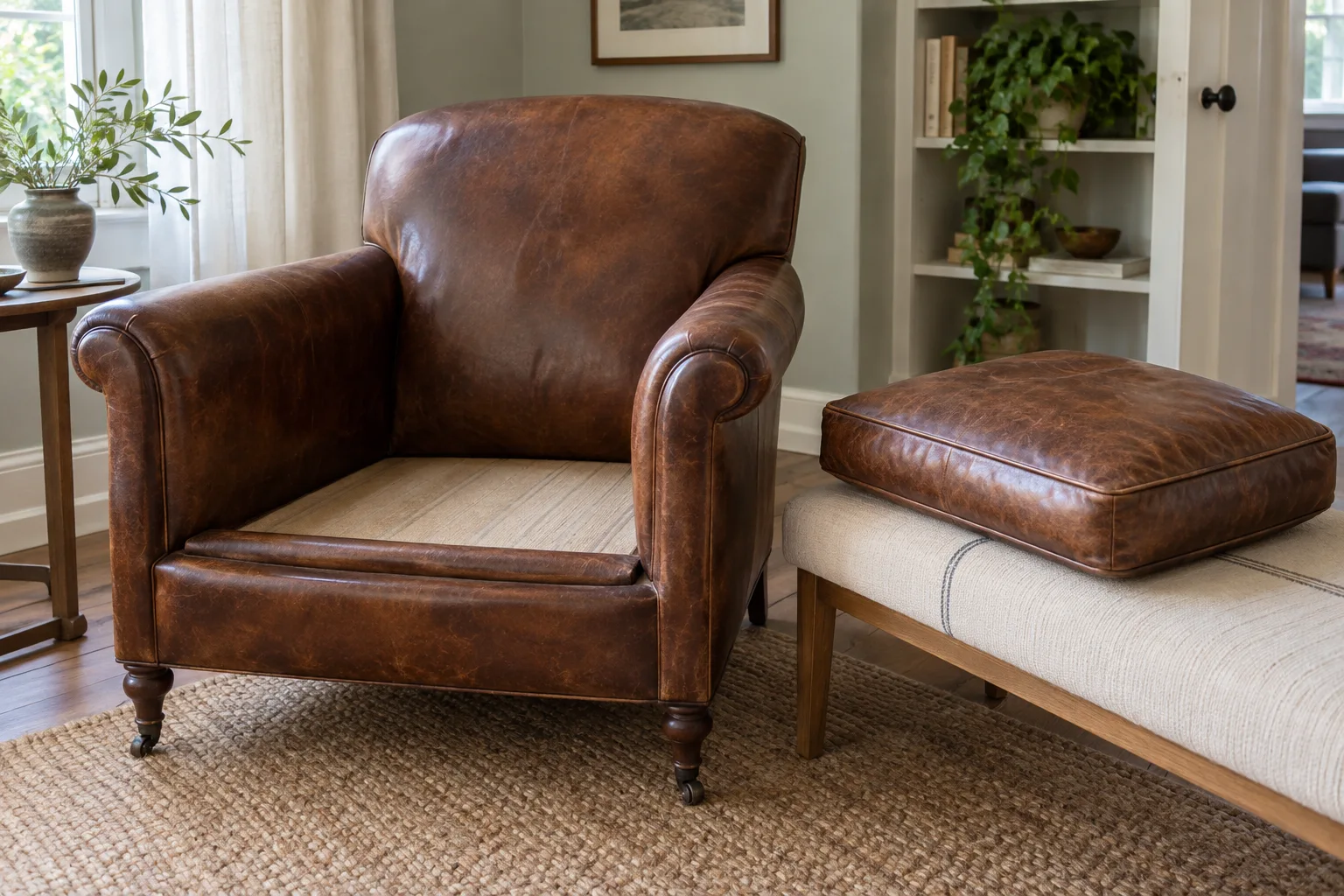
Lift a removable cushion only if it is meant to come off and can be handled without straining the cover. Clear accessible crumbs around it gently and note anything needing attention. You do not need to strip the chair or remove its underside to maintain an everyday seat.
Look at where the chair lives. Keep it out of direct heat and strong sun rather than trying to compensate with more treatment. CCI discusses heat and environmental deterioration of leather; moving a chair away from a radiator is a different kind of care from applying a product to its surface.[1]
For a small fresh spill, absorb what you can with a clean undyed cloth without scrubbing it into the covering. Follow the identified leather’s instructions for further cleaning. With an unknown surface or a persistent stain, record what was spilled and seek advice before adding water, soap or a stain remover.
Why one source says “condition” and another says “leave it”
CCI’s guidance concerns leather in collections and generally advises against routine leather dressings and saddle soap. It describes risks including changes in appearance and harmful residues. That is a strong reason to avoid an automatic dressing on unknown old leather; it is not a claim that every current furniture maker’s specific care instruction is wrong.[1]
For example, Carl Hansen gives particular treatment guidance for its goatskin, while distinguishing that material from its other leather options. The useful question is whether you have the identified covering to which that instruction applies. Do not turn one recommendation into “all leather needs cream”.[2]
| Situation | Useful next step |
|---|---|
| Known covering and current care instructions | Follow those instructions, including exclusions and frequency. |
| Unknown old leather, stable enough for ordinary use | Keep care minimal; identify it before choosing a treatment. |
| Peeling, powdering, sticky areas or colour transfer | Pause cleaning and ask a leather conservator or suitable upholstery specialist. |
| An old stain you want removed | Give the specialist its history and photographs before approving a treatment. |
A hidden spot test is not permission to use any product you happen to own. First establish that the treatment is suitable. A small patch cannot predict every delayed colour change or interaction with an old coating. Avoid kitchen oils, shoe polish and an improvised sequence of cleaners.
Ask for a result you actually want
When speaking to a specialist, describe the desired outcome: retain the faded colour, clean a specific mark, repair a seam or make a damaged cushion usable. Do not use “restore” as a complete brief. A recoloured surface may look more even while losing variation you wanted to keep.
A useful care enquiry
This chair has the following known covering and treatment history. I would like to retain its present colour and texture while dealing with this specific problem. Can you identify the surface, explain the least extensive suitable treatment and tell me what may change? Please include aftercare instructions for the finished work.
Photograph the chair in ordinary light before agreed work. Keep the product names and date of any professional treatment afterwards. If a later mark appears, that small record is far more helpful than “it was conditioned sometime last year”.
The everyday aim is a chair you can enjoy without continually treating it. Accept stable age where you like it, deal with a specific problem when it matters and let the known material determine the routine. A shelf full of leather products is not a care plan.