
What are you being offered?
MoMA’s introduction explains printmaking as an indirect transfer and distinguishes techniques including woodcut, etching, lithography and screenprint. Multiple impressions can come from the same printing surface. That is different from photographing an existing artwork and printing the photograph. A digital print may also be an artist’s original work; the process name alone does not settle the artistic or edition claim.[1]
| Description | What it should tell you |
|---|---|
| Original print | An artwork made through a print process; identify artist, technique and edition where applicable. |
| Later impression or restrike | A later printing from the printing surface; establish date, publisher and authorisation. |
| Reproduction | A copy of an existing image; identify the reproduction’s maker and date if known. |
| Decorative print, unconfirmed | An honest starting description when attribution and process are unresolved. |
These distinctions are particularly useful for ordinary landscapes, architectural views and posters. A handsome 1960s reproduction in a good frame does not need to be an expensive original to work in your room.
Read one documented print all the way through
The National Gallery of Art records its impression of Rembrandt’s The Three Trees, 1643, as etching with drypoint and engraving on laid paper. Accession 1943.3.9119 has a plate measuring 21.4 × 28 cm and a sheet measuring 21.8 × 28.7 cm. The separate plate and sheet measurements are the useful lesson: a framed opening or overall frame size is a third measurement, not a substitute for either.[2]
This museum example is a method reference, not a suggested budget purchase. Apply it to an ordinary signed landscape: record the title, the actual sheet, the image or plate area, the technique claim and any publisher information. Compare with a reliable catalogue record. Agreement in subject alone proves little; a mismatch in size or process may be exactly what distinguishes a reproduction.
A catalogue date may refer to the composition or plate. Ask what establishes the date of the impression on offer. A later printing is not automatically fraudulent, but it should not be sold to you under an earlier date without explanation.
The frame can hide the expensive questions
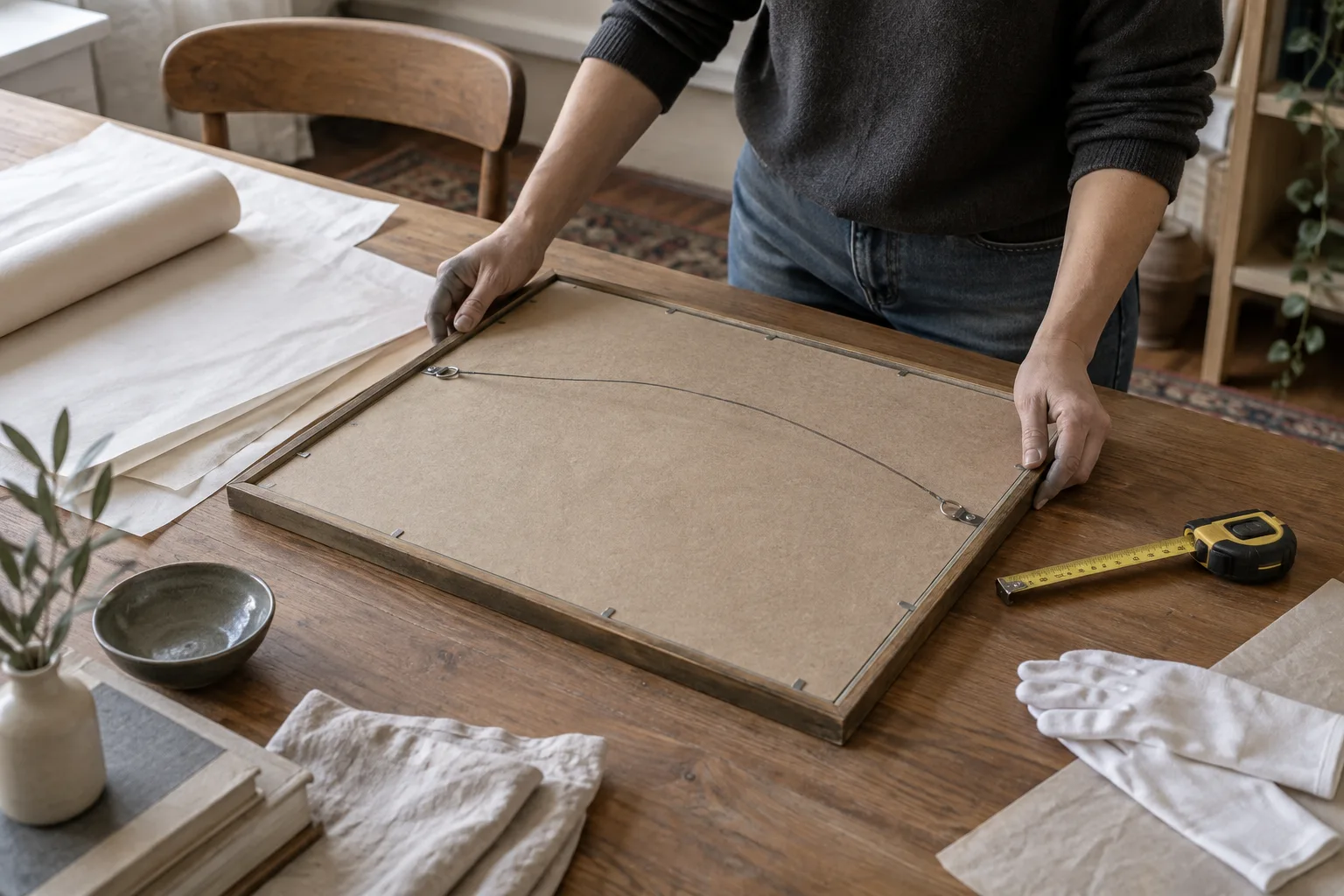
Request an undistorted view of the complete image, visible margins, inscriptions and the intact back of the frame. Ask whether the sheet is mounted, trimmed, hinged or adhered, and whether anyone has examined it outside the frame. Do not ask an inexperienced seller to dismantle fragile glazing or pull a sheet off a board.
Look for reported staining, fading, tears, creases, abrasion and repairs. A brown edge around a mount needs assessment, not a promise that reframing will remove it. An unusually fresh-looking signature also needs context, but appearance alone cannot date the ink.
Keep the limitation clear when the sheet cannot be examined. You can buy a decorative framed image on that basis; an attribution-dependent price may justify examination by a print specialist or paper conservator first.
Add framing and transport before choosing
Compare two complete options. An illustrative €90 framed print needing an assumed €140 reframing job costs €230 before transport. A €180 example with appropriate usable framing may be cheaper overall. These are arithmetic examples, not market prices or conservation quotations.
Specify the result to the framer: preserve the sheet, retain useful labels and old documentation, and explain the proposed mounting, glazing and backing. For a valuable or compromised work, get conservation advice before treatment. A new frame can improve presentation; it cannot supply missing authorship evidence.
Ask the seller
Please confirm the claimed artist, title, technique, impression or edition date, sheet and image dimensions, and the source for those details. Is the sheet trimmed, adhered, stained or repaired? Please show inscriptions and frame backing, and state what has actually been examined outside the frame.
Choose the level of certainty your purchase needs. A modest print bought for its image and described honestly can be an excellent find; leave the exceptional attribution to evidence strong enough to carry it.