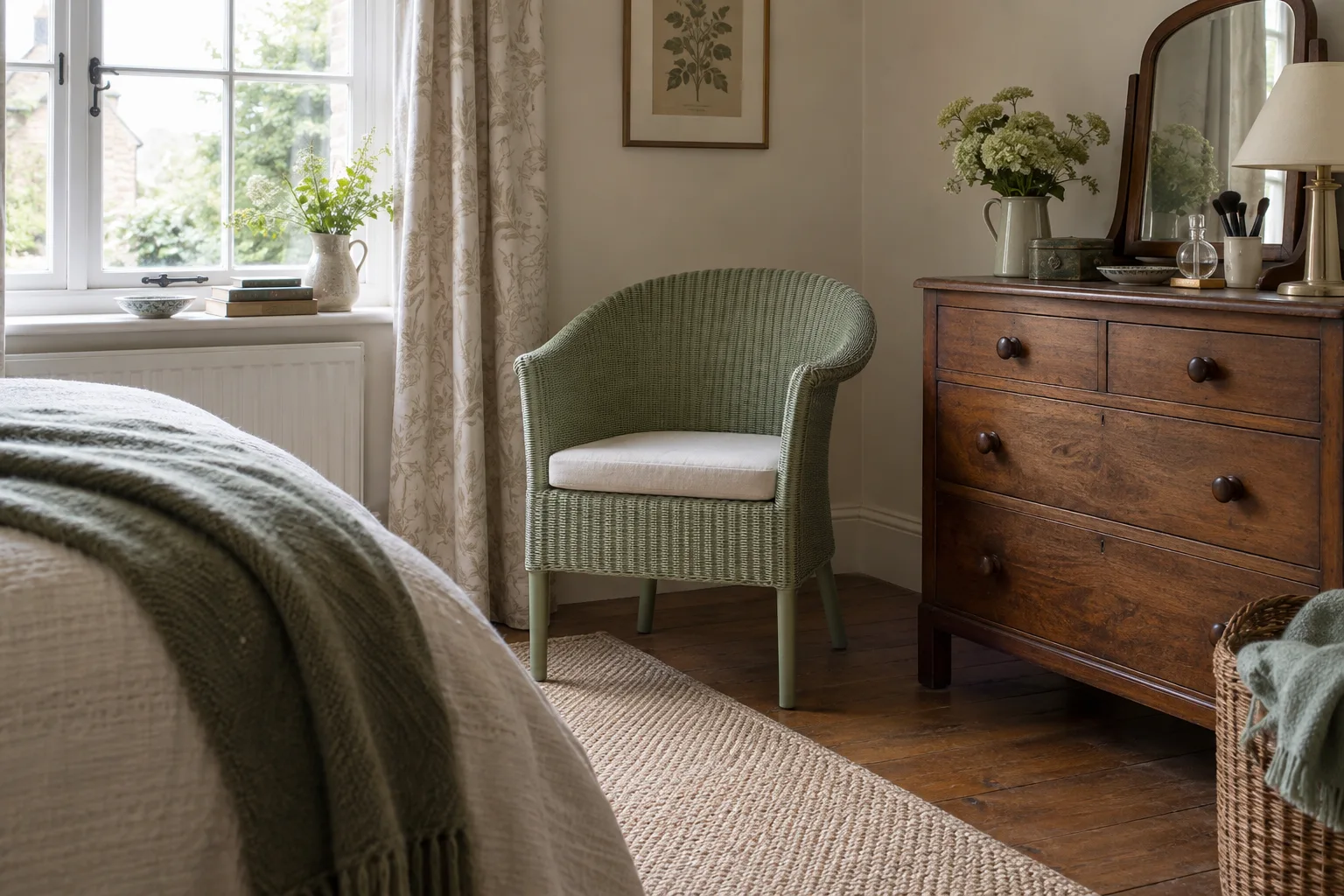
That fine weave is the point
From across a room, Lloyd Loom can look like ordinary wicker. Close up, its fine repeated texture has a more fabric-like character than broad cane strips or substantial rattan poles. It gives a small bedroom or occasional chair a soft outline without a heavy upholstered body.
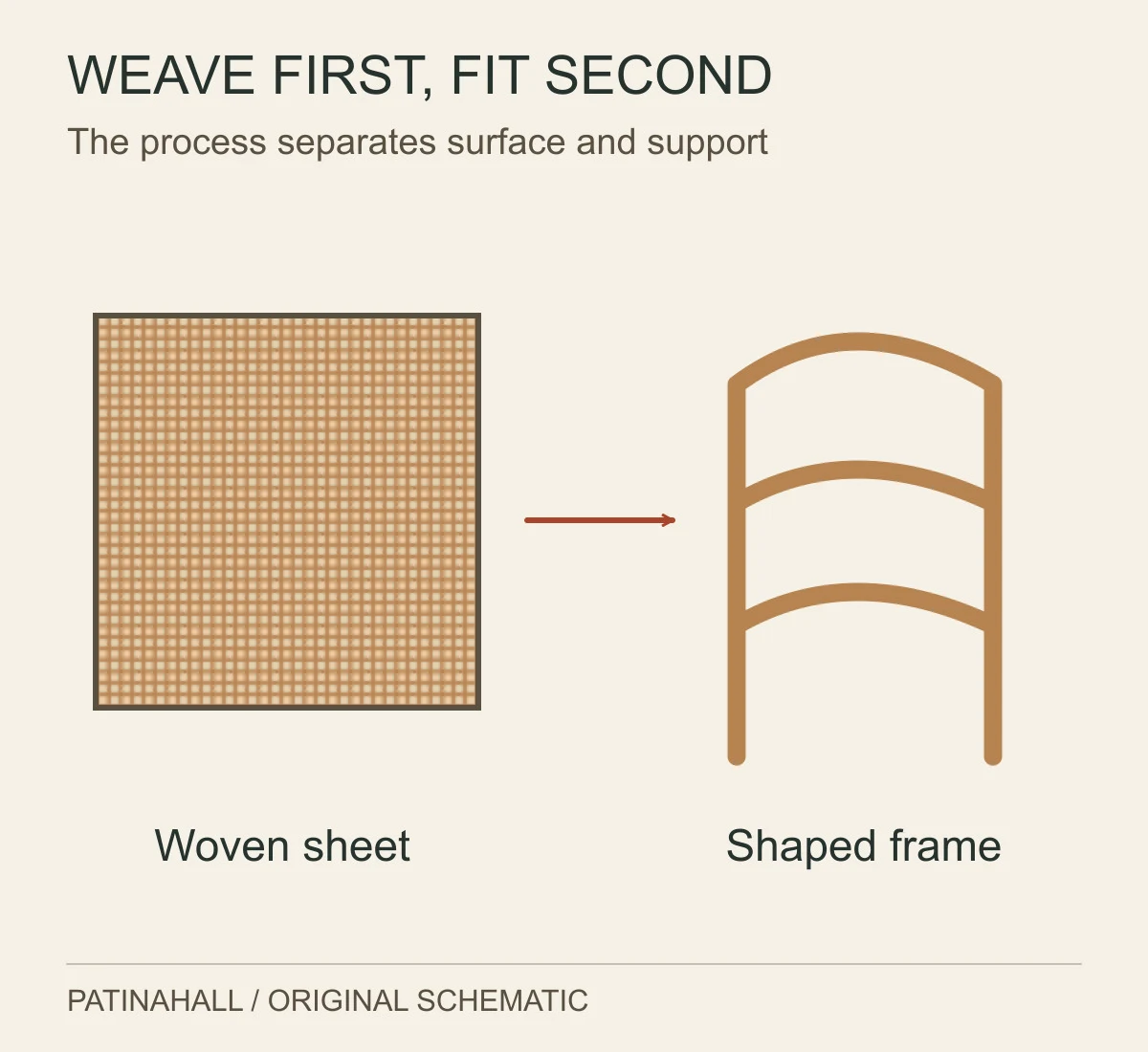
Lloyd Loom Manufacturing describes its present material as twisted kraft paper and wire, woven into a sheet and fitted over a frame. That explains why the material needs its own treatment approach. It does not identify or date every old chair sold under the name, nor prove that the old frame has the same specification as today’s production.[1]
Start with the complete chair, any surviving label and its location. A rounded painted wicker chair is not automatically a Lusty Lloyd Loom example. If the maker matters to your budget, keep the description provisional until the form and record support it. The separate Library story follows the invention and British production history.
A worn colour and a hole are different purchases
Follow the surface around the front corners of the arms, the upper back and the edges beside the seat. These are places your hands and clothes meet the chair. Note whether the texture remains continuous or whether strands have broken and the covering has separated from its edge.
Consider an illustrative pair of chairs you like equally. The first has rubbed paint on the arms, but the weave continues around the corners and its seat support is sound. The second is your favourite colour, yet a tear runs into the edge binding and the seat sags. They are different projects: you might enjoy the first with its worn colour, while the second needs a proposal for both the covering and the support.
| What you see | What to establish |
|---|---|
| Patchy colour over continuous weave | Is this worn paint, an earlier colour or staining? Can the present surface be kept? |
| A split, missing strand or loose binding | What material is damaged, how far does it continue and what repair would remain visible? |
| Thick paint obscuring the pattern | How many treatments are known, and are edges or repairs buried beneath them? |
A patch can remain visible through its texture and boundary even after recolouring. Ask what the finished repair would look like, and view the reverse of the damaged area where accessible without peeling back the covering.
The cushion is not the seat structure
Ask the seller to lift the loose cushion and show the entire seat area, including its edges and underside where safely accessible. You need to know what supports the sitter, whether it sags, and whether a later board or pad has been added. A new cushion is not proof that the structure below it was repaired.
Also view the legs and their relationship to the frame. A chair that rocks because a floor is uneven and one with a moving joint are not the same problem. Have unexplained movement assessed rather than pressing harder to see how far it goes.
For daily reading, try the actual chair long enough to notice its width between the arms and the firmness of its back. A compact bedroom chair might be excellent for dressing and occasional sitting yet too upright for an evening with a book. Its modest size is useful when the intended job is modest too.
Would you keep it if the colour stayed?
That is the most useful question before buying a heavily painted example. Recolouring may be possible, but chemical stripping, soaking and abrasive scrubbing should not be assumed suitable for paper-based weave, its coating or its attachments. Get a treatment proposal for this material and chair; do not borrow a rattan-cleaning recipe.
If you want a bare natural surface, start with another material. For a Lloyd Loom chair, finding a colour you already enjoy can be simpler than undoing several owners’ decorating choices.
Ask before making the offer
Could you show the chair without its loose cushion, the seat underside, the arm edges and any label in context? Please point out broken weave, loose binding, movement and added seat boards. What is known about repainting or earlier repairs, and is any work included in the price?
Choose the repair you can live with
The appealing purchase is a comfortable, sound chair whose worn paint or disclosed repair suits the room. A little unevenness need not spoil it. If the weave and support both need work, compare the whole restoration proposal with another chair before you let a low asking price decide.
For construction beyond loom-woven paper, see the rattan, cane and wicker Guide.
For documented design history, read the accompanying Furniture Library story.