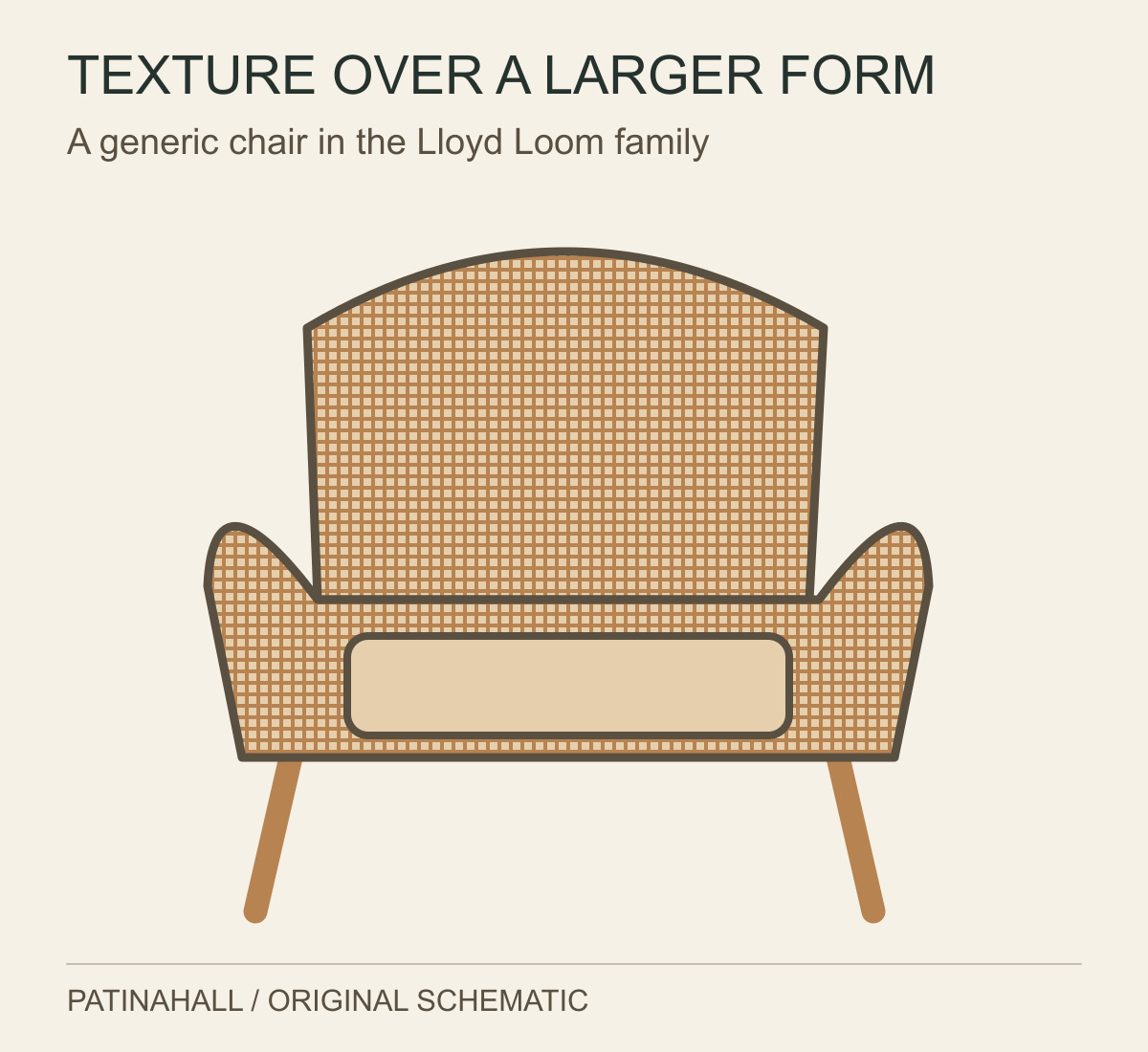
First weave the surface
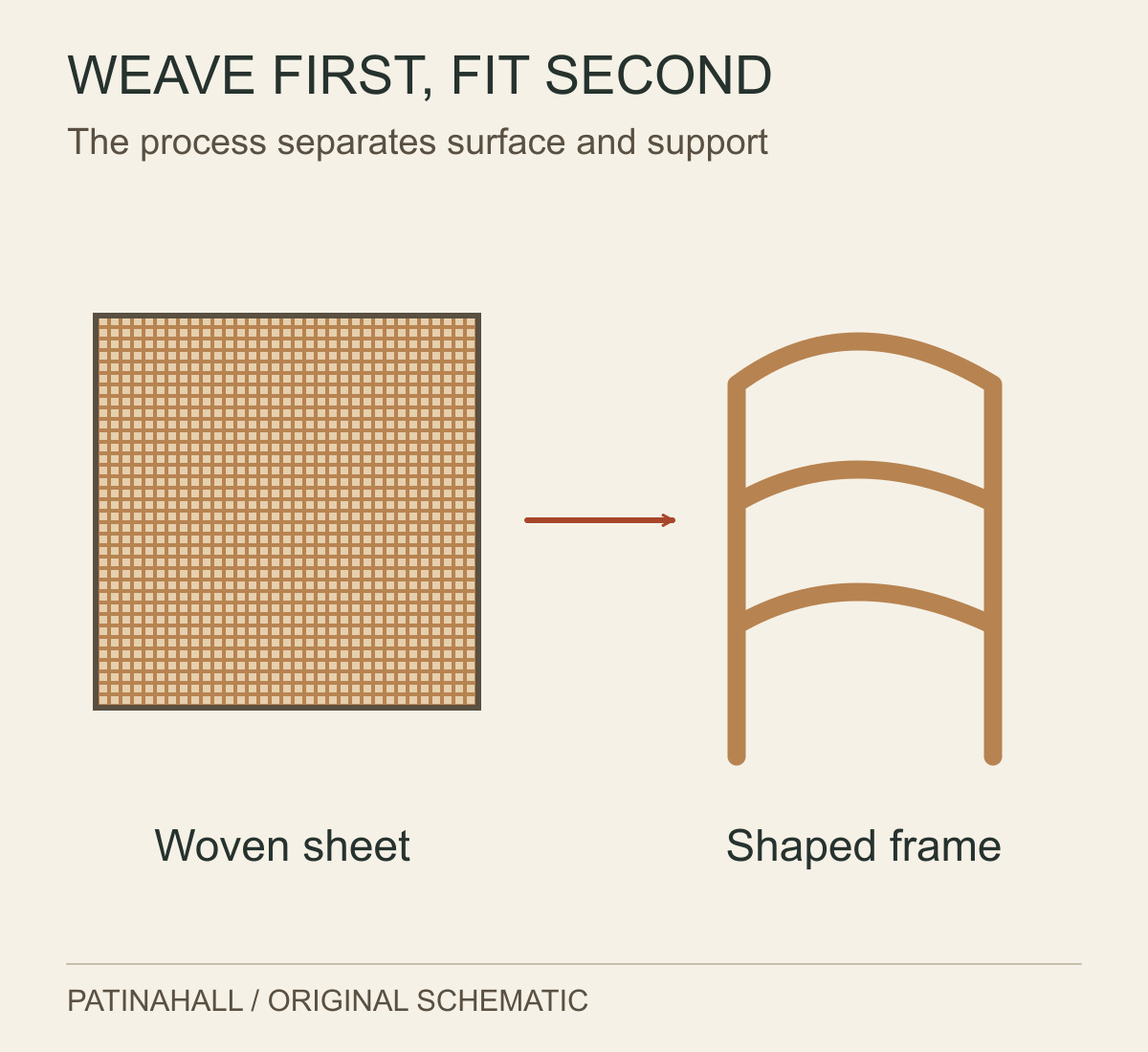
A Lloyd Loom chair begins with a change in the order of making. Instead of weaving cane directly around a chair frame, the process produces a fabric that can be cut and fitted to furniture. The continuous woven surface is made before it becomes the back or side of a particular chair.
Lloyd Flanders describes cellulose fibres twisted into cord, wound onto spools and fed through looms. In its present factory, the fabric is then cut to shape, stretched over a frame and secured; a braid finishes the edges. The current reinforced strands, aluminium frames and coatings belong to that manufacturer’s modern process.2
Look closely at the weave as it travels around a corner. A surface made as fabric has to meet the frame, stretch into position and end somewhere. The border is therefore part of the construction story, not simply an extra decorative line.
An American invention reaches Bow
The Furniture History Society dates Marshall B. Lloyd’s invention to 1917. By 1921, the British manufacturing rights had passed to W. Lusty & Sons, a London business that had begun in 1872 making packing cases. Its factory was in Bow, and it exhibited at the British Industries Fair in 1922.1
This history helps explain why Lloyd Loom is a family of objects connected by a process, rather than one chair by one designer. A woven material could be fitted around different frames and appear as upright bedroom seating, broader armchairs and other furnishings. The recurring texture links them even when their silhouettes differ.
The invention travelled as a way of making. Its British story involved another factory, its workers and its own furniture models, rather than simply imported examples of a single American chair.
The hotel chair behind the familiar texture
The Society records that railway hotels began using Lloyd Loom furniture during the 1920s, helping its popularity grow. It also identifies a surviving Lusty model 464 armchair, dated 1930, in the V&A collection. Those references place the weave in furnished rooms and commercial production, beyond the patent’s date.1
A hotel needed several chairs to furnish a room; a household might acquire just one. The same process could supply a repeated surface across both settings. That is part of what makes an old woven chair feel familiar before its label has been read.
The useful thing to notice is the meeting of fabric and frame. Follow the weave to its edge and the apparently simple chair starts to show the sequence of work that made it possible.