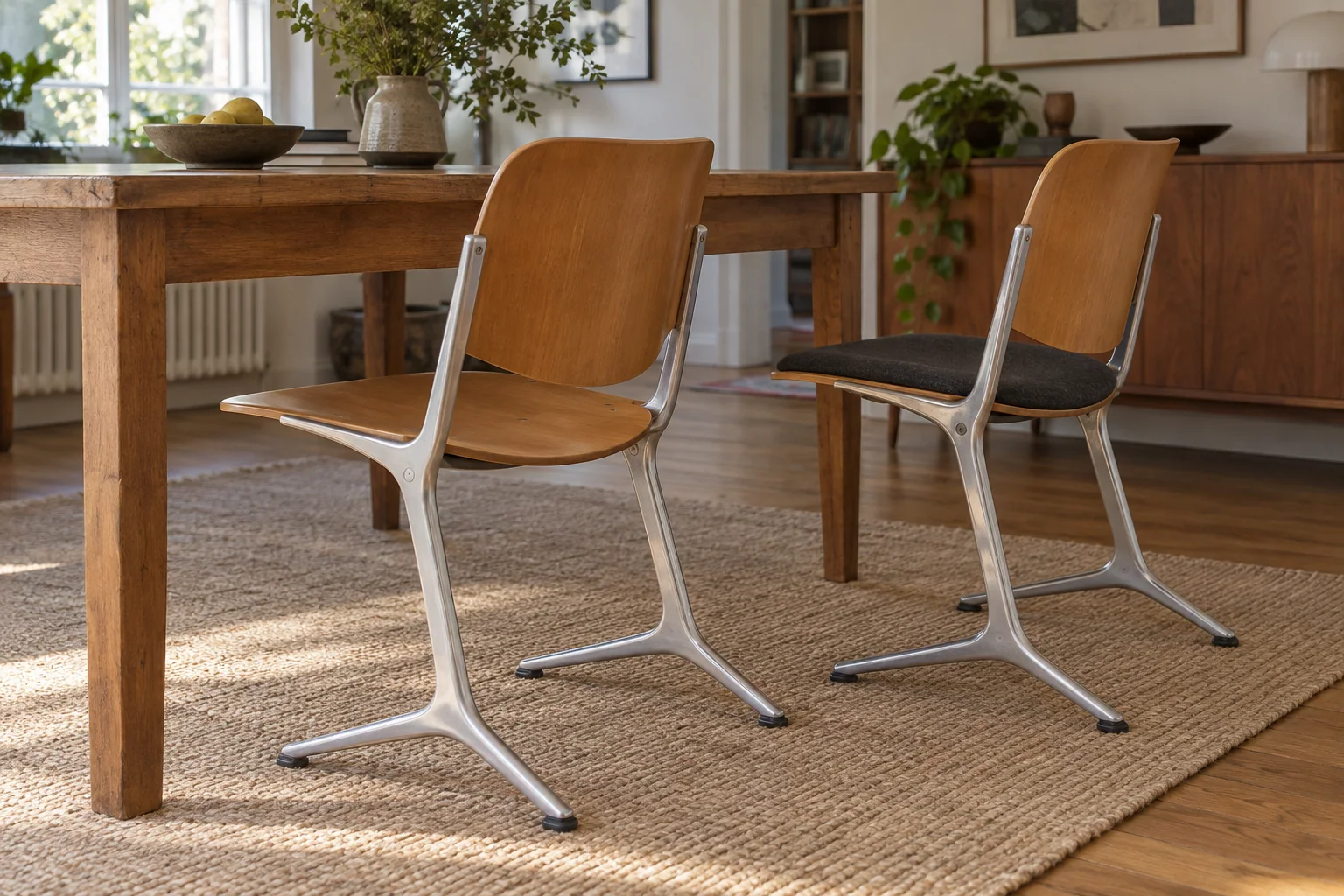
Start with how dinner will feel
Anonima Castelli dates Giancarlo Piretti’s DSC 106 to 1965. Its broad seat and separate back make a useful dining alternative to a heavily upholstered chair, but the design date does not date the offered example. Ask whether the seat and back have been recovered or replaced.[1]
Try the bare-seat version for long enough to notice pressure at the front edge and the shape of the back. Try an upholstered one at the same table if possible. A newly padded seat may sit higher or feel shallower than the wooden version you liked in a photograph.
| Offered version | Look at this before budgeting |
|---|---|
| Exposed wooden panels | Edges, finish, local damage and the condition around attachments. |
| Fabric upholstery | Wear, seams, odour, padding and what is known about the panel underneath. |
| Coated upholstery or imitation leather | Cracking, peeling and replacement scope; polishing cannot rebuild a failing covering. |
For a kitchen that also becomes a homework table, think about ordinary use as well as an occasional dinner. Ask for care instructions suited to the actual upholstery or wood finish. “Wipe-clean” in a listing is not a material description.
The shiny frame is not automatically chrome
An intOndo seller’s recorded wooden DSC 106 describes a die-cast aluminium frame and curved beech seat and back. The important distinction for a buyer is that shiny metal alone cannot identify its surface or prescribe a polish. Get the frame material and previous treatment confirmed for the chairs you are considering.[2]
Examine where the side frames meet the seat and back, with the seller showing the underside safely. Compare fasteners across the set. A replaced screw is not automatically a problem, but a mismatched fixing, split panel or unexplained bracket is something a repairer should assess.
Look for sharp damage, cracking or distortion in the frame before a sitting trial. Do not try to straighten a casting, tighten every screw harder or make a deliberate wobble test. The useful observation is where ordinary movement occurs, not how far a doubtful part will bend.
Four cheap chairs can make a surprisingly long parts list
Anonima Castelli’s current spare-parts page lists DSC 106 sleeves and glides separately. That gives you a specific starting point for an enquiry. It does not guarantee that a current kit fits every vintage example or every later replacement frame.[3]
Number the chairs and photograph the existing parts with their positions clear. Count what is absent, split or worn through. Ask the supplier to confirm fit against those photographs and measurements; confirm whether a quoted set serves one chair or several.
If stacking is part of the attraction, ask the seller to demonstrate normal stacking only after condition has been checked. Note contact points and whether the chairs actually settle together without pressure. Do not infer a safe stack height or component compatibility from a catalogue photograph of a different production.
Compare the set after its necessary work
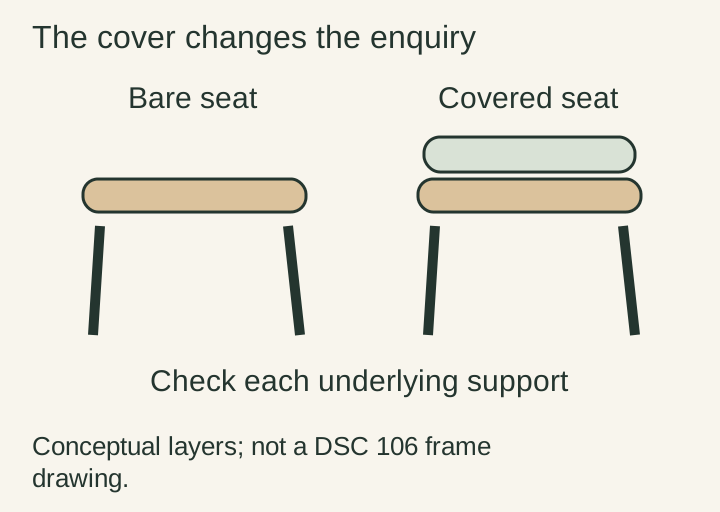
Ask an upholsterer to price seat and back work separately, including any panel repairs and suitable filling. A cheap cover-only figure can miss the part that determines whether the chair is usable. For bare wooden panels, ask whether the intended result is a local repair, a changed finish or replacement.
Keep the acceptable wear in the decision. A sound set with varied colour can be enjoyable as it stands; matching every chair perfectly may involve considerably more intervention than you want. Agree which differences you are keeping before paying for work that erases them.
A useful message for a seller or repairer
Please show the seat and back attachments, labels, sleeves and feet of each chair. Which panels or covers have changed? I need a price for the complete usable set, including the specifically compatible small parts and any necessary inner upholstery work.
The right DSC 106 set is the one whose surfaces, seating feel and small parts make sense together. A bright frame is only one part of that result.