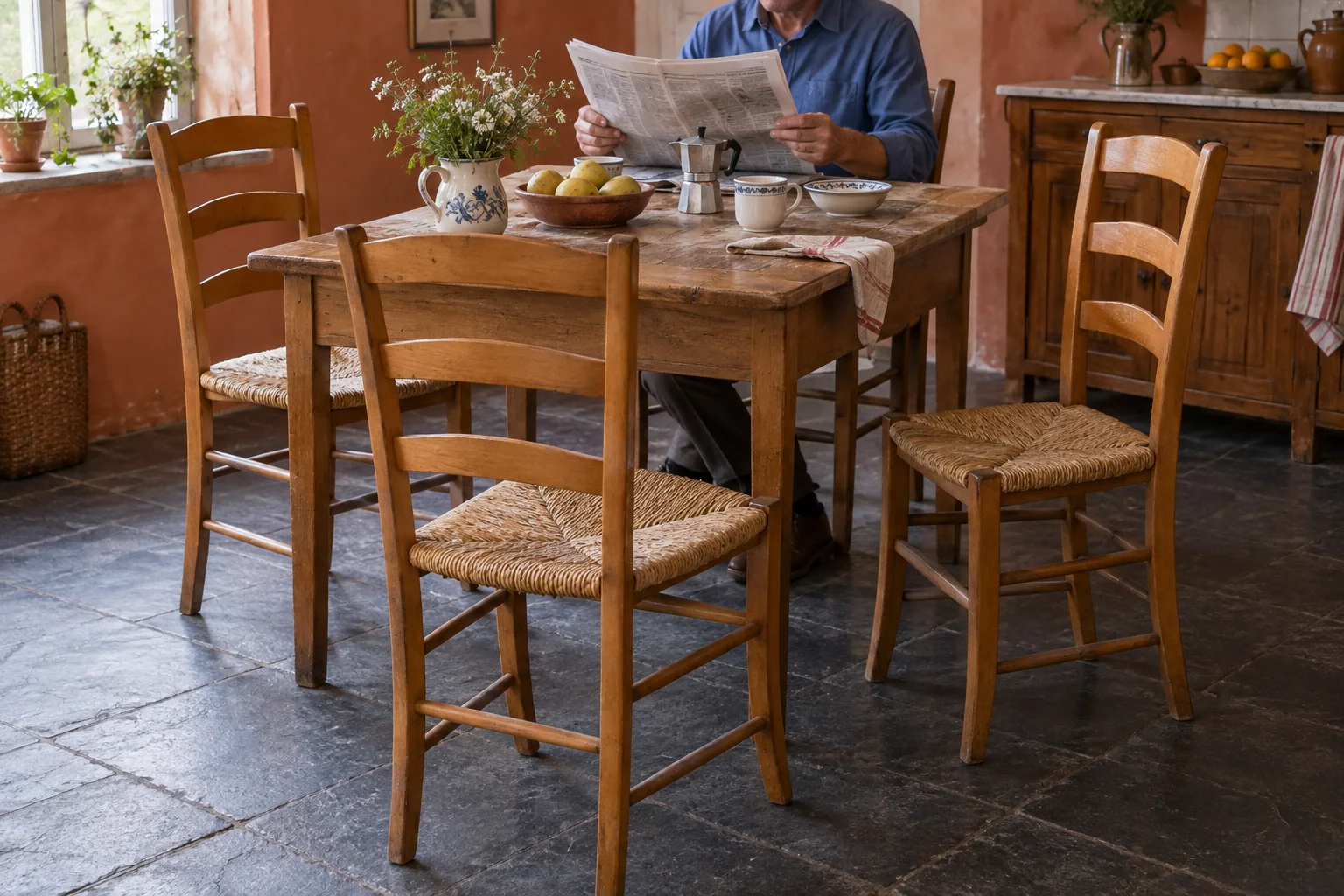
Traditional does not tell you the production date
Ladder-back chairs have horizontal slats or rungs between two uprights. Their familiar outline is easy to call “eighteenth century” in an advertisement, but makers have returned to it repeatedly. The Franklin D. Roosevelt Library records a Val-Kill chair from around the 1930s whose design drew on an early eighteenth-century model. It is a useful, documented example of an older-looking form made much later.[1]
Use a date claim to begin research, not to skip a sitting trial. A plainly described twentieth-century set may offer exactly the character you want at dinner. Ask for the basis of a more specific maker or age claim separately from the questions about use and condition.
The seat can be narrower than it looks
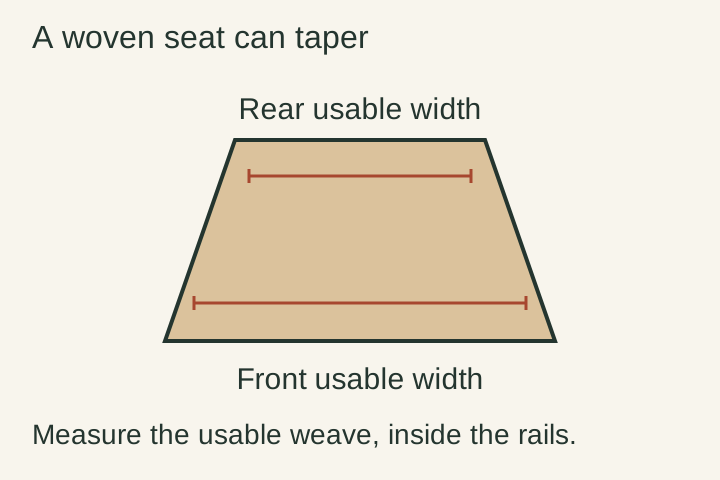
Measure the usable woven area at the front and towards the back, not only the outside of the frame. Side rails and taper can take up space that appears generous in a frontal photograph. Notice whether the weave has settled evenly or forms a deep hollow that changes your posture.
If the chair is sound, sit in your normal dining position and feel where the upper rungs meet your back. A straight, high back can work for one person and create a pressure point for another. Try turning to talk as well as facing forwards. A chair that feels fine for thirty seconds can become tiring while you linger over dinner.
| Observation | Why it matters |
|---|---|
| Usable woven width at front and rear | A tapering seat may restrict hips or encourage you to perch at the front. |
| Height while occupied | A settled seat can place you lower than its rail height suggests. |
| Upper-rung contact | Your shoulders may meet a broad slat, a narrow rung or a gap. |
| Thigh room under the apron | A replacement seat or added cushion can change this clearance. |
A replacement seat can alter the fit
Here is an illustrative comparison. Chair A has a firm, recently woven seat; chair B has a deeply settled original seat. Their wooden frames measure the same height, yet you sit lower in B. If you buy B because it fits under a tight table apron, renewing its seat may change that useful clearance. Agree the intended finished seat with the weaver before treating frame height as the whole measurement.
This is also why six similar frames deserve six observations. Different reweaving campaigns can produce a mixed experience within a visually matching set. Ask when each seat was done and which material was used. “Rush” in a listing is not enough to identify the fibre or specify a matching replacement.
Separate weaving from the wooden frame
A weaver needs clear photographs of the top and underside, usable seat dimensions and the frame around the weave. Broken strands, a loose pattern and a frame that racks are different problems. Confirm whether the wooden joints must be repaired before the new seat can be woven and who will coordinate the work.
Avoid ordering a decorative layer over a failing seat to hide the problem. An ordinary loose cushion may improve comfort on a sound chair, but it does not restore support. Ask whether old material will be removed, what the replacement will be and how the finished seat should be used and cared for.
If you are comparing two sets, total the seats actually needing work. A slightly more expensive group with sound, comfortable seats may cost less to put around the table than a cheaper group requiring six replacements plus frame repairs. Use real local quotes; a single online per-seat price may exclude your frame shape, material and transport.
Request the two most revealing chairs
Message to adapt
Could you identify the lowest or most worn seat and the most recently replaced one, and send their usable seat dimensions and underside photographs? Please include any loose frame joints. I would like to try those two chairs first and obtain a matched reweaving quote if the set needs work.
The reward is straightforward: useful everyday chairs with texture and character, where the weave and wooden frame work together. Choose the proportions you like sitting in; then decide how much renewal the set deserves.