
A genuinely older IKEA story
IKEA Museum dates Niels Gammelgaard’s GUIDE to 1984 and records its appearance in the 1985 catalogue. Its account describes 170 cm side frames and shelves, reversible white and anthracite faces, and red, blue, yellow and green edges. These are historical design details, not dimensions to assume for an unidentified second-hand set.[1]
IKEA’s own later material connects GUIDE with relaunches under ENETRI and BYAKORRE. That family history can explain a familiar silhouette, but it cannot date a particular shelf or guarantee that old and new boards fit the same supports. This guide concerns older sets; a current specification is useful only when it actually matches the offered production.[2]
Ask for an inventory before the flat-pack journey
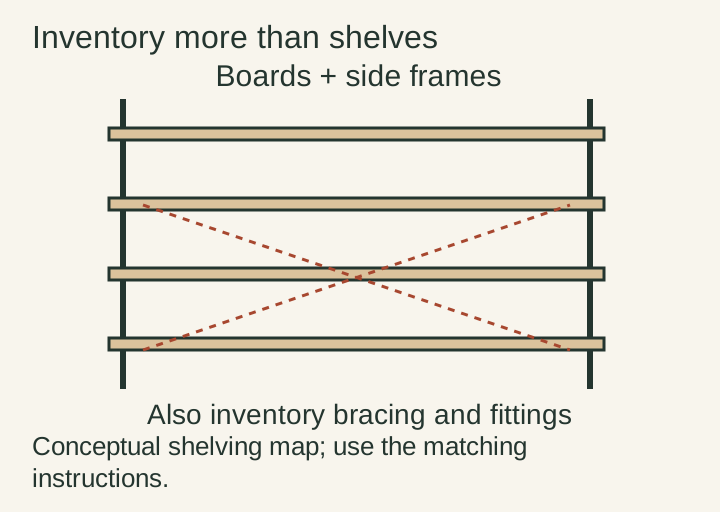
Request the whole unit assembled, followed by clear photographs of the side frames, both faces and all edges of the shelves, bracing, feet and loose fittings. Number the pieces. For a dismantled purchase, match every numbered part with the seller at collection.
| Part group | Check |
|---|---|
| Side frames | Matching size, intact connections and undamaged shelf supports. |
| Boards | Count, dimensions, edge condition, swelling and bowing. |
| Bracing and connectors | Presence and fit against the instructions for this version. |
| Feet and wall attachment | Complete components and a suitable installation plan. |
IKEA’s ENETRI instruction sheet AA-1916684-4 specifically requires permanent wall attachment with fixings appropriate to the wall. It is a reference for that documented version, not an instruction to assume any older GUIDE is assembled identically. A tall unit that appears steady while empty is not a substitute for the correct installation.[3]
Long boards need an honest condition view
Ask for a photograph along each unloaded shelf edge. Record bowing, chipped corners and swollen areas rather than relying on an attractive front view. A reversed board may change which colour is visible, but turning it over is not evidence that damage has been repaired.
Plan what you will put on the shelves: a few ceramics and paperbacks, a row of heavy art books or audio equipment are different loads. Establish the rating for the confirmed version and the condition of the surviving components. Do not borrow the load figure of a current reissue for an old, unidentified board.
A replacement shelf changes more than colour. Its thickness, depth, support geometry and attachment must be compatible. Have a supplier confirm those details rather than ordering a board cut only to the visible length. Keep a note of later replacements with the set.
Count the cost of the missing small pieces
Compare an incomplete set plus confirmed parts, transport and installation with a complete older example. If a seller cannot show how their loose pieces form one unit, price the uncertainty explicitly. Buying a second incomplete set can simply double the pile.
Before collection
Please photograph this set assembled and number every board, side frame, brace, foot and fitting for collection. Which instructions match it, what has been replaced, and what wall attachment does this version require?
The appeal is a light, open structure that lets books and objects make the room. A complete set gives you that pleasure without turning the spare room into a long-running hunt for one unlabelled fitting.