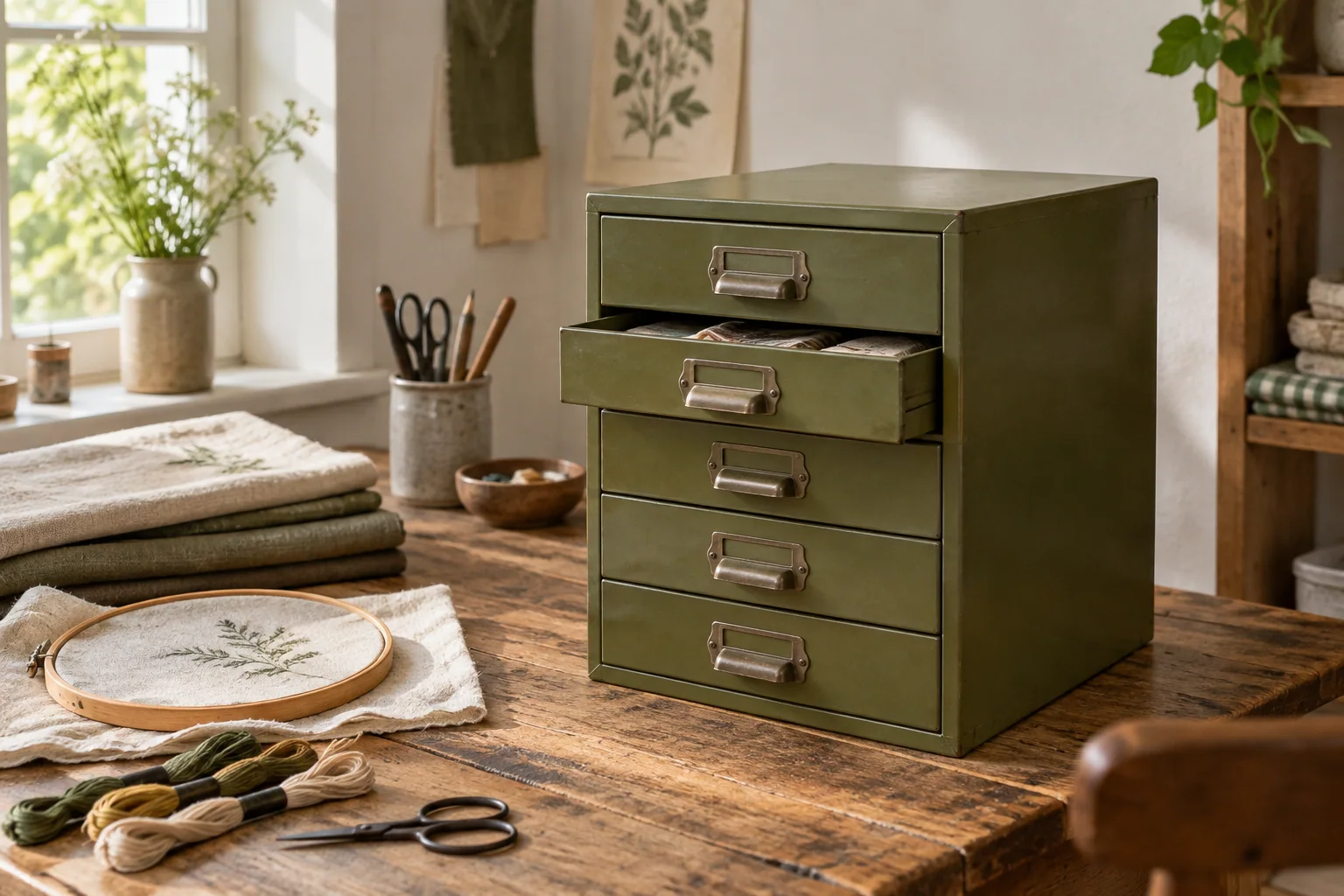
Why the little drawers are the point
Bisley dates the MultiDrawer design to 1958 and credits Freddy Brown. The compact steel format still makes sense on a worktable: separate drawers let you find pencils, patterns or components without disturbing everything above them. The appeal is not how much you can cram in, but how easily you can see and retrieve it.[1]
That is also why a large filing cabinet is a poor substitute for some hobbies. A deep drawer suits folders standing upright; a shallow one suits a single visible layer. Start by laying out one realistic drawer’s contents on the table. Include packaging you intend to keep, rather than measuring a naked object and forgetting its box.
A4 describes the paper, not the whole job
For a concrete reference, Bisley lists the current five-drawer H125NLCH at 325 mm high, 279 mm wide and 380 mm deep. Its stated internal drawer dimensions are 47 mm high, 234 mm wide and 375 mm deep. Those figures describe that product, not every older MultiDrawer. Ask for the measurements of the cabinet for sale.[1]
| Measurement | What it resolves |
|---|---|
| Clear internal height | Whether a bottle, reel or small box fits upright. |
| Width and depth between the drawer sides | Whether a paper pattern, tool roll or divided tray lies flat. |
| Clearance at the opening | Whether the filled drawer can close without its contents catching. |
| Space consumed by an insert | Whether the organiser leaves enough useful depth and height. |
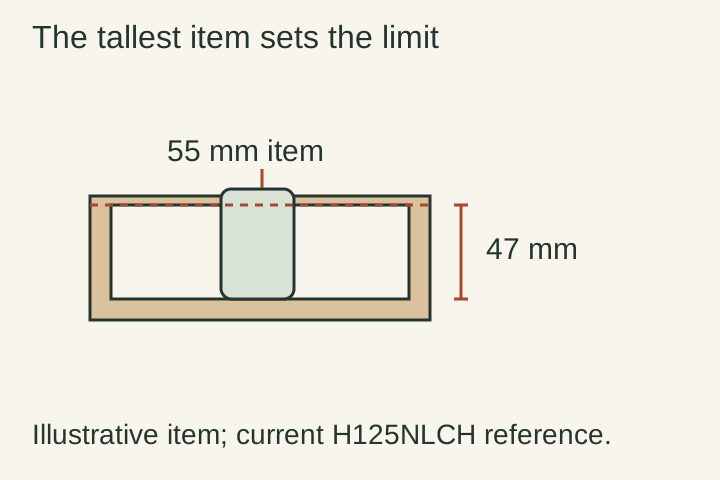
As an illustrative comparison, an item 55 mm tall cannot stand in a drawer with 47 mm of clear height. Laying it down may work for a spool; it may be a bad answer for something that can leak. Do not buy a taller cabinet expecting taller drawers unless the seller has checked that distinction.
Try every drawer, including the bottom one
Ask the seller to demonstrate each empty drawer in normal use. A different scrape halfway through its travel deserves a closer look at the drawer side and runner. A dented case can affect several drawers together. Compare the gaps between fronts and look inside the emptied case where access is available, without forcing a stuck drawer out.
Check handles and label holders for sharp or bent edges. A missing paper label is trivial; an absent handle, distorted front or incompatible replacement drawer is a different job. Ask whether all drawers belong to this case. The matching colour of a repaint cannot answer that question.
The current reference above has removable drawers and no anti-tilt mechanism listed. Do not assume an older cabinet has a drawer interlock or a safe stacking arrangement. Decide how the actual cabinet will be supported, and avoid opening several loaded drawers to test its balance.[1]
Buy the storage arrangement, not just the colour
Photograph any dividers or trays beside a ruler. Bisley offers several sizes of MultiDrawer and different organising inserts, so the brand name alone is insufficient for ordering accessories. A listing with the right trays may be more useful than a cheaper bare cabinet, particularly when you need many small compartments.[2]
Compare three totals: the cabinet as sold; the cabinet with the inserts you need; and a sound alternative already organised for your task. Include collection or delivery. Buying a heavy steel box from far away to save a small amount can undo the bargain before the first pencil goes inside.
A useful seller message
Could you measure the inside of one drawer and its opening, show every drawer moving, and photograph the included inserts? My tallest item is ___ mm and my largest flat item is ___ × ___ mm. Please also show any case dents and the underside.
If the dimensions work, a few honest scratches need not spoil the pleasure of using it. The successful purchase is the cabinet that makes tomorrow’s work easier to find.