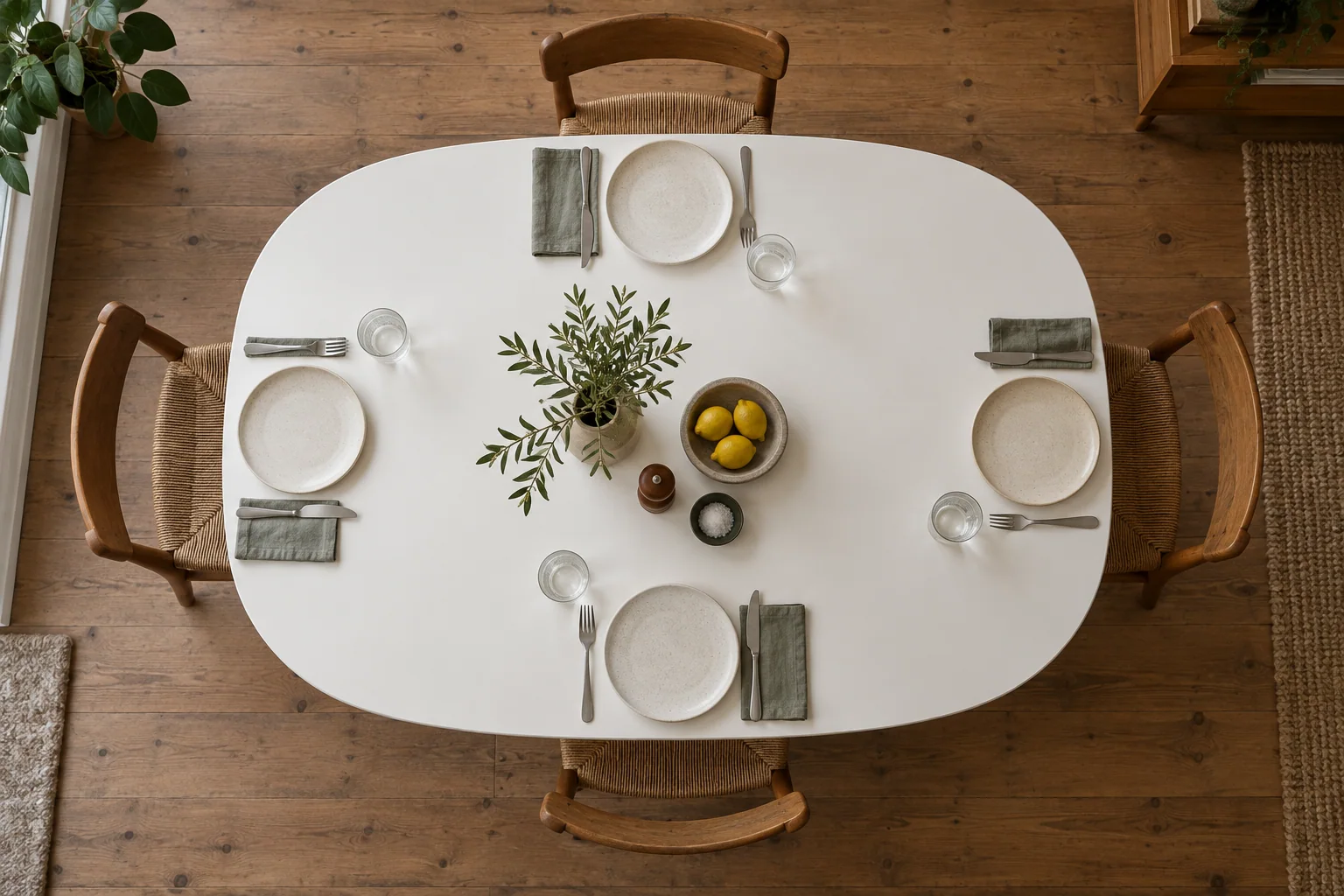
A 1979 example shows why the year matters
Zorrobot describes a table dated 1979 with a white HPL-laminate top, brushed aluminium edge and chrome-plated steel base, measuring 150 × 100 × 71 cm. The listing identifies clamping legs. Those facts belong to that seller’s example; they do not establish the material or height of every white Superellipse.[1]
Fritz Hansen’s 2025 Table Series sheet distinguishes span legs from pedestal bases and lists more than one height and tabletop option. It credits the Superellipse specifically to Piet Hein and Bruno Mathsson, 1968. Keep that narrower attribution separate from the wider Table Series, which also includes Arne Jacobsen’s work.[2]
This is a useful research method: compare your listing’s underside, dimensions and documented finish with an appropriate reference. A similar outline is insufficient to prove the manufacturer, and a new surface name is not a description of an older laminate.
Make the seller show the support arrangement
Ask for photographs of the whole underside with every leg connection visible. Count the assemblies and any plates, blocks or other fittings present on this example, without assuming a universal kit. Ask what has been removed, replaced, repositioned or repaired.
| Part | A useful question |
|---|---|
| Top and core | Is the top flat in ordinary use, and are there swollen or damaged edges? |
| Edge band | Is it secure, with any lifting, impact damage or sharp separation disclosed? |
| Leg attachments | Are the intended fittings complete and the surrounding material sound? |
| Leg assemblies and feet | Do they match the table and sit correctly on a level surface? |
A table that can be dismantled is not an invitation to improvise assembly. Ask the seller to supply the relevant instructions and have someone who understands the construction handle removal and refitting. If a connection moves or an improvised screw appears, get that detail assessed before loading the top.
Mark the curved footprint, not just a rectangle
Use the measured outline to plan places at the table, including the legs beneath it. A rectangle drawn from maximum width and length will overstate the surface near curved corners. Put paper plate templates at the places you intend to use and allow for people’s arms as well as crockery.
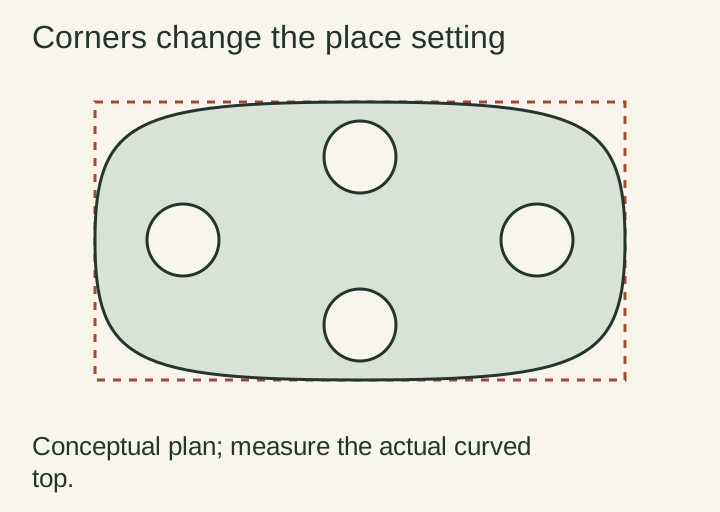
Try your widest chair at an end and beside a leg position. Check the approach when seated and when getting out, then the route behind an occupied chair. A generous-looking top can still pair badly with a bulky armchair or a room that needs a clear passage through one side.
For the listed 150 × 100 cm example, do not convert the seller’s seating claim into a guarantee of six comfortable places in your room. The useful result is a layout tested with your own chairs and everyday place settings. That is especially worth doing before buying a set to match.
Keep the thin top and its fittings together
Ask what the visible surface actually is and what treatment it has received. HPL, a veneer and a later replacement top call for different care and repair decisions. Do not apply current heat-treatment or abrasive advice for a named modern finish to an unidentified vintage surface.
Have the mover plan support and protection for the top and edge. If the legs travel separately, agree who labels, packs and refits the complete hardware. Confirm that the delivery service includes a table assembled and checked for ordinary use, rather than a top and several loose pieces left at the door.
A useful pre-purchase request
Please show the full underside and each leg attachment, confirm the measured height and top material, and list any replaced fittings. I also need the intended assembly method and a quote for delivery with correct reassembly.
Choose the example whose complete construction and comfortable places you understand. The elegant outline will still be there after those less photogenic questions are answered.