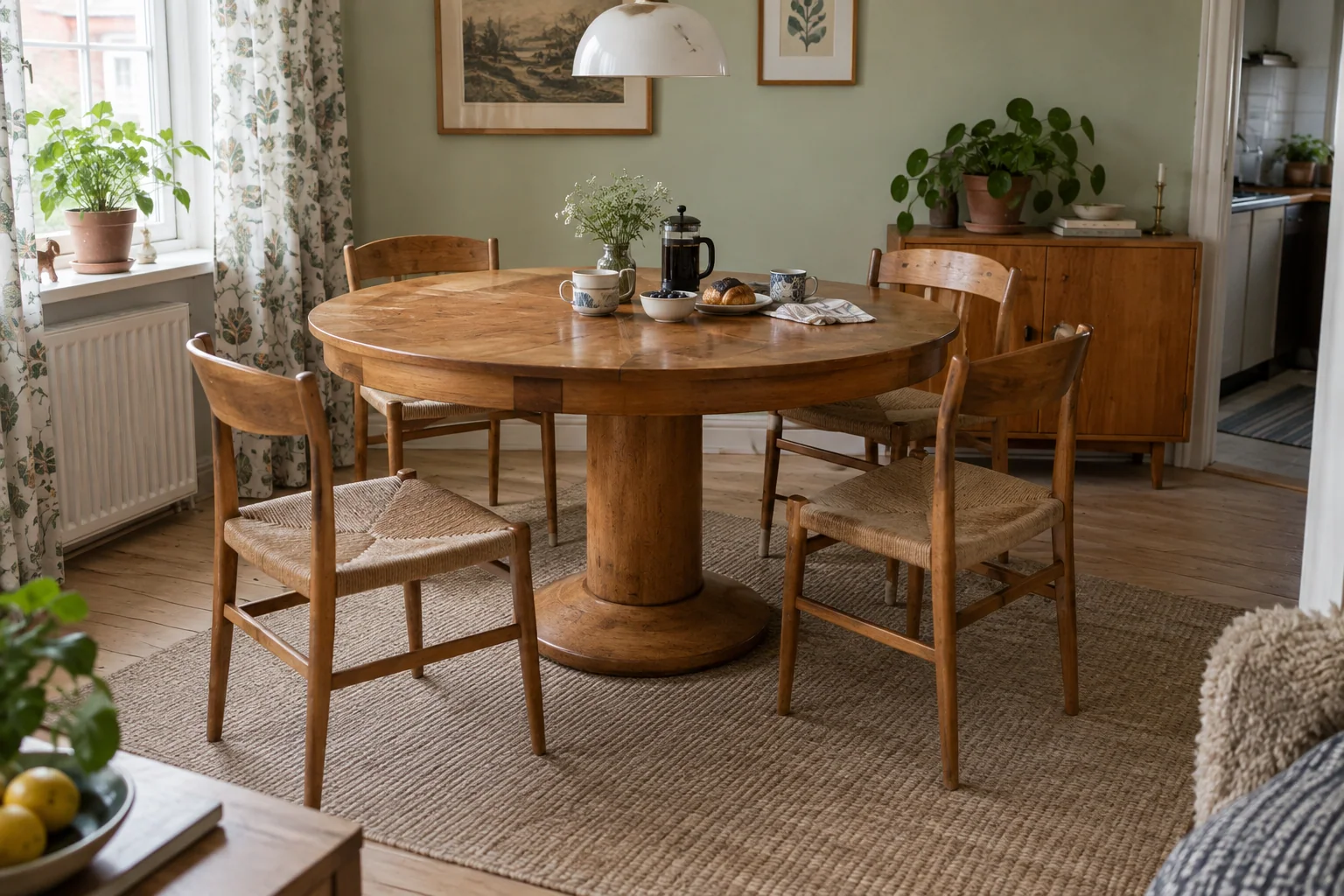
The familiar opening has a history
Skovby traces this table’s development from the DC06 in 1988 to the renamed and restyled #32 in 1996. In 2017 a new conical base made from six joined sections accompanied the #33 name. This is useful evidence when comparing listings: related mechanisms do not make every base, dimension and spare part identical.[1]
Ask for the label, complete base and underside, then seek the instructions for that example. A seller’s “SM32/SM33” title may simply mean they have not resolved the model. Establish that before ordering a part, planning disassembly or relying on a current catalogue drawing.
Watch from closed to open and back again
Skovby describes the #33’s three tabletop sections moving together to reveal integrated extension leaves. For a remote viewing, request one continuous demonstration showing the top, the normal operation and the fully extended surface, followed by its return to the closed position. Have the owner use the appropriate instructions; this is not a reason to force a stiff mechanism.[2]
| Position | What you need to see |
|---|---|
| Closed | The joins meet, the top sits evenly and the table feels settled. |
| During normal opening | All intended sections and leaves move without one being forced or supported by hand indefinitely. |
| Fully extended | The leaves are complete, the joins align and the usable surface is shown from more than one angle. |
| Closed again | The leaves stow and the top returns to its original alignment. |
A persistent gap, missing component or uneven section needs an explanation and a repair scope. Finish wear at a join is not the same as a mechanism that fails to complete its travel. If the seller cannot demonstrate it, price the purchase as an unresolved project rather than a working extending table.
A 26 cm increase reaches every side
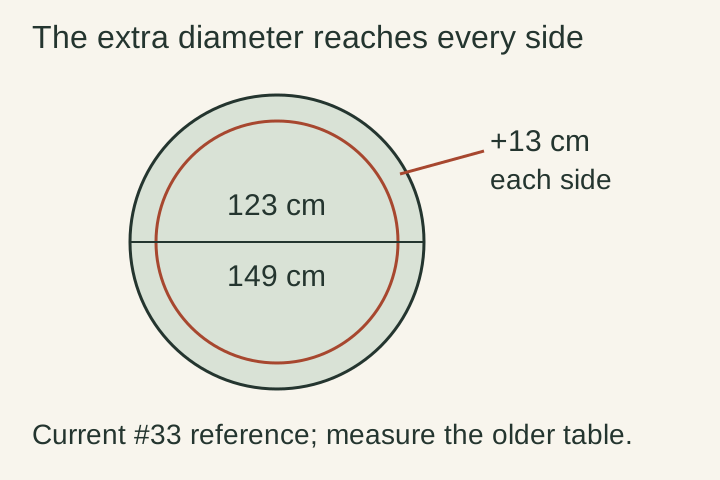
For the current #33, Skovby lists a diameter changing from 123 to 149 cm and a height of 74 cm. The diameter increases by 26 cm, so a centred table reaches another 13 cm towards each surrounding obstruction. These are current #33 reference dimensions; measure the older example you are buying.[2]
Mark both circles on your room plan. Then add the chairs in their occupied and pulled-back positions, including the route past them. Manufacturer seating counts are useful planning suggestions, but nine narrow seats and nine broad armchairs do not make the same dinner arrangement.
Try the chair legs and feet around the pedestal as well as the tabletop edge. A round surface can be generous above while the base makes one position awkward below. Do not settle the purchase with diameter alone.
Include the moving plan before collection
Get the handling and transport requirements for the identified version. A synchronised table contains more than a top on a base, and casual lifting or unsupported storage can create an expensive problem. The current SM33 assembly instructions specifically warn against resting the tabletop on its edge; that is a reason to give the correct manual to the carrier, not to invent a dismantling method.[3]
Ask whether the table will be transported assembled or separated according to its instructions, who will carry out any disassembly and who will check it after reassembly. Include protection, access and that work in the delivery quote. A short journey is not necessarily a simple move.
Ask for evidence of the feature you are buying
Message to adapt
Please confirm the model and send a continuous opening-and-closing video, photographs of the label and underside, and measured closed and extended dimensions. Are any leaves or mechanism parts repaired or replaced? Please also confirm the correct handling instructions and who will demonstrate the table after delivery.
This is a particularly satisfying design when a compact daily table turns into a generous gathering place. Buy that demonstrated transformation, with enough space around it to enjoy the extra places.