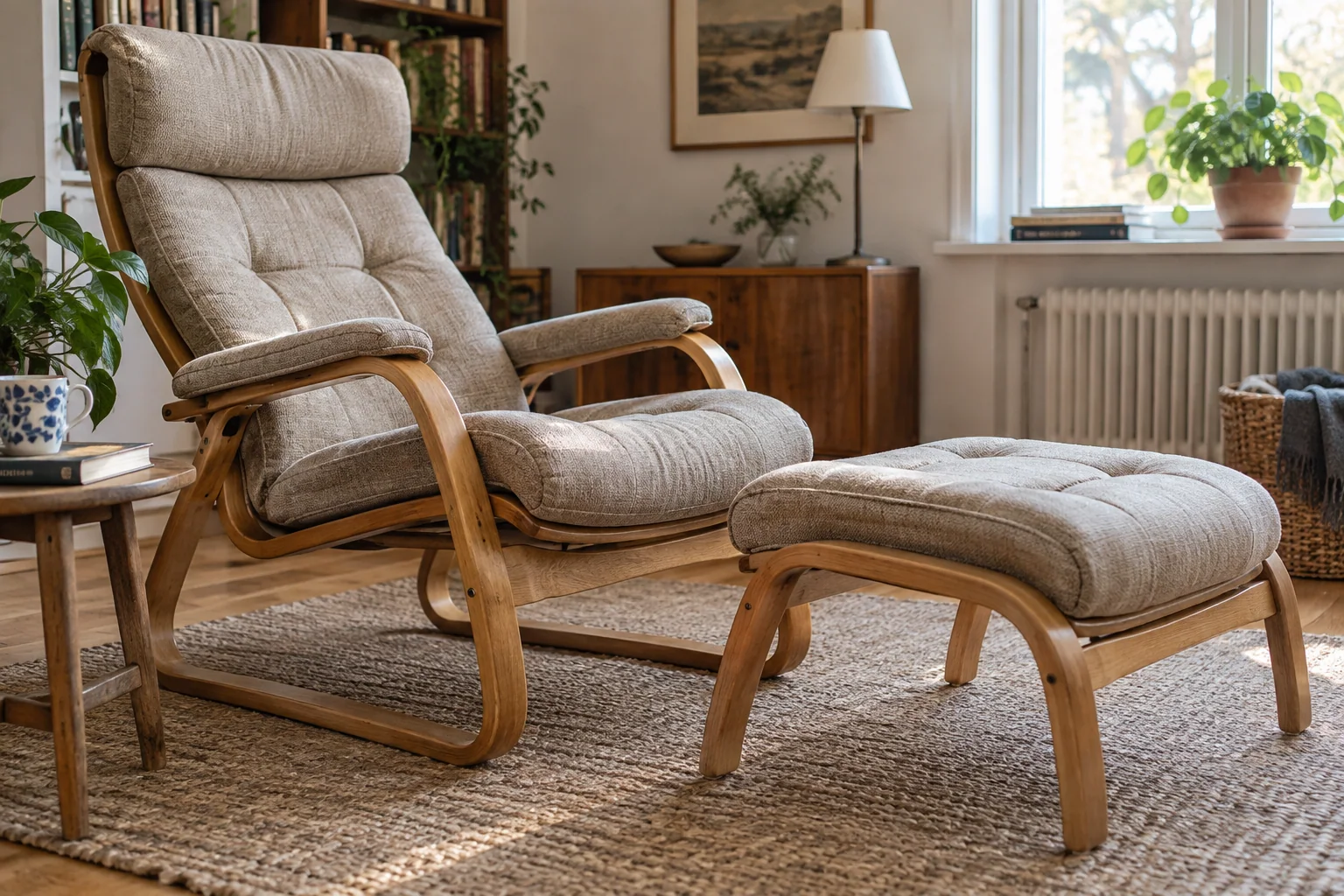
Find out what belongs to this chair
DUX describes the current Pernilla 69 as a laminated-beech chair with fitted cushions and padded armrests. Its furniture booklet describes supporting web and lists the footstool separately. Use those sources to organise the parts enquiry, not to certify an older example or assume that today’s replacement will fit it.[1][2]
Ask for the producer mark in place, the complete front and side profiles, the uncovered areas that can be shown without dismantling, and the chair and stool together. Record whether cushions, arm pads, straps or fasteners have been renewed. A later cover may suit everyday use very well, but it should not be sold to you as untouched original upholstery.
Keep the model wording on the purchase record. If the listing says only “Pernilla”, ask which model the seller means and what supports that identification. Other reclining designs should not be compared using a 69 parts list.
Follow the load from cushion to frame
At the laminated curves, look for opened layer lines, splits near connections and previous repairs. Compare corresponding areas on both sides. Different colour at a joint may be a finish change rather than a failed repair; movement or a lifting layer requires a more specific assessment.
Have the seller describe what supports the cushions and show any safely exposed web. A low or uneven position may involve both support and filling. Do not ask them to remove fixed upholstery or pull against an old web merely to obtain a photograph.
Get the upholstery proposal broken into the seat and back cushions, their support, arm pads and any frame work. Ask how the replacement will preserve the chair’s profile and intended position. A thicker cushion can change where the arms and back meet your body even when its new cover looks tidy.
Plan a chair and a footstool, not two isolated rectangles
The current UK page lists the chair at 90 cm deep; DUX’s furniture booklet lists a footstool 73 cm deep. Treat these as source-specific reference dimensions. The older example must be measured, and the gap between the two belongs in your plan as well.[2]
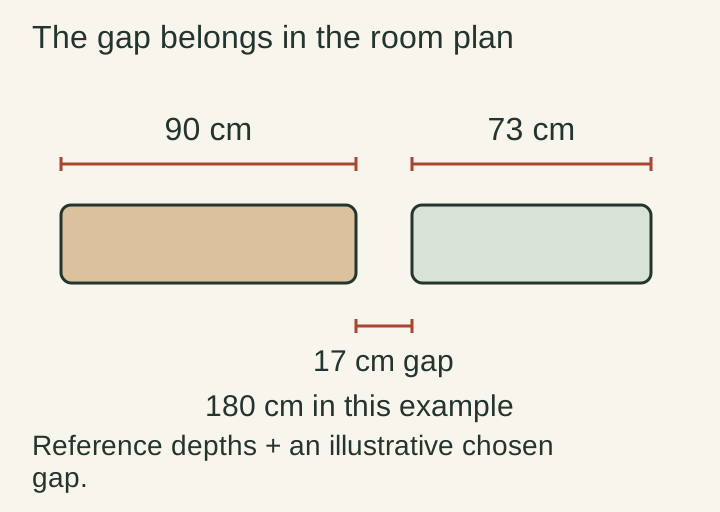
For illustration, 90 cm of chair, a chosen 17 cm gap and a 73 cm stool occupy 180 cm in a straight arrangement. That calculation is a planning example, not a prescribed posture. Change the gap during a comfortable trial and keep a walking route around the occupied arrangement.
The published width also differs between the current UK page and the furniture booklet. That alone does not establish a production change; it is a reason to stop treating an online dimension as a measurement of the seller’s chair. Check the widest point, including any upholstery that projects beyond the wood.
Choose the position before choosing the colour
Try sitting down, resting and standing up if the chair is sound. A reclined position that looks wonderfully relaxed can be inconvenient for conversation or for someone who wants a more upright seat. The footstool should earn its place in your own routine.
Ask before buying
Could you identify the Pernilla model and producer, list the included cushions and stool, and show any repaired laminations or replaced support? Please measure the chair and stool separately. I would also like to know whether an upholsterer has assessed the existing support and fitted cushions.
Proceed when the whole arrangement fits you and the work has a defined result. If the frame needs an uncertain repair, settle that before investing in a made-to-order cover.